India Says Entrenched Interests Are Blocking U.N. Security Council Reform
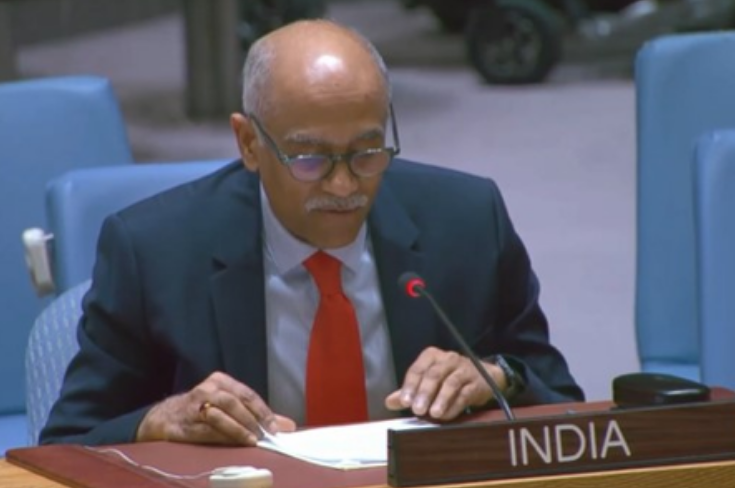

UNITED NATIONS — India has accused “entrenched interests” at the United Nations of blocking long-stalled reforms to the Security Council, warning that the body’s credibility is eroding because its structure remains rooted in the power dynamics of 1945.
India’s Permanent Representative to the U.N., P. Harish, said Tuesday that the lack of progress in Inter-Governmental Negotiations on Security Council reform reflects the desire of several member states to preserve the status quo and maintain the council’s eight-decade-old structure.
Harish made the remarks during a Security Council debate on “Upholding the Purposes and Principles of the UN Charter and Strengthening the UN-Centred International System.”
At the center of India’s proposal is an expansion of the council’s permanent membership.
“We must address and expand the permanent category of membership, which alone will change the decision-making process of this Council,” Harish said.
He warned that failure to adapt to changing global realities would further weaken the Security Council’s “authority, credibility, legitimacy and effectiveness.”
Secretary-General Antonio Guterres also said the council faces a credibility crisis because it no longer reflects today’s geopolitical realities.
“A Security Council that does not reflect the geopolitical realities of today’s world cannot fully deliver on its responsibilities,” Guterres said.
“Global institutions must reflect today’s realities – not those of 1945,” he said. “Nowhere is this more urgent than in this Council.”
Guterres pointed in particular to Africa’s exclusion from permanent membership, saying reform is necessary to restore credibility and ensure the council can act decisively and inclusively in defense of the U.N. Charter.
Harish said the U.N.’s current challenges are tied to an institutional architecture “frozen in the 1940’s.”
“It is akin to running advanced AI technologies on the 1945 version of the computer called the Electronic Numerical Integrator and Computer (ENIAC),” he said.
He argued that the U.N. must be flexible and adaptable if it is to deliver meaningfully on the principles and purposes of its charter.
Making India’s case for permanent membership on a reformed council, Harish cited India’s contributions to global peace and its role in the period leading up to the founding of the U.N.
The five permanent members of the Security Council — China, France, Russia, the United Kingdom and the United States — were the victors of World War II. Harish said India also made major wartime sacrifices, with more than 2.5 million Indian soldiers fighting alongside Allied powers and more than 87,000 killed during the war.
“This was not our war, but we paid dearly for it. Therefore, it was natural for us to become a founding member of the UN,” Harish said.
“It was reflective of our yearning for peace,” he added.
Harish said India has continued that commitment through its role in U.N. peacekeeping and the maintenance of international peace and security, including in Korea, Indochina, Congo and Gaza.
He also pointed to divisions among the council’s permanent, veto-wielding members, saying calls to improve efficiency and productivity at the U.N. are stronger than ever.
Guterres echoed concerns about disunity, saying the council too often fails to act with unity and purpose.
“When the Security Council is divided, the consequences are felt far beyond (this Chamber),” he said. (Source: IANS)