MIT Professor Kripa Varanasi and Vishnu Jayaprakash Receive United Nations WIPO Global Award for Agricultural Technology Innovation
AgZen's patented RealCoverage platform recognized for transforming crop spraying through AI, physics, and advanced engineering, helping farmers reduce chemical use while increasing yields.
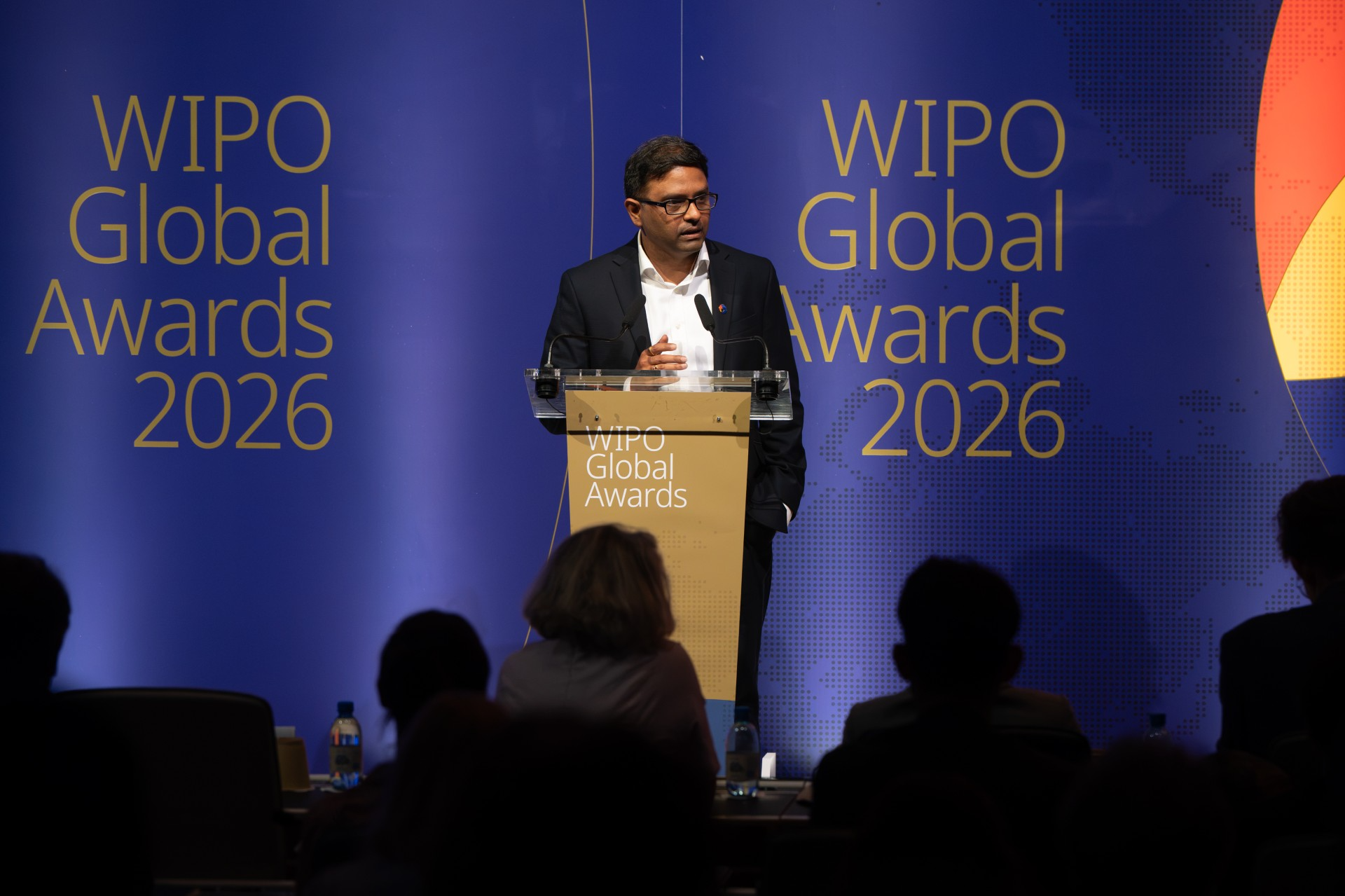

CAMBRIDGE, Mass. — Massachusetts Institute of Technology (MIT) Professor Kripa K. Varanasi, an internationally recognized inventor and entrepreneur, has received the 2026 United Nations World Intellectual Property Organization (WIPO) Global Award for his startup AgZen, recognizing the company’s pioneering patent portfolio for efficient agrochemical spraying technology.
The prestigious global award, presented by the World Intellectual Property Organization (WIPO), honors innovative startups and small businesses that use intellectual property to develop technologies addressing major global challenges. Varanasi accepted the award from WIPO Director General Daren Tang during the organization’s awards ceremony last week.
The recognition marks another milestone for Varanasi, whose research has consistently translated scientific discoveries into commercially successful technologies with broad societal impact.
From a Simple Question to a Global Innovation
Varanasi said the journey that led to AgZen began unexpectedly in 2009 while giving a presentation at the U.S. Department of Agriculture.
“This journey started for me back in 2009, when I was giving a talk at USDA and learned just how inefficient agricultural spraying really was — a problem that’s persisted for nearly a century,” he said.
Despite more than $75 billion spent annually on pesticides to protect an estimated $2 trillion to $3 trillion worth of crops worldwide, farmers still lose between 20 and 40 percent of crop yields to pests each year.
“More than a billion drops are sprayed per acre, but until now, no one truly knew where those droplets end up,” Varanasi said.
The challenge sparked years of research at MIT.
“I was curious to understand why drops are not retained by leaves even when they are loaded with surfactants,” he said. “A decade of study in my MIT lab and we had solutions that worked in pilot studies in farms.”
Varanasi later co-founded AgZen with his former Ph.D. student, Vishnu Jayaprakash, to bring those laboratory discoveries to the agricultural industry.
Reinventing Agricultural Spraying
AgZen’s flagship technology, RealCoverage, combines advances in interfacial science, fluid dynamics, computer vision, physics-informed artificial intelligence, and real-time sensing to measure how spray droplets interact with plant leaves.
According to Varanasi, the technology replaces decades of guesswork with precise, data-driven insights.
“Our flagship product, RealCoverage, removes this century-old blindfold from agricultural spraying,” he said. “By combining advances in interfacial science, fluid dynamics, physics-informed AI, computer vision, and real-time sensing, we have created a new class of Physical AI for agriculture.”
“For the first time, spraying can be quantified not simply in gallons per acre, but in droplets per leaf and micro-ounces per square millimeter of leaf.”
The technology continuously measures spray performance under changing field conditions, allowing growers to optimize pesticide application while maintaining effective crop protection.
“We are making every drop count to drive measurable yield gains while lowering costs for farmers without compromising pest control,” Varanasi said. “Conditions in the field change constantly, and RealCoverage closes the loop on spraying, removing nearly a century of guesswork. It gives us intelligence on every droplet on every leaf, and the ability to control that outcome — which is transformative for crop protection.”
Rapid Growth and Measurable Results
AgZen’s technology has seen rapid adoption across the agricultural industry.
Varanasi said RealCoverage is now deployed on more than one million acres, representing a 15-fold increase in a single growing season. The platform serves stakeholders across the agricultural ecosystem, including crop protection companies, original equipment manufacturers, and growers.
The company reports that farmers using the technology have achieved chemical savings of between 30 and 50 percent while also increasing crop yields.
“Just for reference, 6 percent savings is about a $1 billion savings for farmers,” Varanasi noted, adding that demand for the technology has been so strong that “we are completely sold out for next year.”
A Distinguished Career of Innovation
The WIPO Global Award adds to a growing list of honors recognizing Varanasi’s contributions to science, engineering, and entrepreneurship.
A professor of mechanical engineering at MIT since 2009, Varanasi leads the interdisciplinary Varanasi Research Group, where his work spans interfacial science, advanced materials, thermal fluids, manufacturing technologies, energy, water, agriculture, life sciences, transportation, and decarbonization.
An alumnus of IIT Madras, Varanasi earned both his master’s and doctoral degrees from MIT. He has co-founded six technology companies—including LiquiGlide, Infinite Cooling, Alsym Energy, and AgZen—successfully translating academic research into commercial innovations.
In 2025, he was elected a Fellow of the National Academy of Inventors, one of the highest professional distinctions for inventors, recognizing the real-world impact of his technologies on economic development and quality of life.