Rubio’s India Visit Signals Steady Growth in U.S.-India Ties, Quad Cooperation
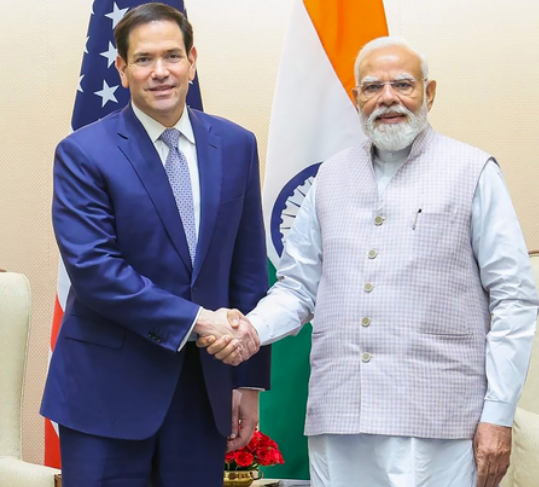

WASHINGTON — U.S. Secretary of State Marco Rubio’s recent visit to India reflected a more mature phase in relations between Washington and New Delhi, marked by strategic alignment as well as candid discussions on trade tensions, geopolitical differences and questions over American consistency, according to a new analysis.
The visit also highlighted the Quad’s shift from a largely diplomatic platform into a more practical framework focused on resilience at a time of global fragmentation, former Indian Foreign Secretary Nirupama Rao wrote in India Narrative.
Rubio visited India from May 23 to 26 in what Rao described as a “restrained affair” but one with strategic significance. She said the trip could be seen as an effort to reassure India amid mounting geopolitical uncertainty.
“In diplomacy, timing matters. Rubio arrived in India just days after President Donald Trump’s summit with Xi Jinping in Beijing, a meeting that produced language about a ‘constructive relationship of strategic stability’ between the U.S. and China. Simultaneously, the continuing conflict involving Iran and the resulting instability in the Gulf and around the Strait of Hormuz have brought energy security and maritime vulnerability to the forefront of global politics,” Rao wrote.
Rao said those developments formed the backdrop to Rubio’s visit and the Quad Foreign Ministers’ Meeting held in Delhi on May 26.
The bilateral portion of the trip appeared designed to reassure New Delhi, she wrote. Rubio repeatedly described India as central to U.S. Indo-Pacific strategy and called the Quad a cornerstone of regional stability. Prime Minister Narendra Modi also received an invitation to visit Washington.
Rubio and External Affairs Minister S. Jaishankar reviewed a wide-ranging agenda that included trade, defense, critical technologies, semiconductors, artificial intelligence, energy, nuclear cooperation and mobility.
“The atmospherics were good, although reassurance is not reset,” Rao wrote.
She said Rubio’s visit had two main objectives: to reaffirm the importance of the U.S.-India partnership and to signal to the broader Indo-Pacific region that Washington’s engagement with China would not come at the expense of its regional commitments.
Rao said the official statement issued after the Quad foreign ministers’ meeting showed that the grouping is becoming more operational, geo-economic and systemic in its approach.
She said the Quad’s current agenda rests on four pillars: “maritime and transnational security, economic prosperity and security, critical and emerging technologies, and humanitarian assistance and emergency response.”
Rao also noted that India has long preferred flexible strategic coalitions over rigid alliances, making the Quad’s current direction a more natural fit for New Delhi.
“A Quad focused on energy security, maritime awareness, critical minerals, infrastructure and technological resilience aligns far more naturally with Indian strategic culture than an overtly militarized bloc would,” she wrote. (Source: IANS)