
Opinion: The Voice from Mission Control: Charles Duke’s Journey from the Moon to Spiritual Awakening

By Asad Pervez
BOSTON–On July 20, 1969, astronauts Neil Armstrong and Buzz Aldrin became the first men to walk on the Moon. On Earth, the voice of Mission Control guiding them through the tense final descent belonged to astronaut Charles Duke Jr., serving as CAPCOM (Capsule Communicator). When the lunar module touched down, Armstrong radioed, “Houston, Tranquility Base here. The Eagle has landed.” Duke replied, “Roger, Tranquility. We copy you on the ground. You got a bunch of guys about to turn blue. We’re breathing again. Thanks a lot.”

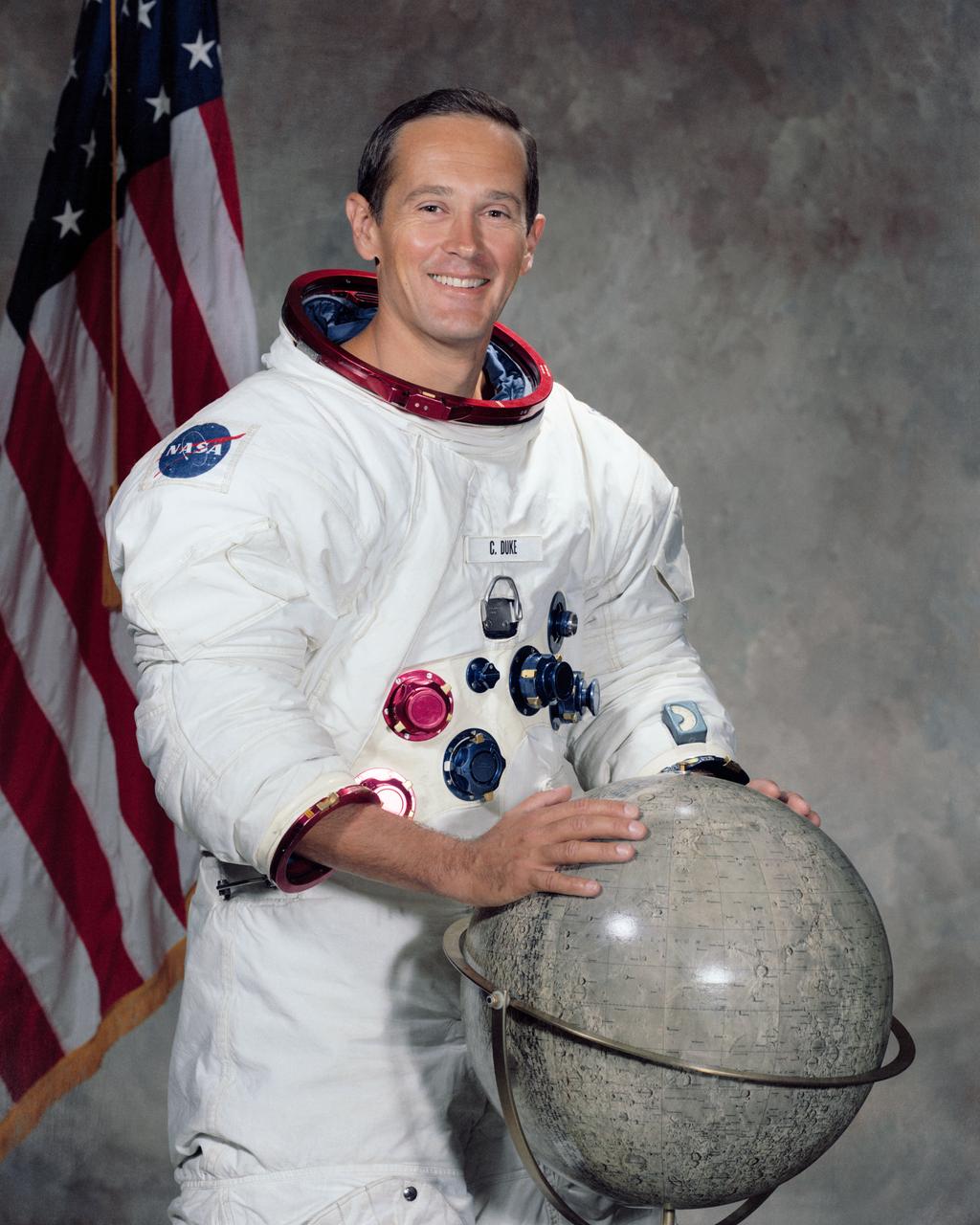
That brief radio exchange was humanity’s first inter-celestial conversation and made Charles Duke the first human voice from Earth to be heard on the surface of the Moon. Three years later, in April 1972, Duke landed on the Moon himself as Lunar Module pilot of Apollo 16 — becoming the tenth person, and the youngest at age 36, to walk on its surface.
On February 21, 2008, two members of the Center for Peace & Spirituality International, Dr. Rajat Malhotra and Dr. Sadia Khan, met Charlie Duke at the Ashoka Hotel in New Delhi for an interview. As a keepsake of the meeting, Duke gave them a signed photograph of himself in a spacesuit on the lunar surface.
The interview was on the subject of spirituality. Reflecting on his life, Duke said:
“From the beginning, there was no peace in my life. I thought going to the Moon would give me peace. I thought this great career as an astronaut, all these goals and these accomplishments, would give me peace, but they didn’t. So I thought I’d change my career. I left my career with NASA as an astronaut and went into business. I made a lot of money, but I still could not find any peace. There was still something missing in my life.”
In 1978, Duke’s spiritual life changed course when he attended a Bible study session. In his autobiography, he wrote that his temper, ego, single-minded devotion to work, and greed had damaged his relationship with his wife, Dotty, and their children. His marriage nearly ended in divorce when Dotty battled depression and, at one point, considered suicide. After Duke committed his life to God, he said, both his marriage and his relationship with his children improved considerably; the couple credited God with making their lives fuller and more joyful.
Maulana Wahiduddin Khan once wrote that this pattern is not unique to Charles Duke. He said that this is the case with almost everybody today. The present age is an age for ‘making it big,’ or attaining great success. Today there are multiple opportunities to obtain wealth, fame, and power. People are racing against each other to acquire these things, and many of them do
manage to obtain them. Such people are hailed as ‘super-achievers.’ But experience tells us that many of these people fail to achieve inner joy, and finally they died in a state of despair and frustration.
The pattern repeats endlessly: someone works tirelessly to amass wealth, only to find that money cannot give them the joy they sought. Another marries the partner of their dreams, only to watch the relationship grow stale. A politician climbs to the top of the ladder, only to find the position — and themselves — miserable once they arrive. Someone spends years saving for and building a dream home, only for unhappiness to follow them through the door.
This may be why tragedies consistently draw larger audiences than comedies in novels, news, and film — people relate to them on a personal level. Science bears this out: experiments in which participants tried to induce happiness by listening to “happy music” produced only artificial, short-lived bursts of ecstasy, not genuine contentment. Even Charlie Chaplin, the king of cinematic comedy, struggled with depression.
The secret that Charles Duke Jr. discovered was that the experience of God-realization directly addresses the root cause of human unhappiness: a life that feels meaningless and directionless. When a person develops a deep, personal connection with their Creator, their existence is no longer defined by fleeting pleasures or material success, but by a profound sense of purpose and alignment with a greater plan. This transforms the very nature of their journey, turning every event, whether favorable or unfavorable, into a meaningful part of a divine scheme.
As Duke put it in one testimony: “My walk on the Moon lasted three days. My walk with God will last forever.” In another, he reflected: “If I had to live my life over again, I would hope to do the same things I did, but with one difference — I would put God in the center of my life. That would give a balance to my life where I think I would have avoided these other problems with marriage and life.”
While history books will forever anchor the Apollo program to Neil Armstrong’s historic first step, Charles Duke’s legacy reminds us of an equally vital frontier. Armstrong showed us how far humanity could reach into the cosmos, but Duke demonstrated what happens when an explorer turns that gaze inward. To remember Charles Duke is to celebrate not just a man who walked on the Moon, but a man who stepped beyond the boundaries of material achievement to find a deeper, lasting peace. His journey teaches us that the ultimate destination isn’t a footprint in the lunar dust, but a true awakening of the human spirit.
( Asad Pervez volunteers for the Center for Peace & Spirituality USA in Waltham, MA)