
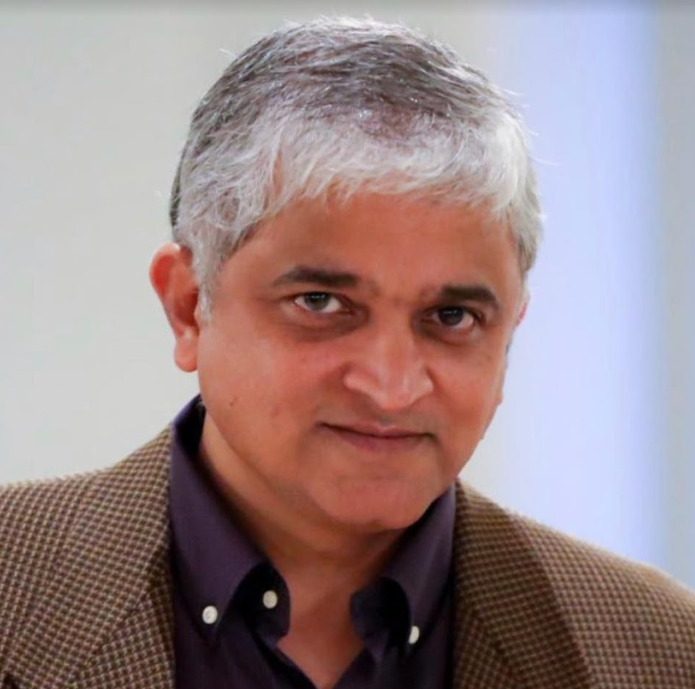

By Prashanth Palakurthi
(Editor’s Note: Prashanth Palakurthi is an entrepreneur, philanthropist, and CEO of Boston-based Juju Productions. Over the years, he has expressed his views on technology, business, public policy, and social issues through live video discussions and public forums—often taking positions that are contrarian and, at times, controversial. In this op-ed, he argues that democracy, as it was designed in the industrial era, is increasingly unable to meet the demands of a hyperconnected, technology-driven world. He explores the forces he believes are undermining traditional democratic institutions and proposes a conversation about what a future system of self-governance might look like.
INDIA New England News welcomes diverse viewpoints on this important and provocative topic and plans to host a live video roundtable discussion on the future of governance in the digital age. Readers interested in participating are invited to email editorial@MishraGroup.com.)
BOSTON–Democracy, once the undisputed champion of the public good, is irretrievably dead.
While it was undoubtedly the greatest governance system of its era and deserves to be honored for its historical achievements, its practical utility has expired. Today, the digital revolution has fundamentally altered citizen expectations, the speed of society, and the nature of information, rendering 18th-century democratic structures structurally unviable and necessitating a new system of self-governance.
Arriving at this conclusion has been an immensely painful intellectual journey. As a former outspoken advocate for democracy—and an above-average beneficiary of it—my worldview has undergone a complete reversal. I am deeply grateful to my BITS senior, Vernon Badrinath, whose consistent and wise counsel guided me to analyze more deeply and arrive at this sobering realization.
What proof did I need? Just look at election results across democracies worldwide: majorities are increasingly voting for candidates who openly campaign on dismantling the very institutions that uphold democracy. And when that does not happen, the political pendulum often swings sharply to the opposite extreme.
The Historical Trajectory
Systems of governance do not exist in a vacuum; they are built on the technological realities of their time. The wheel rendered tribal organization obsolete. Martial technologies necessitated feudal systems. The printing press and the Industrial Revolution birthed mass representative democracy.
Below is an outline of the trajectory of human organization. The structures we rely on today were optimized for managing factories, railroads, and nation-states. They are actively struggling to manage artificial intelligence, stateless currencies, and global data flows. The questions at the end of the table become the most critical puzzle of our time.
| Era | Defining Technology | Governance Problem Solved | Resulting Political Order |
|---|---|---|---|
| Agrarian | Farming, metallurgy | Managing resource surplus and territorial defense | Kingdoms, Feudalism, Empires |
| Enlightenment | Printing press | Breaking elite monopolies on knowledge | Early Republics, Nation-States |
| Industrial | Steam, rail, mass production | Managing complex, urbanized labor at scale | Mass Representative Democracy |
| Digital / AI | Internet, AI, Big Data | Managing hyper-complexity and global networks | ? |
What Killed It? – Drivers of Obsolescence
1. The Velocity Mismatch: The Speed of Tech vs. the Slowness of Deliberation
Technology has drastically altered our baseline expectations for service and responsiveness. As consumers, we experience speed in nearly every activity—receiving goods, accessing entertainment, traveling, and working. As citizens, though, a different reality emerges.
The New Standard: Supply chains and algorithms allow platforms like Amazon to deliver goods in minutes or hours. Citizens are conditioned to expect frictionless, immediate problem-solving. As consumers, we enjoy the speed of responsiveness.
The Democratic Bottleneck: In contrast, as citizens, fixing a simple local pothole can take a year. The gap is growing between citizen expectations and the ability of the system to serve because democracy is inherently designed for friction—requiring deliberation, consensus-building, and strict auditability. For centuries, this friction was a feature that ensured stability. Today, it is a fatal bug. We have built a world that operates at the speed of algorithms, yet we are governed by a system that demands months of public hearings to execute the simplest logistical tasks.
The Result: The very mechanisms that make democracy “fair” (deliberation and audits) make it unacceptably slow, causing the system to feel unresponsive, outdated, and unsuited for a quick-response world. Institutions become unresponsive, and public angst against them is real. This is reflected in elections across the world.
2. The Death of the “Trusted Middle”
Historically, representative democracy functioned because it was built on a foundation of localized, interpersonal trust. This went all the way up to the highest levels of elected office, starting in villages. Modern media and capital have destroyed this foundation and made these honest intermediaries irrelevant. Worse, these positions are vulnerable to exploitation by financially well-backed people with no commitment to the community.
The Lost Ideal: Representation used to be earned from the ground up. Communities elected leaders who had a tangible stake in their neighborhoods. These representatives formed a “well-intentioned middle layer” that advanced through years of proven local service.
The Mass Media Disruption: The advent of television, newspapers, and the internet transformed elections into mass-media spectacles, which are astronomically expensive.
The Result: The two-year election cycle has become a perpetual fundraising machine. Consequently, the traditional “middle layer” of community-tested leaders has vanished. They have been replaced by wealthy individuals or those backed by deep pockets who can buy reach without ever having served at the grassroots level—and who may even use the position for self-enrichment.
3. The Epistemic Collapse: The Loss of Shared Truth and the Rise of Social Media
For a mass democracy to function, two prerequisites are absolute: a shared baseline of truth and an unbroken chain of trust between communities and their representatives. Social media has dismantled these prerequisites and fractured our shared reality. Democracy is no longer failing because we are electing the wrong people; it is failing because technologies have destroyed the social compact that communities once shared. We no longer reach out to our neighbors, we no longer empathize with their lives, and we have little space for anything other than our own worldview. Even families are fractured along political lines.
The Rise of Echo Chambers: Algorithmic social media has fractured the public square into isolated echo chambers. The role of sense-making—once held by trusted community leaders—has been usurped by algorithms designed to whip false information into a frenzy.
The Hardening of Divisions: In these digital silos, divisions are weaponized and hardened. Truth is lost in a maze of algorithmic outrage and has effectively become irrelevant. Honest intermediaries have gone the way of the dodo.
The Result: Accountability disappears. Leaders can lie with impunity because their followers, insulated within their echo chambers and fueled by extreme frustration with existing institutions, actively refuse to fact-check. Democracy cannot function when the electorate cannot agree on basic facts. The tragedy of our current political era is not that we have lost our capacity for self-governance, but that our antiquated system forces us to place our faith in television campaigns and echo chambers instead of each other.
4. All Votes Being Equal in a Complex World: The Illusion of Freedom
In a just society, every citizen’s voice is strictly equal when determining our shared values—such as the desire for clean air, public safety, or economic fairness. However, determining the mechanics of how to achieve those values—such as the chemical thresholds for water treatment or the epidemiological modeling of a virus—requires specialized knowledge. Treating a layperson’s opinion on technical mechanics as equal to a scientist’s does not advance democracy; it simply guarantees inefficient policy.
The modern world is overwhelmingly complex. It is structurally unfair to expect a citizen working fifty hours a week to also maintain a working knowledge of macroeconomic policy, structural engineering, and virology. When we ask the general public to vote on highly technical scientific issues, we are not empowering them; we are forcing them to guess—or worse, learn from social media. Don’t forget that we no longer have trusted representatives who performed this job earlier. This creates an impossible cognitive burden that can lead to poor decisions.
This was a major personal hurdle for me. We frequently mistake this ability—to vote on subjects we know nothing about—as true freedom and equality. In reality, it is a deception because our conclusions are not formed through careful analysis, but by what we choose to hear. Surrendering this illusion of freedom may seem like a sacrifice, but an argument can be made that it is a necessary price we must pay to live responsibly with our neighbors and govern our country.
5. Disincentivized Long-Term Policymaking
The constant churn of democratic elections virtually guarantees short-term thinking. Whether cycles run every two to four years, or seem to happen every six months as they do in India (including state elections), no politician in any democracy anywhere is systemically incentivized to plan a decade ahead. This baked-in myopia is failing us. In an age driven by algorithmic speed, where swift changes trigger massive cascading impacts down the line, we can no longer afford leadership that only looks as far as the next ballot box.
Opportunity – American Leadership Needed for the New World
The obsolescence of mass democracy does not mark the end of our political evolution; rather, it signals the dawn of our next great renaissance. The foundational ideals that birthed democracy—that power belongs to the people, leaders must be accountable, and society must serve the many over the few—remain as vital as ever. However, the machinery we use to achieve these ideals must evolve. The institutions of the Industrial Revolution are buckling under the weight of the digital age, yet this friction presents an unprecedented opportunity.
America can and must lead the effort to design a new system of self-governance that bridges the fundamental lacunae of mass democracy by incorporating the following features:
Velocity of Responsiveness: For the first time in history, we possess the technological capability to build a governance structure that executes at the speed of an algorithm.
Restoration of Community Trust: We can ensure leadership is grounded in local realities by establishing a minimum requirement of five years of grassroots public service.
Empowerment of True Expertise: We now have the technology to continuously poll real, verified experts to accurately determine the public good.
Incentivizing Long-Term Vision: By granting officials longer tenures, we can finally shift the focus away from short-term election cycles toward generational thinking. Age limits may also help address cross-generational conflicts.
When evaluating these necessary structural shifts, it becomes clear why the Chinese model of governance currently delivers consistently effective results for its citizenry.
And it probably offers a useful template from which to begin designing a new one.