Indian-Americans Power Growing Grassroots Political Movement in Lexington as 24 Run for Town Meeting, Planning Board and School Committee
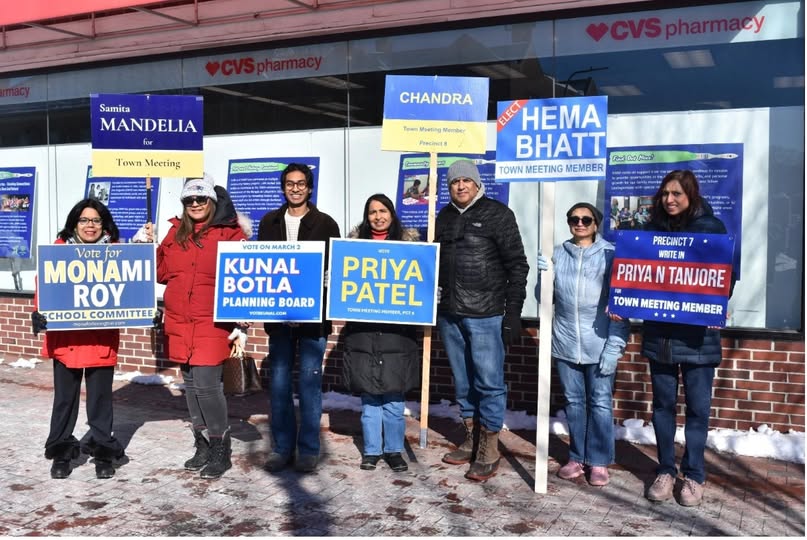

LEXINGTON, MA — Indian-American civic engagement in Lexington is reaching new heights, with about 24 community members running for Town Meeting seats and key local offices in the upcoming elections on March 2.
Among them, Kunal Botla is vying for a contested seat on the Planning Board, while Mona Roy is running unopposed for the School Committee. Their efforts reflect a sustained, grassroots political movement that has reshaped local governance and could serve as a model for other cities and towns across the United States.
This remarkable wave of participation echoes the wisdom of the late U.S. House Speaker Thomas P. “Tip” O’Neill, who famously said, “All politics is local.” In Lexington, that principle is in full display: these candidates are not only engaging with national-level issues but also deeply shaping the daily life of their community — from transportation and zoning to education and public health.
The movement traces its roots to Narain Bhatia, who passed away recently, and who inspired Lexington’s Indian-American community to pursue public office systematically. Today, this network continues to grow, with candidates bringing professional expertise, civic dedication, and intergenerational leadership to the forefront.
Key Candidates

Mona Roy — Candidate for Lexington School Committee Mona Roy is running unopposed to become the second Indian-American to serve on the School Committee, following Deepika Sawhney. An American-born attorney fluent in Bengali, Roy has been a community leader in Lexington for over 25 years. Her decades-long education advocacy includes founding SHAC’s Neurodiversity Subcommittee, co-chairing IAL’s Education Committee, six years on the WDMS PTA Board, and serving in key roles with SEPAC, the Dyslexia Task Force, and the Town-Wide Mental Health Task Force.
A Johns Hopkins engineering graduate and partner at Handal & Morofsky, Roy brings legal expertise, analytical rigor, and community insight to governance. She also contributes culturally as a musician and Bengali music teacher, and has worked on the drafting team for Massachusetts legislation S371/H655 on curriculum reform.
Kunal Botla — Candidate for Lexington Planning Board At just 20 years old, Kunal Botla is Lexington’s youngest Town Meeting member, currently serving as chair of the Transportation Advisory Committee. Botla is running in a contested race for two Planning Board seats, leveraging his academic training in architecture, urban planning, and policy at Tufts University, combined with practical experience in design studios at NuVu, Harvard GSD programs, and international studies in Berlin.

“My architecture and urban planning education and work as a designer have given me the skill set for the technical work of the Planning Board,” Botla writes on his campaign website. “I am the only candidate with a technical background in architecture and planning, with the ability to navigate the complexities of zoning, and a plan for Lexington’s future. I am committed to public service and the Town as chair of the Transportation Advisory Committee, Town Meeting Member, and advocate on statewide issues.”
A Grassroots Model for Civic Engagement
Lexington’s Indian-American community is now represented by a large number of Town Meeting members, a testament to years of coordinated effort, mentorship, and persistent civic engagement. Local experts say that this level of representation — spanning technical, educational, and cultural expertise — is rare and could inspire similar grassroots movements in other cities nationwide.
“It shows what sustained, local involvement can achieve,” said Upendra Mishra, publisher of INDIA New England News and its sister publication IndUS Business Journal. “When a community organizes thoughtfully and focuses on issues affecting daily life, it creates influence and impact that far exceeds its numbers.”
As Speaker O’Neill emphasized, “All politics is local.” Lexington’s Indian-American candidates are proving that principle true: by engaging at the neighborhood and municipal level, they are shaping policy, education, and public services in ways that matter most to residents — and setting a blueprint for civic action that can be replicated across the country.
With elections scheduled for March 2, voters will have the chance to continue this growing tradition of Indian-American engagement, further solidifying the community’s role as a transformative civic force in Lexington.