When Love Collapses: Humiliation, Obsession, and the Fragile Male Ego

 By Sunayana Kachroo
(Editor’s note: Pakistani television dramas are enjoying a remarkable surge in popularity, not just in Pakistan but also India but among Indian audiences across the globe. Known for their emotionally layered storytelling, nuanced performances, and cultural depth, these serials have carved a unique space in the subcontinent’s entertainment landscape. Among the latest to capture viewers’ hearts is the superhit drama Meri Zindagi Hai Tu, a series that beautifully blends romance, resilience, and social insight.
Penned by US-based, award-winning filmmaker, producer, poet, and columnist Sunayana Kachroo, the show reflects a cross-cultural creative sensibility while staying rooted in the traditions that make Pakistani dramas so compelling. As audiences continue to embrace stories that resonate beyond borders, Meri Zindagi Hai Tu stands as a testament to the enduring power of heartfelt storytelling.)
Shayad ham sab hisse hain
Kisson mein uljhe kisse hain
Yeh rishte dil ke dil se hain
Lautein wahin par phir se hain
– Sunayana Kachroo
BOSTON–On what should have been the happiest day of his life, Kamyar watches his world collapse in an episode of the latest superhit drama “Meri Zindagi Hai Tu.” As he walks into his wedding scene, his would-be bride shows him a viral video clip of him allegedly in a compromising position with another woman. Shocked by this revelation, she calls off the wedding, humiliates him, and, in a moment of fury, has him thrown out of the venue. The accusation is false, but the damage is immediate. Kamyar is not just losing a wedding. He is losing love, trust, and the fragile sense of belonging he had briefly found. Devastated and disoriented, he faces the scandal alone, without the steady support of his family. For a man raised in privilege, the emotional bankruptcy is stark. The spectacle is brutal. But the deeper fracture is invisible.
Wait! Who are these people and How did I get here.
Let’s rewind a little bit <<<<<<<<<<<<<<<<<<<<<<<<<
I had not sampled much of these Dramas since Zindagi and Humsafar days of Fawad Khan a decade back. So, it was a surprise that during my recent travel across India in January, conversations about the drama on ARY Digital “Meri Zindagi Hai Tu.” were everywhere, but this time to my surprise it was buzzing among the Gen Z. Before I could even look it up, algorithm like a true antaryami figured out my thoughts and soon I was inundated with the reels of this Drama. Still zoned into Dhurandhar’s high-octane vibe, I first pieced together its story through fractured reels circulating online. The comment sections were abuzz with debates about toxicity, obsession, and trust in relationships. The quintessential question surfaced again and again: Should flawed characters be romanticized? And more importantly, in an era where individuality and imperfection are celebrated, must we demand perfection from our fictional characters?
Perhaps this anxiety is not new. In the Natyashastra, the ancient Indian treatise on performing arts, Bharata Muni reminds us through the sutra “Vibhāva–anubhāva–vyabhicāri–saṁyogād rasa-niṣpattiḥ” that aesthetic experience arises from the careful orchestration of emotional elements. Art has never been about presenting flawless individuals; it has always been about arranging human emotions ; desire, anger, jealousy, compassion into a structured experience that evokes rasa in the audience. It is the audience who ultimately savors the rasa; the actor’s role is to prepare and present it. Thus, a Devdas-like obsessive lover may evoke Karuṇa Rasa (compassion). A violent or possessive lover may stir Raudra (anger) or Bībhatsa (disgust). A broken, abandoned lover may begin in Śṛngāra (love) and gradually dissolve into Karuṇa. These are universal emotional currents, structured and elevated into art. More than a century later, Academy Award–winning director Frank Capra echoed this insight when he observed, “I made mistakes in drama. I thought drama was when actors cried. But drama is when the audience cries.”
The true test of this philosophy emerges when audiences begin to identify with flawed characters. That identification sometimes uncomfortable, sometimes provocative is precisely what invites debate and discussion. At the risk of repeating myself, as a writer I often feel thrilled when I write flawed characters. During the Kabir Singh/Arjun Reddy debate, I had often said this: when an author creates a character, its arc is defined. That arc becomes the reference point for how the character will act, react, and speak in any situation. That is why the Joker kills, Michael Corleone takes revenge, Cruella de Vil wears animal prints, and Arjun or Devdas and now Kamyar self-destructs. Unless biographical, characters are often a weave of influences—the writer’s own experiences, witnessed realities, curious detours, and sometimes even unfulfilled fantasies finding release.
In every generation, Devdas is remade and finds its audience. Dev D, the modern take of Devdas, declares, “Tauba tera jalwa, tauba tera pyaar, tera emotional atyachaar.” Look closely into emotional aytachar and you will find an obsessed lover but dig a little deeper and you will find abandonment or past betrayal. The son of a wealthy businessman, Kamyar grew up in a household where money flowed easily, but affection did not. There was wealth, but no warmth. Security, but no safety. Problems that could have been softened by a father’s reassuring glance or a mother’s embrace were left to harden into silence.
Psychologists have long observed that childhood abandonment—or growing up in deeply dysfunctional families—can shape early brain development in lasting ways. As adults, individuals from such environments may display intense reactions to rejection, a heightened fear of conflict, emotional withdrawal, anxiety, or depression. The wound of instability does not disappear with age; it simply changes its language. His conversations with his grandmother become facts of life disguised as gentle lessons.
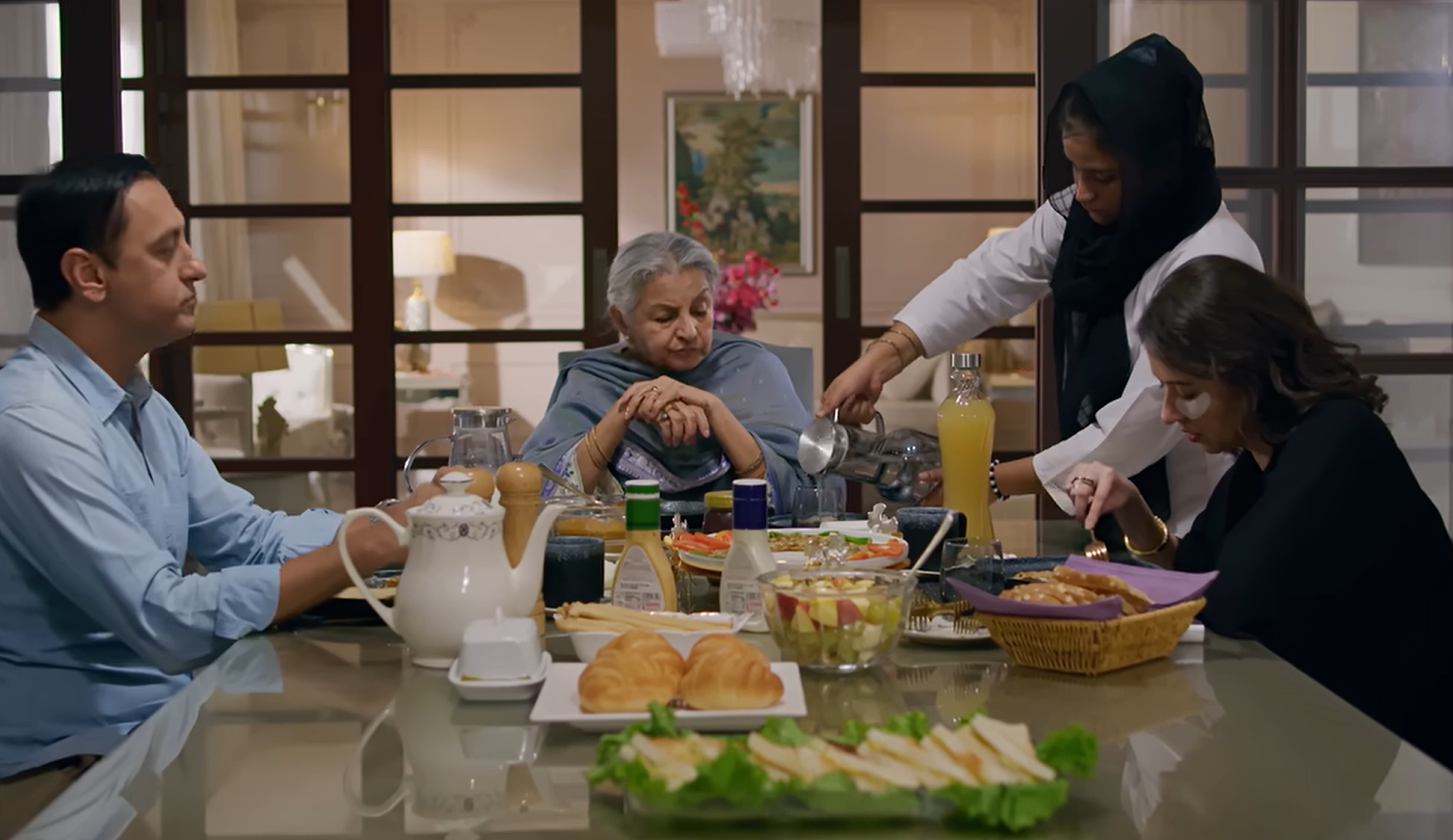
Kamyar’s life begins to shift when he meets Dr. Ayra, a woman from a close-knit upper-middle-class family where medical degree and orange juice is a permanent fixture on the dinner table. In Ayra’s world, phones are not password-protected from family members, and disagreements are resolved, not buried. It is a home defined not by imported luxury cars or curated social circles, but by presence.
For the first time, Kamyar experiences normalcy.
He begins to see beyond the hollow rituals of upscale parties and toxic friendships disguised as sophistication. Yet this awakening brings turmoil. Kamyar does not possess the emotional tools to process rejection or repair. Accustomed to entitlement and emotional distance, he now confronts accountability. To keep Ayra’s love, he must become responsible, grounded, and self-aware, a contributing citizen rather than a reckless heir.
Transformation, however, is rarely linear. It requires dismantling old patterns, relinquishing easy pleasures, and entering the unfamiliar terrain of vulnerability and self-love. Kamyar earns Ayra’s affection not by chance, but through effort. Yet when his loyalty is questioned, he spirals back into self-destruction and old patterns. Even after misunderstandings are resolved, he remains trapped in the downward pull of his own psyche.
From a viewer’s perspective, his behavior appears confusing, bewildering. Why does he not embrace the love he fought so hard to win? Why does he continue to socialize with the very woman who sabotaged his wedding? Why linger in confusion when clarity is within reach?
The answer may lie in the psychology of rupture.
When Ayra returns, she sees their relationship as paused, something that can resume from where it stopped. But for Kamyar, that moment is irretrievable. The version of himself who stood vulnerable, surrendered, organized, trustworthy, and in love no longer exists. Returning would mean revisiting a state of surrender and relinquishing control, something that now feels dangerous. One can recover from what others think about them; it is hard to recover from self-inflicted loss of dignity. When you beg for love and it is rejected, the fall is inward. Duniya mein sabse mushkil hai apni nazron mein girna.
Research suggests that even brief breaks in relationships can fundamentally alter dynamics. This may explain why many couples who remarry after divorce often struggle again; certain fractures resist repair. Once trust is broken or humiliation publicly endured, the emotional landscape shifts permanently.
To understand why Kamyar gravitates back toward his manipulative friend, one must understand how dysfunctional childhoods echo during adult breakups. For someone shaped by instability, even minor distance can feel catastrophic. Chaos feels familiar. Predictable love, paradoxically, feels foreign. Common patterns emerge: choosing emotionally unavailable partners, remaining in unhealthy relationships, testing loyalty, or sabotaging stability. When chaos has been home, peace can feel unsettling. Some unconsciously recreate turmoil because it is the emotional climate they know how to survive.
As I slowly catch up to the story unfolding, I wanted to mention that this narrative has been elevated by the nuanced performances of Bilal Abbas Khan as Kamyar, Shamim Hilaly as his grandmother, Aly Khan as a progressive father, and Hania as a modern, independent girl. Kudos to writer Radain Shah and director Musaddiq Malek for not falling into the trap of tried-and-tested emotions. It is easy to portray an angry lover as volatile or a wounded husband as vengeful. The real challenge is to reveal fury without slipping into misogyny. The performance resists caricature. Kamya’s anger is not directed at Ayra’s autonomy or dignity; it turns inward, toward his own shame, helplessness, and fear of abandonment.
In key moments, rage trembles at the edge of tears. His silences speak louder than accusations. Instead of projecting dominance, he portrays collapse. The body tightens not in aggression but in implosion. When confronted, he withdraws rather than belittles. When hurt, he spirals rather than strikes. The masculinity depicted is flawed but not cruel; reactive but not oppressive. Through restraint and vulnerability, the performance reframes male anger as unprocessed pain rather than entitlement. It shows that a man can be broken without becoming brutal, confused without becoming controlling. The camera lingers not on power, but on fragility.
In this light, Kamyar is less villain and more wounded protagonist, caught between the life he inherited and the one he is trying to build. Ayra stands at the edge of that storm. One cannot help but feel for her, drawn into turbulence she did not create.
Statistics offer little comfort. Relationships marked by unresolved trauma face steep odds. For Kamyar and Ayra to survive, it would require something extraordinary—profound and radical—like simple, old-fashioned unconditional love with a dose of reality.
Or, as cynics might say, the intervention of a generous writer.
One may take a cue from a memorable line spoken by the grandmother in the film Arjun Reddy
“Suffering is personal. Let him suffer.”