India Accuses UN Human Rights Office of Double Standards and Selective Reporting
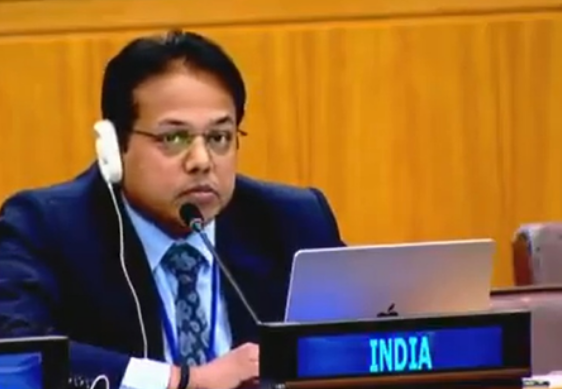

UNITED NATIONS — India has accused the United Nations human rights office of applying double standards and selectively reporting on government responses to protests, arguing that violence against demonstrators in neighboring countries and Western nations has received insufficient attention.
Speaking at a meeting of the UN General Assembly’s Third Committee on Wednesday, Anuj Swarup, first secretary at India’s Permanent Mission in Geneva, criticized the Office of the High Commissioner for Human Rights (OHCHR) for what he described as inconsistent scrutiny of human rights violations.
“Violent responses to protests in our neighbourhood, as well as in the West, have gone uncommented,” Swarup said, referring to reports presented by UN High Commissioner for Human Rights Volker Turk.
India believes the UN human rights office has adopted an approach of “extreme selectivity,” Swarup said, warning that such practices undermine confidence in international institutions.
“Needless to say, such double standards contribute to loss of trust in multilateralism and the work of OCHR,” he said.
His remarks followed a briefing by Turk to the committee, which oversees social, humanitarian and human rights issues.
Despite the criticism, Swarup reaffirmed India’s commitment to working with the UN human rights system.
As a member of the Human Rights Council, India would continue cooperating with the high commissioner in a spirit of trust and partnership, provided that human rights concerns were addressed consistently and without selective treatment, he said.
Swarup also defended India’s constitutional protections and legal framework, invoking Mahatma Gandhi’s principles of nonviolence and equality.
“Mahatma Gandhi’s principles of non-violence and equality shaped India’s Constitution that guarantees fundamental rights to every citizen,” he said.
He maintained that Indian citizens exercise their constitutional freedoms within the framework of public order and safety, while law enforcement agencies operate under the law and courts remain available to address grievances.
Addressing criticism concerning Jammu and Kashmir, Swarup said residents of Jammu and Kashmir and Ladakh enjoy the same constitutional rights as citizens elsewhere in India.
“Like all other regions of India, the Indian Constitution bestows the same fundamental rights to the people of Jammu and Kashmir and Ladakh, an integral and inalienable part of India,” he said.
The Indian diplomat also questioned whether the UN human rights office would follow up on concerns it had previously raised about the treatment of protesters in Pakistan-administered Kashmir.
“When can we expect OCHR to issue a report on the steps taken by the government of Pakistan?” Swarup asked.
He pointed to earlier calls from Turk and the human rights office for investigations into deaths allegedly involving Pakistani security forces, the release of detained Awami Action Committee leaders and guarantees of legal representation and fair trials.
UN officials had also called for political dialogue to address local grievances and the restoration of internet access in the disputed territory.
Swarup urged the office to assess whether Pakistani authorities had acted on those recommendations.
Responding to remarks by a Pakistani delegate concerning Kashmir, Swarup accused Islamabad of failing to safeguard human rights within territories under its administration.
“Pakistan would do well to look inwards and reflect on how such rights are not being enjoyed in its large part, including Khyber Pakhtunkhwa and, for that matter, in Rawalakot which is under its illegal occupation,” he said.
His comments came amid political tensions in Pakistan, including developments involving the opposition Pakistan Tehreek-e-Insaf party and its leadership.
Former Pakistani Prime Minister Imran Khan remains imprisoned, while political disputes involving party leaders have continued to draw attention.
Rawalakot, in Pakistan-administered Kashmir, has also been a center of protests over political representation, economic grievances and control of natural resources. Human rights organizations have raised concerns about the use of force against demonstrators.
The dispute reflects longstanding disagreements between India and Pakistan over Kashmir, as well as competing accusations concerning human rights protections in the region.
India maintained that international human rights monitoring must apply consistent standards across countries to preserve the credibility of the UN system. (Source: IANS)