India’s Aditya-L1 Mission Reveals New Details About Solar Eruptions That Could Improve Space Weather Forecasting

NEW DELHI–India’s Aditya-L1 solar observatory has provided new evidence that powerful eruptions from the Sun can expand unevenly as they travel through space, a finding that could help scientists improve forecasts of solar storms capable of disrupting satellites, communications systems and other critical technologies.
Researchers from the Indian Institute of Astrophysics (IIA) found that coronal mass ejections (CMEs), enormous clouds of magnetized plasma expelled from the Sun, can expand asymmetrically rather than uniformly.
The findings, published in The Astrophysical Journal Letters, offer new insights into how these solar eruptions develop and travel through the solar system.
According to India’s Ministry of Science and Technology, the research challenges simplified assumptions about the expansion of CMEs and could improve scientists’ ability to predict their movement toward Earth.
CMEs are among the most significant drivers of space weather. When directed toward Earth, they can trigger geomagnetic storms that interfere with satellite operations, radio communications and navigation systems.
Understanding how these eruptions change shape and speed during their journey is important for predicting when potentially disruptive solar activity might reach Earth.
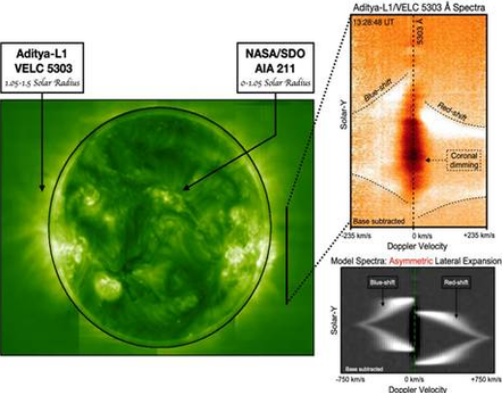
The research team combined observations from the Visible Emission Line Coronagraph (VELC), an instrument aboard Aditya-L1, with data collected by NASA’s Solar Dynamics Observatory.
Scientists also used three-dimensional computer modeling to reconstruct the geometry and movement of a CME, allowing them to examine how the eruption expanded in different directions.
The analysis revealed that uneven sideways expansion and the orientation of the eruption could explain spectral patterns recorded by VELC.
Researchers said these differences in expansion could influence how CMEs interact with the solar wind, a continuous stream of charged particles flowing outward from the Sun.
“The asymmetric shape of an early CME can have important implications for how it interacts with the solar wind and experiences drag during its propagation through the heliosphere. Such effects can influence the CME’s speed and, ultimately, its arrival time at Earth”, said Jayant Joshi, a researcher at IIA and co-author of the study.
The heliosphere is the vast region of space influenced by the Sun’s solar wind and magnetic field.
As a CME travels through this environment, interactions with surrounding solar material can accelerate or slow its movement, affecting predictions of when it might reach Earth.
The new findings could help scientists refine models used to estimate the arrival times of solar eruptions and assess their potential effects on technological infrastructure.
Aditya-L1, India’s first space-based solar observatory, was launched in September 2023 and operates near the Sun-Earth L1 Lagrange point, a gravitationally balanced location that allows the spacecraft to continuously observe the Sun.
The mission carries seven scientific instruments designed to study different aspects of solar activity.
Among them is VELC, the spacecraft’s primary payload, which observes the Sun’s outer atmosphere, known as the corona, using multiple measurement techniques.
The instrument is designed to capture information about solar activity close to the Sun, where CMEs undergo rapid changes in shape, speed and direction.
Scientists said observations in this region are particularly valuable because conventional imaging alone cannot always determine how quickly an eruption is moving toward or away from an observer.
By combining spectral measurements with three-dimensional modeling, researchers can better reconstruct a CME’s motion without depending entirely on images captured from multiple spacecraft at different viewing angles.
The IIA team plans to apply the technique to additional solar eruptions to determine whether similar patterns of asymmetric expansion occur in other events.
Researchers believe the approach could complement existing space-based observations and provide a more detailed understanding of how CMEs evolve during the earliest stages of their formation.
The study adds to the scientific contributions of India’s Aditya-L1 mission, which was developed to investigate solar activity and improve knowledge of the processes that influence space weather.
As satellites, communication networks and navigation technologies become increasingly important to everyday life, more accurate predictions of solar disturbances could help operators prepare for potentially disruptive events. (Source: IANS)