Face-to-Face: Nalini Sharma Talks MFA Boston’s “Divine Color” Exhibition and the Power of Indian Art
Honorary MFA Boston advisor and AIF leader discusses the landmark exhibition showcasing rare Hindu prints from Bengal and the importance of preserving cultural heritage through art and community engagement
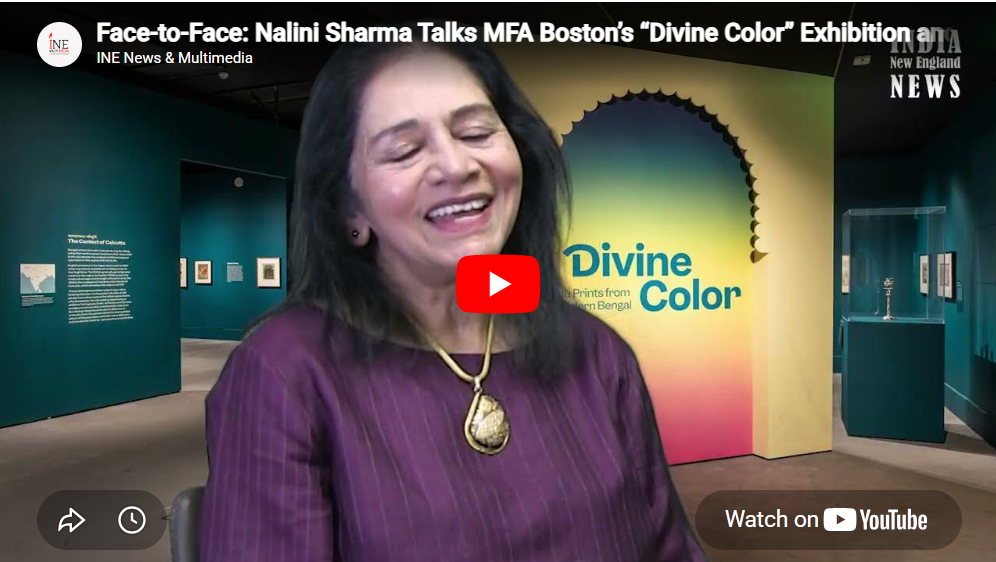

BOSTON — Art patron, environmental advocate, and community leader Nalini Sharma is helping bring global attention to a landmark exhibition at the Museum of Fine Arts, Boston that explores the rich visual tradition of Hindu devotional prints from Bengal.
In an exclusive video interview with INDIA New England News, Sharma spoke about her lifelong passion for art, music, culture, and the environment, as well as the significance of the MFA’s groundbreaking exhibition, Divine Color: Hindu Prints from Modern Bengal, which runs through May 31, 2026.
To watch the full interview, please click here, or on the image below.
Sharma, an honorary member of the MFA Boston’s Board of Advisors and an active member of the American India Foundation, said the exhibition offers audiences a rare opportunity to experience an often-overlooked form of Indian artistic and spiritual expression.
Supported by Nalini and Raj Sharma, the exhibition showcases colorful Hindu devotional lithographs that were once deeply woven into everyday life across India and the global Indian diaspora. Found in homes, temples, businesses, vehicles, calendars, and marketplaces, these images served not only as sacred objects of worship but also as reflections of cultural identity and artistic innovation.
“Art has the power to connect generations and cultures,” Sharma said during the interview. “These prints were part of daily life for millions of people, yet many in the West have never had the opportunity to see or understand their significance.”
Organized by the MFA, Divine Color is the first exhibition in the United States devoted exclusively to the emergence of Hindu devotional prints created by Bengali artists in 19th-century Calcutta, now Kolkata. The exhibition examines how artists embraced new lithographic printing technologies to create affordable, mass-produced sacred imagery that transformed religious devotion and visual culture across India.
The MFA is one of only two museums in the United States known to collect these rare early lithographs. Of the thousands originally produced, only a limited number have survived.
The exhibition features nearly 40 vibrant lithographs, including the striking Sri Sri Krishna Balaram, published by Kansaripara Art Studio around 1910–20. In total, more than 100 objects are on display, including prints, paintings, sculptures, and textiles from the MFA’s South Asian collection, along with select loans.
According to Sharma, the exhibition not only celebrates artistic beauty but also reveals how devotional imagery helped shape Indian popular culture during periods of profound social and political transformation.
“These artists created a bridge between sacred traditions and modern mass media,” Sharma said. “The exhibition demonstrates how deeply art, spirituality, and community are interconnected.”
The exhibition is housed in the Lois B. and Michael K. Torf Gallery at the MFA and is accompanied by a richly illustrated catalogue produced by MFA Publications. The catalogue includes scholarly essays and reproductions of nearly 50 rare lithographs, offering additional historical and cultural context.
Additional support for the exhibition was provided by The William Randolph Hearst Foundations and The Dr. Robert A. and Dr. Veronica Petersen Fund for Exhibitions.
For Sharma, supporting projects like Divine Color aligns closely with her broader commitment to preserving culture, advancing education, and fostering dialogue through the arts.
During the interview, she also reflected on the importance of ensuring that younger generations remain connected to their heritage while embracing global perspectives.
“Culture lives through storytelling, music, art, and shared experiences,” Sharma said. “When we preserve and celebrate these traditions, we create understanding and inspiration for future generations.”
Divine Color: Hindu Prints from Modern Bengal remains on view at the Museum of Fine Arts, Boston through May 31, 2026.