Vivek and Vandana Sharma India Lecture to Spotlight India’s Development Journey at Northeastern University in Boston
Leading scholars Devesh Kapur and Arvind Subramanian will examine India’s economic and political evolution through their acclaimed work on one of the world’s most complex growth stories.

BOSTON— At a time when India’s economic rise and global influence are drawing unprecedented attention, Northeastern University’s D’Amore-McKim School of Business will host a major lecture examining the country’s complex development journey since independence.
The event, “A Sixth of Humanity: Independent India’s Development Odyssey,” will take place on March 26 at the Raytheon Amphitheatre and is part of the Vivek and Vandana Sharma India Lecture Series, organized by the Center for Emerging Markets (CEM).
The lecture will take place on March 26, 2026, from 5:30 p.m. to 7:30 p.m. EDT at the Raytheon Amphitheatre at the Northeastern University in Boston, with both in-person and virtual attendance options available. Click here to register.
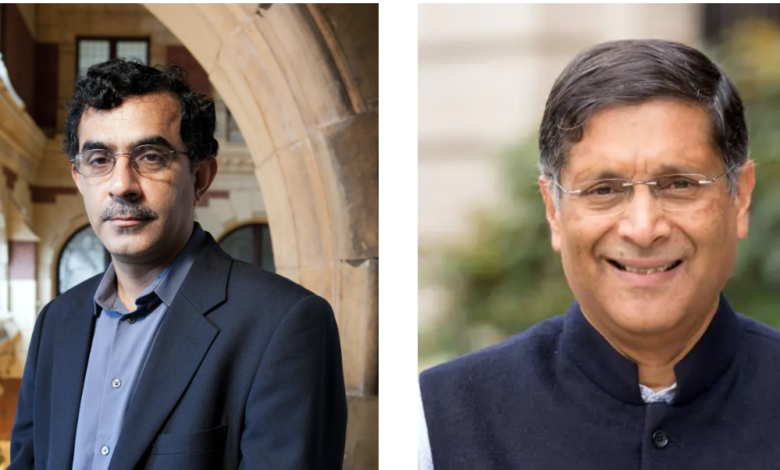
The discussion will feature two globally respected scholars—Devesh Kapur and Arvind Subramanian—whose work has shaped international understanding of India’s political economy and development trajectory.
At the center of the conversation is their widely acclaimed book, A Sixth of Humanity: Independent India’s Development Odyssey, which offers a sweeping analysis of how India—home to nearly one-sixth of humanity—has pursued growth, democracy, and nation-building in ways that defy conventional models.
A Distinctive Development Path
Unlike many nations that prioritized economic growth before democratic expansion, India chose a different route—embracing universal suffrage early while grappling with poverty, inequality, and institutional constraints. The book argues that India’s path has been “precocious,” marked by bold but often uneven choices: prioritizing high-skill services over labor-intensive manufacturing, fostering global talent mobility, and building democratic institutions even amid deep social diversity.
The result is a development story filled with paradoxes—remarkable resilience in democracy alongside persistent governance challenges; rapid economic dynamism paired with uneven distribution of opportunity.
As India now invests heavily in infrastructure, digital systems, and global positioning, the authors suggest the country stands at a pivotal moment—one where its past choices will shape its future trajectory in profound ways.
Distinguished Voices in Global Economic Thought
Devesh Kapur, the Starr Foundation Professor of South Asian Studies at Johns Hopkins University, is widely recognized for his scholarship on the political and institutional drivers of development. Prior to joining Johns Hopkins, Kapur held senior academic roles at the University of Pennsylvania, where he directed the Center for the Advanced Study of India, as well as at Harvard University and the University of Texas at Austin.
His research spans a wide range of areas, including international migration, governance, higher education, and the impact of global economic forces on marginalized communities. His award-winning work includes Diaspora, Democracy and Development and The Other One Percent: Indians in America, both of which explore the global Indian experience and its economic implications. Kapur is also known for his work on public institutions and regulatory frameworks in India, contributing significantly to debates on state capacity and reform.
Arvind Subramanian, a senior fellow at the Peterson Institute for International Economics, brings both academic and policy experience to the discussion. He served as India’s chief economic advisor from 2014 to 2018, a period marked by significant reforms, including the implementation of the nationwide Goods and Services Tax, efforts to address banking sector challenges, and initiatives aimed at expanding financial inclusion through digital infrastructure.
During his tenure, Subramanian oversaw the widely read Economic Survey of India, which gained global attention for its analytical depth and accessibility. His broader body of work spans international trade, development economics, and global financial systems, with publications and commentary featured in leading outlets such as The Economist, Financial Times, and The New York Times. He has also been recognized as one of the world’s top global thinkers by Foreign Policy magazine.

Strengthening U.S.-India Academic and Business Ties
The lecture is part of the Vivek and Vandana Sharma India Initiative, a key effort at Northeastern University aimed at deepening engagement with India’s rapidly evolving economic and business landscape.
The initiative supports a wide range of programming, including the India Lecture Series, which brings leading scholars and practitioners to campus; visiting opportunities for students, academics, and industry leaders from India; and collaborative, use-inspired research focused on real-world challenges. It also fosters connections between business communities in the United States and India, reflecting the growing importance of bilateral economic ties.
By creating a platform for dialogue on critical issues—from economic policy to innovation and entrepreneurship—the initiative seeks to build a vibrant intellectual and professional ecosystem centered on India’s global role.
As the global economic order undergoes significant shifts, India’s development experience offers valuable lessons—not only for emerging markets but also for advanced economies navigating questions of growth, governance, and inclusion.
The March 26 event is expected to draw students, faculty, business leaders, and members of the broader community interested in understanding how one of the world’s largest and most diverse nations has charted its path—and where it may be headed next.
The lecture will be offered in both in-person and virtual formats. Registration is required, and a light dinner will be provided for attendees on campus.