UNGA President Says “Small Steps” Made Toward UN Security Council Reform
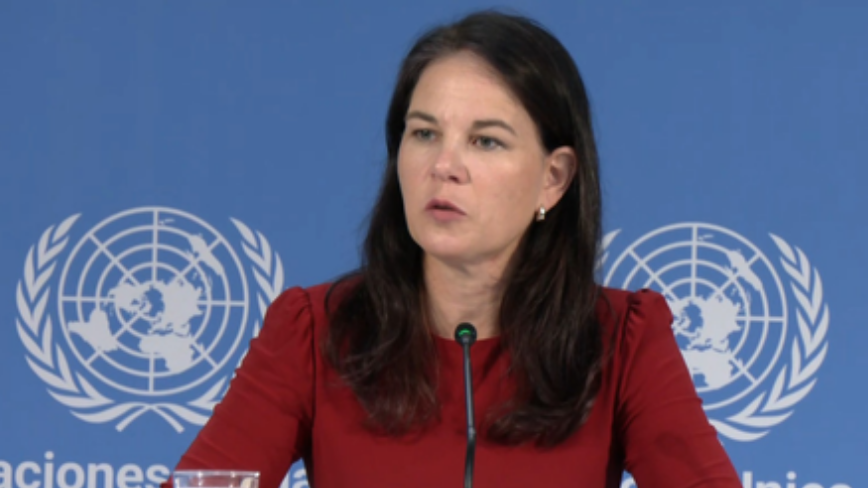

NEW DELHI — United Nations General Assembly President Annalena Baerbock said Tuesday that momentum is building around efforts to reform the UN Security Council, though progress remains incremental.
Speaking at a media briefing in New Delhi, Baerbock said discussions on reform have intensified, even as the issue remains unresolved after years of debate.
“This has been a debate going on for more than 17 years. As we all know, it is in the Charter that five member states do have a special responsibility and also a right to veto,” she said.
She noted that multiple proposals are under consideration, including those put forward by India and the African Union, which has long sought permanent representation on the council.
“The discussions about the reform of the Security Council have also increased. I appointed two co-facilitators to lead this process. Different proposals are on the table, also proposal from this country, but many other proposals as well, especially also from the African Union, which is not represented in the Security Council as a whole continent, as a permanent member of the Security Council,” Baerbock said.
She added that the credibility of the United Nations is tied in part to progress on reform.
“So, the reform debates of the Security Council is also part of the credibility of the United Nations. Yet, we have taken already small steps. We had, for example, the veto initiative debate, after there was a veto against the resolution on the Strait of Hormuz in the Security Council. So, this reform step, that if the Security Council is being blocked, it comes to the General Assembly to debate it, is one also to strengthen the United Nations and its credibility,” she said.
Baerbock also addressed the ongoing process to select the next UN Secretary-General, emphasizing transparency and the role of member states.
“With regard to the selection process of the Secretary General, as the President of the General Assembly, I’m chairing and convening this process on a transparent and neutral matter, and therefore it’s in the hands of each member state to make their decision on the different candidates,” she said.
“We had four candidates in the hearing last week, and the process will go on. The Security Council, which has a special role in it, will also hear the candidates. There will be an open town hall meeting with other candidates as well, and I encourage everybody also here in India to engage in this process, because the next Secretary General will not only serve the delegations and ambassadors within the United Nations halls, but is supposed to serve all people from around the world,” she added.
India has repeatedly called for reforms to the United Nations, particularly the Security Council, arguing that changes are necessary to better address global challenges.
The Security Council consists of 15 members — five permanent members with veto power and 10 non-permanent members elected for two-year terms by the General Assembly. The five permanent members are China, France, Russia, the United Kingdom, and the United States. The current non-permanent members are Bahrain, Colombia, Congo, Greece, Denmark, Pakistan, Latvia, Liberia, Panama, and Somalia. (Source: IANS)