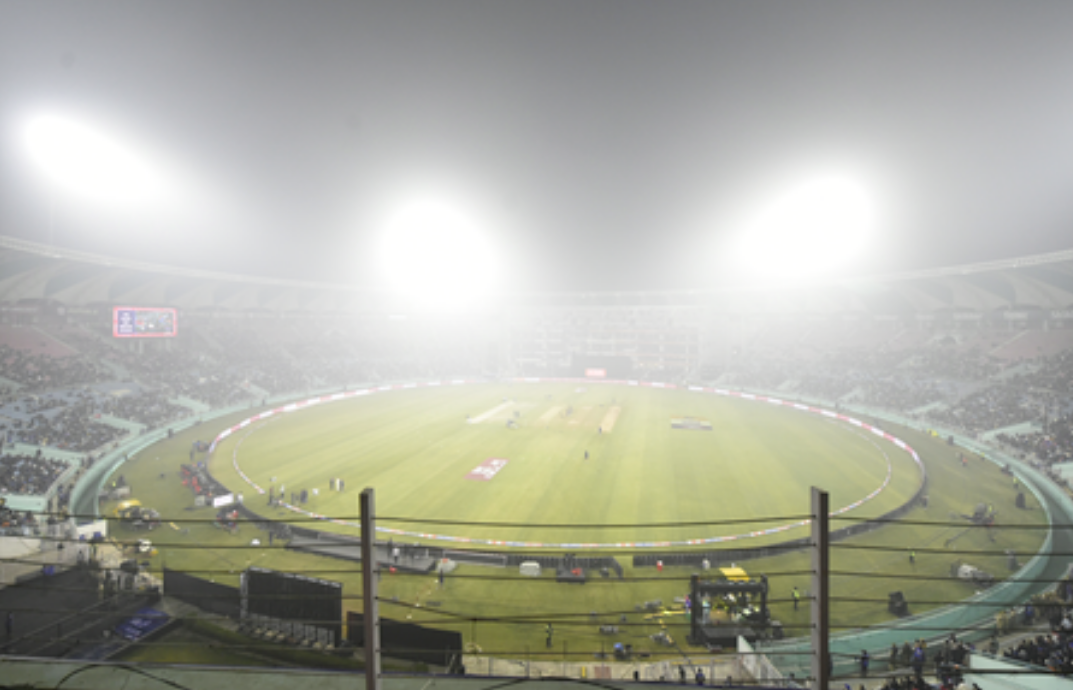
NEW DELHI– Following the abandonment of the fourth T20 International between India and South Africa due to dense fog and poor visibility, the Board of Control for Cricket in India said responsibility for ticket refunds rests with the Uttar Pradesh Cricket Association, the host body for the match.
BCCI Secretary Devajit Saikia said the UPCA is the “competent authority” to oversee a full refund for spectators, amid growing frustration among fans who attended the rain-hit fixture. Under the BCCI’s refund policy, spectators are eligible for reimbursement, minus applicable fees, if a match is canceled or abandoned before a single ball is bowled.
“That is under the domain of the state cricket association, which is UPCA. So, this game’s hosting state is the UPCA. So, they will be able to tell you about this, and they are the competent authority,” Saikia told IANS on Thursday.
“Everything in ticketing is done by the state association, as the BCCI just gives them the hosting rights and all these things are taken care of and are under the domain of the state association,” he added.
The match at the BRSABV Ekana Cricket Stadium was eventually called off at 9:30 p.m. after repeated inspections by on-field umpires K.N. Ananthapadmanabhan and Rohan Pandit, along with reserve umpire J.R. Madanagopal, failed to produce conditions suitable for play.
With the fourth T20I abandoned, India now leads the five-match series 2-1. The fifth and final match is scheduled to be played at the Narendra Modi Stadium in Ahmedabad on Friday.
The cancellation has also reignited debate over the BCCI’s scheduling of international matches during the North Indian winter, particularly as the South Africa series is considered an important part of India’s preparations for the Men’s T20 World Cup in February and March.
This was the first time a T20 International was hosted in Lucknow in December, and it now carries the distinction of being India’s first major international match abandoned due to excessive fog. India’s seam-bowling all-rounder Hardik Pandya was seen wearing a mask on the field, underscoring the severity of the fog and the hazardous Air Quality Index levels.
Saikia, however, described the Lucknow washout as an exceptional case rather than a scheduling failure.
“No, it is a solitary weather situation. Normally we have this kind of weather in the month of January. This time it is quite early, number one, and number two, we had a match in Dharamsala also the other day. Dharamsala is a much colder place. So you cannot predict fog and rain,” he said.
“Nowadays cricket is a throughout-the-year annual event, and we have to have the matches,” Saikia added.
He pointed out that the BCCI has already adjusted domestic schedules to account for winter conditions in northern India, including restructuring the Ranji Trophy calendar.
“When we saw that there were big disturbances from fog in northern India in the month of January, we already restructured our domestic cricket matches. That’s why there is a big gap between Ranji Trophy matches in North India,” he said. “If you look at our schedule, we have bifurcated the Ranji Trophy matches into two parts.”
Saikia said that from last year onward, no Ranji Trophy matches have been scheduled in North India during the first part of January. He reiterated that the Lucknow abandonment was an outlier.
“We had three matches in North India — one in Chandigarh, one in Dharamsala and one in Lucknow — all are in the same build,” he said.
Saikia also cited a previous instance in which the BCCI acted on early warnings about smog in New Delhi, leading to a reshuffle of Test match venues.
“If we had got any sense that there will be something like this, you can take the example of rescheduling or swapping of the Test match in New Delhi,” he said, referring to a series in which a Test against the West Indies was played in the capital after the original plan was altered.
“The first Test match against South Africa was originally scheduled to happen in New Delhi. But when we got to know about this smog situation after Diwali, we swapped the matches of Kolkata and New Delhi,” Saikia said.
In contrast, he said, the fog conditions in Lucknow were not foreseeable.
“Lucknow is an exceptional situation. It was not foreseen, and this kind of predictability is not there in weather conditions,” he said. “I don’t think Lucknow always has this kind of fog at this part of the time.”
“We are still in the second or third week of December. We still have 15 days’ time to be in that situation,” Saikia added. “That is one of the tough things we saw yesterday, and for this, we cannot have any kind of rescheduling.” (Source: IANS)