India’s First Industry-Built PSLV Rocket Set for Launch in Early 2027
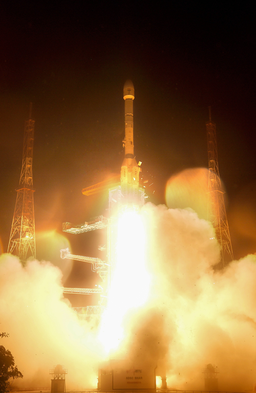

NEW DELHI– India’s first Polar Satellite Launch Vehicle (PSLV) manufactured entirely by domestic industry is expected to make its maiden flight in the first quarter of 2027, Indian Space Research Organization (ISRO) Chairman V. Narayanan said Tuesday.
Speaking to reporters on the sidelines of the India International Space Conclave in New Delhi, Narayanan said the rocket is being manufactured by a consortium of Hindustan Aeronautics Ltd. (HAL) and Larsen & Toubro (L&T) under a contract awarded by NewSpace India Limited (NSIL), ISRO’s commercial arm.
“Earlier it was built only by ISRO through the support of the industry, but now the L&T and HAL consortium has been given five PSLVs and the rocket is getting ready. The first launch is expected next year in the first quarter,” he said.
The consortium is manufacturing five PSLV rockets under a contract valued at Rs 860 crore.
The initiative is part of India’s broader strategy to transfer launch vehicle manufacturing to domestic industry, expand private-sector participation and strengthen the country’s commercial space capabilities.
Often referred to as ISRO’s workhorse, the PSLV is an expendable medium-lift launch vehicle weighing approximately 320 metric tons.
Since its first flight in 1993, the rocket has established a strong reliability record and has been used to launch numerous Indian and international satellites.
The vehicle can carry payloads of up to 1,750 kilograms into sun-synchronous polar orbits at an altitude of 600 kilometers. It has also been used to deploy satellites into geosynchronous and geostationary orbits.
Narayanan also provided an update on India’s Gaganyaan human spaceflight program, saying development of the orbital module has entered its final stages.
He said preparations are progressing for upcoming mission milestones, describing the program as a technologically demanding undertaking.
His remarks followed comments Monday by ISRO astronaut Prasanth B. Nair, who said several operational procedures and protocols required for the mission are being developed from scratch.
Nair emphasized the need for comprehensive safety, operational and recovery systems to ensure astronauts can travel into space and return safely.
The first uncrewed Gaganyaan mission, Gaganyaan-1, is expected to carry an artificial intelligence-enabled humanoid robot to help validate spacecraft systems and procedures ahead of a crewed mission.
Narayanan also called for greater industry participation to meet India’s growing demand for space infrastructure, noting that the country currently has only 56 space assets.
“We need to develop a lot of space assets for communication and earth observation. This cannot be done only by the government sector,” he said.
He emphasized the importance of expanding collaboration between ISRO and private companies as India seeks to strengthen its position in the global space economy. (Source: IANS)