Glacier Collapse, Flash Floods and a Battle Over Information in Tibet
A disaster near the Langtang Lirung region has raised fresh questions about transparency, climate risks and the cross-border consequences of Himalayan disasters
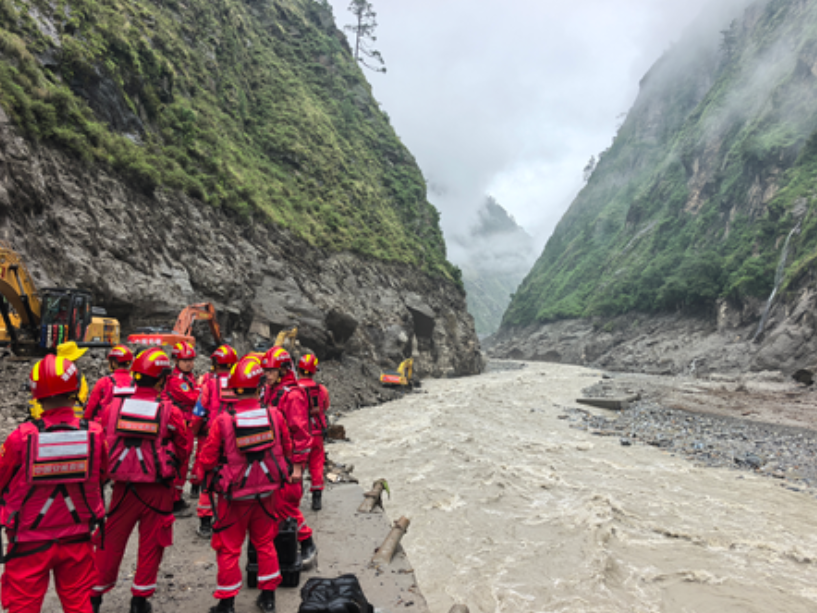

BRUSSELS — A devastating glacier collapse in the Himalayas that sent torrents of water through communities along the Tibet-Nepal border is drawing renewed attention to the region’s vulnerability to climate-driven disasters — and to questions about the flow of information from inside Tibet.
A report published in the European Times said the collapse near the Langtang Lirung peak triggered an enormous ice avalanche and subsequent flash flooding, with consequences extending into Nepal. The report, citing Tibetan activist and writer Khedroob Thondup, accused Chinese authorities of restricting information about the disaster inside Tibet.
The claims could not be independently verified from the material provided.
According to Thondup, a section of glacier high above Langtang Lirung broke away and plunged more than two kilometers into the valley. He said the resulting avalanche generated seismic energy comparable to a magnitude-5.2 earthquake and unleashed flash floods downstream.
While the disaster’s physical impact crossed borders, the report argued that information about its effects inside Tibet remained difficult to obtain.
A disaster with consequences beyond borders
The Himalayan region is home to some of the world’s most rapidly changing high-altitude environments. Glacial retreat, unstable ice and rock formations and changing precipitation patterns are increasing concerns about sudden floods and other hazards in mountain communities.
The danger does not stop at national boundaries.
Water flowing from the Tibetan Plateau feeds river systems that cross into Nepal, India and Bangladesh, making disasters in the high Himalayas a potential regional concern.
The European Times report argued that the lack of transparent information can make such disasters more dangerous by limiting early warnings, coordination and communication between communities on either side of international borders.
It described the situation as particularly difficult for families trying to determine the fate of relatives and communities affected by flooding.
Questions over transparency
Thondup, who is the nephew of the Dalai Lama, argued that Beijing’s approach to disasters in Tibet is influenced by political considerations.
He contended that Chinese authorities prioritize an image of stability and therefore have an incentive to limit reporting that could highlight environmental vulnerabilities or raise questions about major infrastructure and hydropower projects in the Himalayas.
The report also alleged that local accounts and testimony from Tibetan communities are routinely suppressed or dismissed.
Those allegations are part of a longstanding dispute over access to information in Tibet, where independent reporting and access for foreign journalists have faced significant restrictions.
The report cited previous earthquakes, landslides and infrastructure failures as examples of what it described as a broader pattern of limited disaster reporting.
Climate change adds urgency
Beyond the political dispute, the incident highlights a growing scientific concern: the stability of the Himalayan cryosphere.
Scientists have documented substantial glacier loss across the Hindu Kush Himalaya in recent decades, with rising temperatures affecting snow and ice and potentially increasing hazards from glacial lakes, landslides and unstable mountain slopes.
As glaciers retreat, mountain landscapes can become increasingly unstable, creating risks for communities located far downstream.
The consequences can also be geopolitical. Rivers originating in the Tibetan Plateau supply water to hundreds of millions of people across Asia, making the region strategically important as well as environmentally fragile.
The European Times report framed the Langtang Lirung disaster as a warning that environmental emergencies cannot be contained by political borders — or by controlling the flow of information.
Whether viewed through the lens of climate change, disaster preparedness or regional politics, the event underscores the same fundamental challenge: communities downstream need timely information when conditions in the high Himalayas suddenly change.
And as the region warms, the need for reliable monitoring, early-warning systems and transparent communication is likely to become increasingly urgent.