Rare Lakshadweep Coral Sighting Offers Clues to Climate Resilience
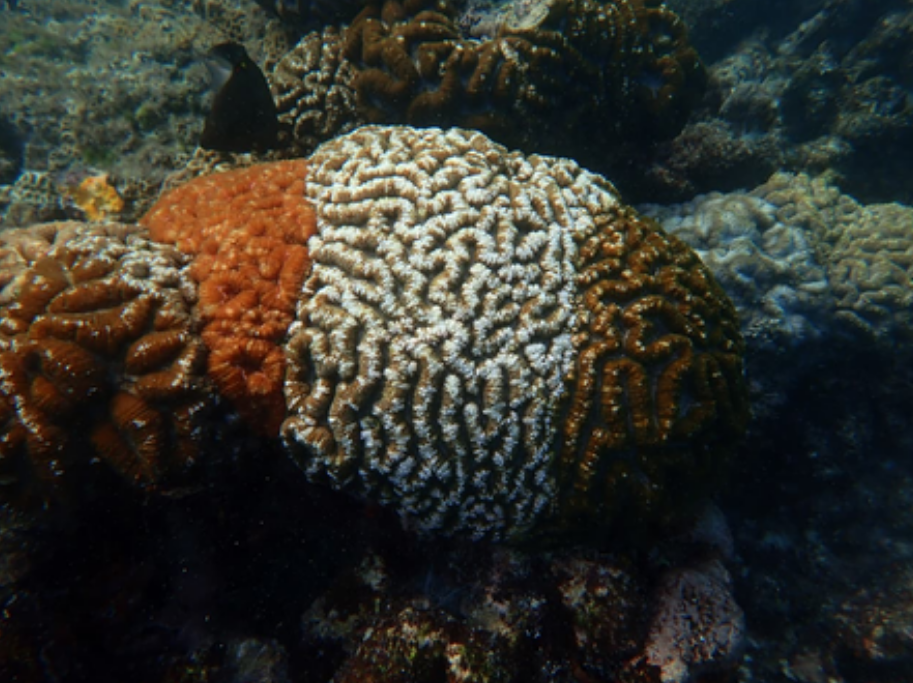

KOCHI — Scientists studying coral reefs in Lakshadweep say a rare cluster of orange, white and green corals off Minicoy Island may offer valuable insight into why some colonies survive rising ocean temperatures while others bleach under the same conditions.
The formation was photographed by Alvin Anto, a research scholar with the ICAR-Central Marine Fisheries Research Institute, during a marine mammal survey.
Researchers identified the orange coral as Lobophyllia corymbosa, while neighboring white and green colonies were identified as Lobophyllia radians.
What caught scientists’ attention was the sharply different condition of two L. radians colonies growing next to each other. One had bleached after losing its symbiotic algae, while the other remained healthy and green despite being exposed to virtually the same environment.
The contrast gives researchers a natural opportunity to study why some corals are better able to tolerate heat stress.
“This is not merely a symbol of India’s rich marine biodiversity. It tells the story of both resilience and vulnerability to climate stress,” CMFRI Director Dr. Grinson George said.
George said understanding the different responses of neighboring colonies could eventually help scientists improve coral restoration efforts and develop strategies for protecting reefs as ocean temperatures rise.
Coral bleaching occurs when environmental stress, especially unusually warm water, causes corals to expel the algae living within their tissues. Those algae provide much of the coral’s energy and color.
Bleaching does not necessarily kill coral immediately, but prolonged stress can weaken colonies and ultimately lead to death.
The Minicoy sighting is particularly useful because it allows scientists to compare colonies of the same species living almost side by side while showing markedly different responses to thermal stress.
CMFRI is also expanding work aimed at improving the resilience of marine habitats. With central government support, the institute is increasing the deployment of artificial reefs in coastal waters to restore degraded ecosystems, boost biodiversity and support small-scale fishing communities.
Researchers are also working to replenish depleted marine resources through fish breeding, seed production and sea-ranching programs.
George said restoring damaged habitats and creating artificial reefs could help strengthen marine ecosystems against future climate pressures.
For scientists, the unusual tricolor coral formation is therefore more than a striking underwater image. It could provide an important clue to understanding why some reefs withstand warming seas better than others. (Source: IANS)