Democrats Introduce Bill to Block Trump Administration’s ‘Public Charge’ Rule

Washington — Democratic lawmakers have introduced legislation aimed at blocking federal funding for the Trump administration’s new “public charge” immigration rule, arguing that the policy could discourage immigrant families from seeking healthcare, food assistance and housing support.
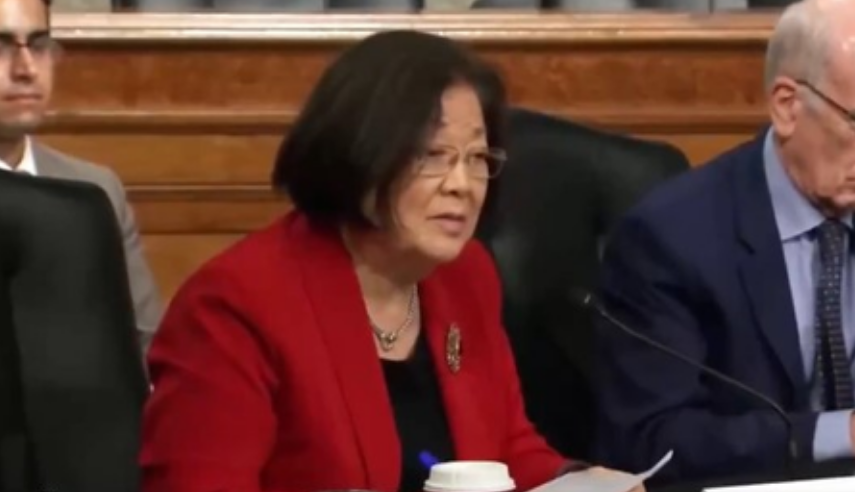
Rep. Judy Chu and Sen. Mazie Hirono introduced the Protect American Values Act ahead of the rule’s scheduled September 18 implementation. Indian American Reps. Pramila Jayapal and Raja Krishnamoorthi are among more than 50 House lawmakers cosponsoring the legislation.
The bill would prohibit federal funds from being used to implement, administer, enforce or otherwise carry out the new rule.
According to Chu’s office, the policy could make it more difficult for some immigrants who use government benefits to obtain green cards or adjust their immigration status.
Under the public charge test, immigration authorities may consider whether an applicant is likely to become primarily dependent on government assistance when deciding applications for admission to the United States or lawful permanent residence.
The Trump administration’s rule rescinds a 2022 Biden administration policy that excluded certain non-cash benefits, including Medicaid, Supplemental Nutrition Assistance Program benefits and housing assistance, from public charge determinations.
The new rule does not specify which benefits immigration officers may consider when evaluating an applicant. Critics argue that the change gives officers broad discretion while leaving immigrants without clear standards for determining whether use of a particular benefit could affect their immigration status.
“Donald Trump is once again weaponizing our immigration system against families who are simply trying to build better lives in America,” Chu said.
“Unlike the previous rule, this finalized policy does not even identify which benefits will be considered in a public charge test, giving Trump’s immigration officers sweeping discretion to deny green card applications based on subjective judgement instead of clear legal standards,” she added.
The rule also eliminates a safeguard that prevented immigration officers from considering benefits received by an immigrant’s family members. Opponents say the change could discourage U.S. citizens and permanent residents living in mixed-status households from using programs for which they are legally eligible.
Hirono said the lack of specific guidance could create uncertainty and fear among immigrant communities.
“By removing any guidance for what qualifies as ‘public charge’ the Trump Regime’s rule creates fear and prevents immigrants and their families from accessing services they need—even if they are still entitled to them,” she said.
More than 100 organizations have endorsed the legislation, including the American Academy of Pediatrics, Asian Americans Advancing Justice, the National Immigration Law Center, Stop AAPI Hate and the National Women’s Law Center Action Fund.
Wendy Cervantes of the Center for Law and Social Policy said concerns about potential immigration consequences can cause eligible families to avoid essential assistance programs.
“Research has consistently shown that when families fear immigration consequences, many avoid services that they or their children are eligible for, putting children’s health and development at risk,” Cervantes said.
The “public charge” concept has long been part of U.S. immigration law and allows the government, in certain circumstances, to deny admission or permanent residency to applicants considered likely to become primarily dependent on public support. (Source: IANS)