Vinod Kumar Shukla (1937–2024): The Quiet Revolutionary of Hindi Literature
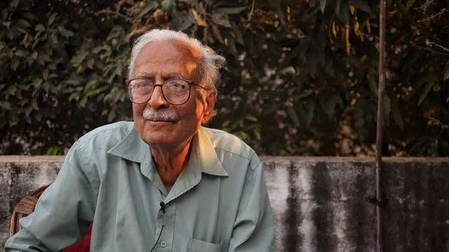

New Delhi/Raipur–Vinod Kumar Shukla, one of the most original and understated voices in modern Hindi literature and a recipient of the Jnanpith Award, leaves behind a body of work that redefined how the ordinary could be rendered extraordinary. Shukla, who passed away on December 24, 2025, at the age of 89, was a writer whose restraint, simplicity and deep human insight reshaped contemporary Hindi prose and poetry.
Born on January 1, 1937, in Rajnandgaon district of present-day Chhattisgarh, Shukla spent much of his professional life as a teacher, quietly nurturing a parallel existence as a writer who resisted literary grandstanding. His first poem, “Lagbhag Jaihind”, published in 1971, marked the beginning of a career that would unfold slowly, deliberately and with remarkable consistency.
Shukla’s writing defied easy categorisation. Experimental without being obscure, and simple without being simplistic, his work drew its power from everyday life — its silences, repetitions and unspoken emotional undercurrents. Novels such as “Naukar Ki Kameez”, “Deewar Mein Ek Khidki Rehti Thi” and “Khilega To Dekhenge” revealed a distinctive narrative sensibility that transformed mundane settings into sites of quiet revelation.
Filmmaker Mani Kaul adapted “Naukar Ki Kameez” into a film, further extending Shukla’s influence beyond the written word. “Deewar Mein Ek Khidki Rehti Thi” earned him the Sahitya Akademi Award, one of several honours recognising his singular contribution to Hindi literature.
Over the decades, Shukla’s work was translated into multiple languages, bringing international attention to his unique literary voice. Yet, he remained rooted in modesty, consistently resisting the spectacle often associated with literary fame.
In 2024, he was conferred the 59th Jnanpith Award — India’s highest literary honour — becoming the first writer from Chhattisgarh and only the 12th Hindi author to receive the accolade. The award acknowledged not just his creativity, but his lifelong commitment to a form of writing that trusted silence as much as speech.
Prime Minister Narendra Modi, expressing condolences at the time of his passing, described Shukla as a writer who would “always be remembered for his invaluable contribution to Hindi literature.”
Shukla passed away while undergoing treatment at AIIMS Raipur after suffering from multiple organ infections and age-related ailments. He is survived by his wife, son Shashwat, and a daughter.
Vinod Kumar Shukla’s legacy lies not in volume, but in precision; not in loudness, but in resonance. His work taught generations of readers that literature does not need to announce its importance — it only needs to remain truthful to life as it is lived.
In an age increasingly marked by excess, Shukla’s writing stands as a reminder that simplicity, when handled with integrity, can be quietly revolutionary. (Source: IANS)