Two Indian Americans Among 32 Named 2027 Rhodes Scholars; Harvard’s Aran Sonnad-Joshi and UNC’s Anish Aradhey Selected
The scholars-elect will pursue fully funded postgraduate studies at Oxford; Sonnad-Joshi’s work spans addiction prevention, public policy and community service, while Aradhey researches supermassive black holes

WASHINGTON— Two Indian Americans are among the 32 students from across the United States selected as 2027 Rhodes Scholars, one of the most prestigious academic honors available to U.S. college graduates.
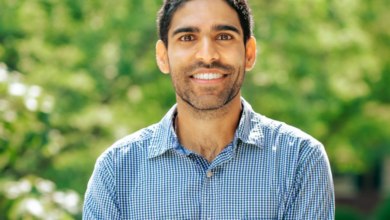
The two are Aran Sonnad-Joshi, a Harvard University senior from Atlanta, Georgia, and Anish S. Aradhey, a senior at the University of North Carolina at Chapel Hill from Harrisonburg, Virginia. They will join the other U.S. scholars-elect for fully funded postgraduate studies at the University of Oxford in England beginning in October 2027.
The Rhodes Trust announced the selections on Saturday following interviews conducted by 16 independent U.S. selection committees across the country. The committees interviewed 238 finalists from a pool of more than 3,000 students who began the application process. A total of 1,006 candidates received formal endorsements from their colleges and universities, representing more than 281 institutions.
The 2027 class represents 22 colleges and universities and includes several institutional milestones. Prairie View A&M University and The Citadel, The Military College of South Carolina, have produced their first-ever Rhodes Scholars. Fordham University has its first recipient of the scholarship since 1962.
Two Indian American scholars-elect
Sonnad-Joshi is a double concentrator in Social Studies and Molecular and Cellular Biology at Harvard. His research focuses on intergenerational substance abuse, addiction prevention and the origins of American international drug policy.
Beyond academics, he serves as director of Y2Y Harvard Square, a student-run homeless shelter, and president of the Harvard Advocate, the college’s quarterly literary magazine. He also works as a research associate with Harvard’s Weatherhead Center for International Affairs.
At Oxford, Sonnad-Joshi plans to pursue two master’s degrees: one in Evidence-Based Social Intervention and Policy Evaluation and another in Health Service Improvement and Evaluation. His academic interests and community leadership bring together research, public policy and efforts to address social challenges. <Cite refs={[“turn920003search0″,”turn704383view0”]}/>
Aradhey, who studies Physics at the University of North Carolina at Chapel Hill, researches the relationship between supermassive black holes and their host galaxies. A recipient of the Barry Goldwater Scholarship, he has operated telescopes at an observatory in Chile, presented his research at international conferences and published multiple peer-reviewed articles.
He has also applied his interest in science to education. As a summer teaching intern in rural Mississippi, he designed a curriculum for a middle school astronomy class. At Oxford, he plans to pursue a Doctor of Philosophy degree in Astrophysics. <Cite refs={[“turn704383view0”]}/>
A class marked by academic achievement and public service
The 2027 scholars-elect have demonstrated academic excellence across the humanities, social sciences, and physical and life sciences, alongside leadership, public service and creativity.
Their interests range from aerospace engineering and space pollution to healthcare, water scarcity, bioelectronics and art history. Among them are an aerospace engineer developing methods to detect objects in space, with an interest in addressing orbital debris; a foreign service student fluent in Spanish and Arabic researching water scarcity in the Middle East; and a bioengineer working on ultrathin bioelectronic devices who also grows giant pumpkins.
The class also includes a mathematics and philosophy student who has researched artificial intelligence adoption in healthcare and worked as a health and science writer for CNN, as well as a former community college student trustee who became a Yale art historian researching French modernist paintings.
The 32 U.S. scholars will join recipients selected from 25 other Rhodes jurisdictions worldwide, forming an international cohort of just over 100 scholars.
With this year’s announcement, the number of Americans awarded Rhodes Scholarships since the first U.S. class in 1904 has reached 3,738, representing 331 colleges and universities. Since women became eligible for the scholarship in 1976, 704 American women have received the award. More than 2,100 American Rhodes Scholars are living today in communities across the United States and around the world.
The 32 American Rhodes Scholars-elect for 2027
The following list is organized by the 16 U.S. selection districts. The selections are subject to ratification by the Rhodes Trustees after each scholar-elect is accepted by one of the colleges of Oxford University.
District 1
- Michael H. Bueker — Dartmouth College, Wellesley, Massachusetts
- Thomas S. Politano — Brown University, Lynn, Massachusetts
District 2
- Richard O. George — Yale University, Monroe, New Jersey
- Christopher Y. Shin — Harvard University, Cherry Hill, New Jersey
District 3
- Asuka Koda — Yale University, New York, New York
- Marina Milea — The City College of New York (CUNY), New York, New York
District 4
- Mary I. Cipperman — Harvard University, Devon, Pennsylvania
- Ian N. Fox — United States Military Academy, Hooversville, Pennsylvania
District 5
- Jupiter K. Huang — Georgetown University, Arlington, Virginia
- Quentin A. Walsh — The Citadel, The Military College of South Carolina, Silver Spring, Maryland
District 6
- Bryson A. Handy — George Washington University, Lawrenceville, Georgia
- Aran Sonnad-Joshi — Harvard University, Atlanta, Georgia
District 7
- José E. Caballero — Columbia University, Miami, Florida
- Liana R. Cutter — Fordham University, Birmingham, Alabama
District 8
- Arianna G. Doss — Massachusetts Institute of Technology, Houston, Texas
- Kailynn M. Weaver — Prairie View A&M University, Greenwood, Louisiana
District 9
- Anish S. Aradhey — University of North Carolina at Chapel Hill, Harrisonburg, Virginia
- Elliot S. Lee — Princeton University, Great Falls, Virginia
District 10
- Michelle C. Du — University of Chicago, Vienna, Virginia
- Almoatasim M.N. Shahbain — University of Illinois at Urbana-Champaign, Burr Ridge, Illinois
District 11
- Mya M. Koffie — Princeton University, Appleton, Wisconsin
- Lucas D. Wagner — Duke University, Eden Prairie, Minnesota
District 12
- Ariona J. Cook — Duke University, Marysville, Kansas
- Evan C. Garrison — Mississippi State University, Webb City, Missouri
District 13
- Layla L. Hijjawi — Harvard University, Salt Lake City, Utah
- Elizabeth G. Koenck — Georgetown University, Aurora, Colorado
District 14
- Emily E. Hove — Princeton University, Kalispell, Montana
- Lorenzo R.F. McCleese — University of Washington, Port Townsend, Washington
District 15
- Elizabeth C. Fetter — United States Military Academy, Palo Alto, California
- Charles D. Sander — University of Notre Dame, Sacramento, California
District 16
- Ashley K. Agatep — Chapman University, Los Alamitos, California
- Sabrina D. Soriano — Yale University, Azusa, California
Established in 1902 through the will of Cecil Rhodes, the Rhodes Scholarship is the oldest and one of the most recognized international academic awards. It provides financial support for postgraduate study at the University of Oxford.
The scholarship covers Oxford University fees, a living stipend, travel to and from Oxford and, where applicable, additional support for research, conferences and academic activities. It is funded through partnerships with the Second Century Founders, John McCall MacBain O.C., The Atlantic Philanthropies and other benefactors.
Dr. Ramona L. Doyle, American Secretary of the Rhodes Trust, said academic achievement is essential but represents only the beginning of what the selection process seeks.
“Academic excellence is essential, but it is only the beginning. A Rhodes Scholar should demonstrate ambition for social impact, strong leadership, empathy for others, and an acute awareness of inequities. The Trust seeks Scholars of exceptional character who are committed to making a profound difference in the world,” she said.
U.S. applicants may apply through their state of legal residence or a state where they have studied for at least two years. Each district selection committee chooses two scholars.