Tara Menon’s Debut Novel Explores a New Dimension of Grief Literature
“Under Water” immerses the reader in friendship, setting, and climate disaster
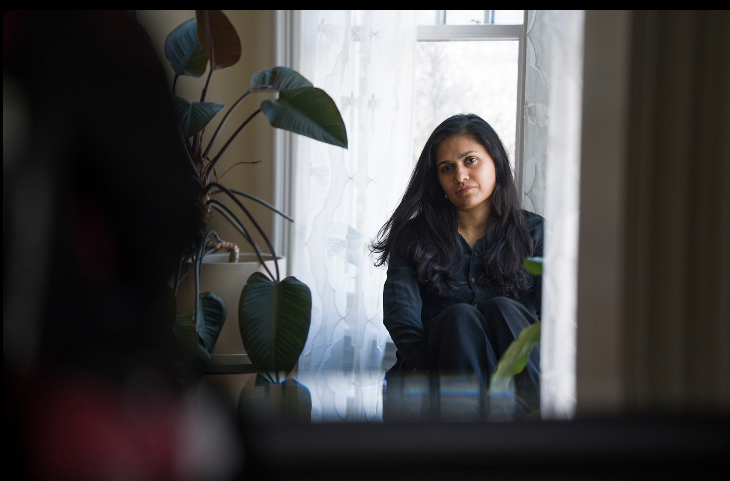

By Eileen O’Grady, The Harvard Gazette
As Hurricane Sandy approached New York City in 2012, Tara Menon remembers being surprised by the unconcerned attitude of many of her fellow New Yorkers.
As a teenager living in Singapore in 2004, she had watched on the news as the Indian Ocean earthquake and tsunami wreaked devastation on Thailand, Indonesia, Sri Lanka, and other countries in the region, claiming more than 230,000 lives — including relatives of some of her classmates. Eight years later, living on the other side of the world, the event still loomed large in her mind.
“I was struck by the idea of a big natural disaster where you have a lot of advanced warning,” said Menon, Assistant Professor of English. “Days ahead [of Sandy], people were saying, ‘It’s coming, it’s coming,’ but the emotional response from people was really blasé. With the tsunami, there was no warning at all.”
Menon’s debut novel, “Under Water,” which published this month, tells the story of two girls coming of age amid the reefs, forests, and beaches of coastal Thailand until the best friends’ lives are forever altered by a cataclysmic natural disaster.
Writing a novel that deals directly with the changing natural world became a priority for her after reading Amitav Ghosh’s literary criticism “The Great Derangement,” which calls on writers to confront climate change more directly in fiction.
“There are certain things we can’t control, and we can’t gain mastery of. There’s still ways in which the earth makes us stop,” Menon said. “There are some events that, no matter who you are, you’re not protected from them.”
In this edited conversation, Menon discusses female friendship, grief literature, and capturing a city on the page.
This novel is about a very strong female friendship. What made you decide to write a novel that centers this type of relationship?
The female friendship thing, in some ways, came out of a failed academic project. I was going to write my first dissertation about the Bechdel-Wallace Test in 19th-century novels. I didn’t do that, because not many 19th-century novels pass the Bechdel Test and it’s difficult to write a dissertation about something that doesn’t exist! But I spent a lot of time in my early years of graduate school thinking about intellectual relationships between women. Obviously, we live in a post-[Elena] Ferrante boom world, where there’s lots of depictions of female friendship, but many of them are really competitive. That is true about some real female friendships, but not true of a lot of them. It is actually possible to be extraordinarily close friends with someone and not have competition be the main force between them.
Did any other literature inspire this relationship?
A: I read this poem by Tennyson when I was in college called “In Memoriam A.H.H.,” which is about Tennyson’s grief for his friend. It’s a staggeringly beautiful poem. I was really struck when I read it that I hadn’t really read grief literature about friends. It’s usually about a spouse or a child, or sometimes about a parent or a lover. That kind of grief about friends, which can be totally overwhelming and long lasting, is just not represented often.

You teach the English course “City Fictions” on narratives set in major cities around the world. Your novel is set in New York City and Thailand. What is your approach to writing about place?
A: Setting or place is really important in the novel, and I wanted each to feel richly realized so both sections of the book could feel in sharp contrast with the other. In the New York City part, it was important to me to capture this lonely character existing in a really crowded place. One of the traditions that the novel is working in is with a flâneur person, a “man walking around New York” novel that I deliberately rewrote with a female protagonist. She does have interactions with people — a bartender, a bookseller, a random person on the road, and these anonymous interactions are a character of city life.
The Thailand sections I wanted to appear like an idyllic, paradise-type space, because she has a romanticized understanding of the place that she grew up in. I’ve spent a lot of time in Thailand, but I also did loads of research. I read wildlife guides and did research about the sea and animals and birds.
Could you talk about the approach to climate fiction that you took with this novel?
When we think about climate change, we think about spectacular events, or something that happens in the future. I obviously wrote a book which includes two very spectacular events, but both of those happen at the end of the novel — that was really important to me. I wanted the writing that takes up the majority of the novel to focus on things like biodiversity loss. It’s about the slow violence, the destruction, and degradation that we don’t pay attention to as much. I wanted to create a protagonist like Marissa who is able to pay attention because she’s hyper attuned to the natural world. When she goes to Central Park she can see that there’s an invasive species of turtle ruining the habitat for everyone else, so there was an awareness and attention to the smaller types of environmental degradation.
What does your writing process look like. Are you a “wake up at 5 a.m. and write every day” person?
Uh, no. Though I am a wake up at 5 a.m. person! I have the book “Daily Rituals: How Artists Work,” where it describes writers’ routines and there’s so many who are like, “I wake up at 8:00, I have a coffee, I work, then I go outside for a walk.” I don’t think I have two days that look the same. I’m chaos. I had an advisor at graduate school who described some writing styles as “boom or bust,” and I would say that’s a pretty accurate description. For this novel I had some very intense periods of writing where I would work on it every day for multiple hours a day, and then many weeks, sometimes even months, where I didn’t work on it at all. I did need periods of really deep immersion. For instance, in August 2024, I wrote every day for, like, seven hours a day. I had to be in the world of it.