Trump Administration Announces $6 Billion in Science and Technology Initiatives
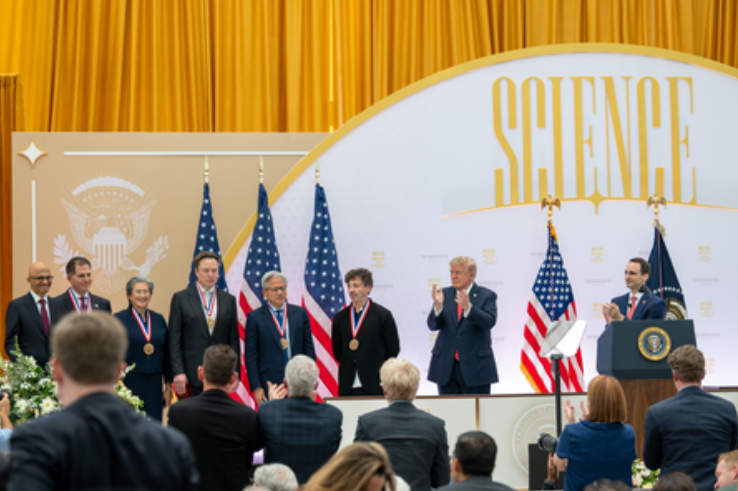

Washington — President Donald Trump’s administration has announced more than $6 billion in science and technology initiatives aimed at accelerating research in artificial intelligence, quantum computing, nuclear-powered space exploration and biomedical sciences.
The initiatives, unveiled at the White House’s Science: A New Golden Age Summit, bring together federal agencies, major technology companies, universities and philanthropic organizations to strengthen American leadership in emerging technologies.
According to a White House fact sheet, 11 industry partners have committed $2.4 billion in computing resources and technology support for the Genesis Mission, an initiative designed to use advanced artificial intelligence to accelerate scientific discoveries.
Nvidia pledged $1 billion, followed by AMD with $500 million and OpenAI with $200 million. Anthropic and Google committed $150 million each, while Amazon Web Services, Micron and other technology companies also joined the effort.
The resources will support research across more than 15 federal agencies working on challenges involving energy, healthcare, space exploration and other scientific fields.
“Today marks the most transformative day for the American scientific enterprise since the reshaping of the Federal research ecosystem following World War II,” White House science adviser Michael Kratsios said.
“The efforts announced today will channel billions of dollars across our science ecosystem to realize the new scientific opportunities that now exist,” he added.
The administration also announced a $1 billion investment involving universities, industry partners and the state of Georgia to expand scientific computing infrastructure and workforce development.
More than 14 universities across 10 states will participate in a regional computing consortium, while five universities in North and South Carolina will establish a separate research computing hub.
The National Science Foundation (NSF) and Department of Energy announced more than $100 million to support advanced scientific instruments and autonomous laboratories.
In quantum computing, the Energy Department launched a $215 million competition focused on developing fault-tolerant quantum computers capable of addressing complex scientific problems.
NASA and the Energy Department also outlined plans to advance nuclear-powered spacecraft and lunar energy systems. The projects include Space Reactor-1, a nuclear-powered spacecraft intended for a Mars mission in 2028, and Lunar Reactor-1, a proposed nuclear fission reactor on the Moon.
Biomedical research is another major focus of the administration’s science initiative.
The National Institutes of Health, Department of Energy and Biohub announced a $1.8 billion program to develop virtual models of cells and biological systems.
The initiative is intended to improve researchers’ ability to predict disease progression and understand how biological systems respond to potential treatments, potentially accelerating drug discovery and medical research.
The White House also introduced a $100 million Genesis Mission Fellowship to support accelerated doctoral programs combining artificial intelligence with scientific and engineering disciplines.
Additional initiatives will provide opportunities for gifted students, early-career researchers and scientists working outside traditional academic institutions.
A new X-Labs Consortium will receive more than $310 million in commitments from industry and philanthropic organizations to support multidisciplinary research teams pursuing scientific breakthroughs.
The White House said the announcements build on previous federal investments, including a $5 billion commitment supporting the Genesis Mission and a $1.5 billion National Science Foundation initiative focused on independent research laboratories.
Administration officials said the broader effort is intended to accelerate scientific discovery through advanced computing and artificial intelligence while expanding domestic research capabilities and developing the next generation of American scientists and engineers.
The White House described the initiatives as a coordinated partnership among government, industry, universities and philanthropy designed to maintain U.S. technological leadership in an increasingly competitive global research environment. (Source: IANS)