
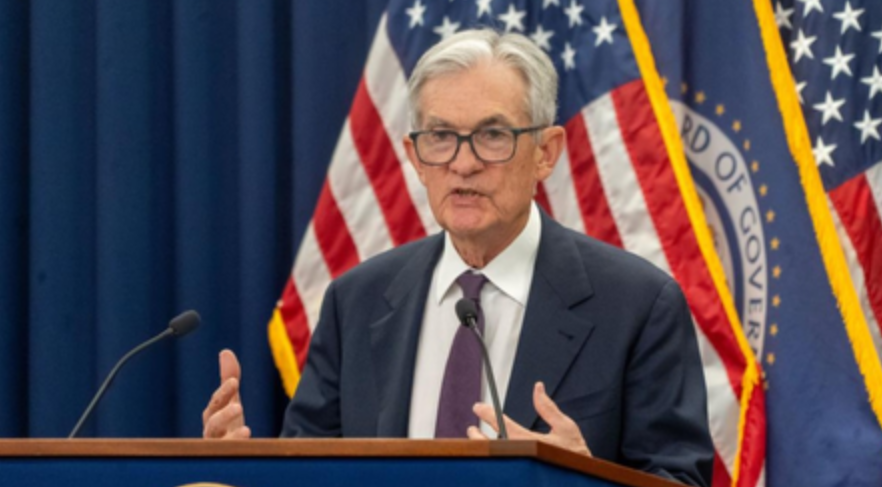

WASHINGTON– Federal Reserve Chair Jerome Powell said higher U.S. inflation is being driven largely by tariffs on goods rather than excess demand, an assessment that could influence expectations across global, trade-linked economies.
“These elevated readings largely reflect inflation in the goods sector, which has been boosted by the effects of tariffs,” Powell said Wednesday, while noting that price pressures in the services sector continue to ease.
The Federal Open Market Committee left interest rates unchanged, keeping the benchmark federal funds rate in a range of 3.5 percent to 3.75 percent. Powell said the current policy stance remains “appropriate” as inflation continues to run above the Federal Reserve’s 2 percent target.
Powell said much of the impact of tariffs on prices has already worked its way through the economy. “A lot of it has,” he said, describing tariffs as “likely to move through and be a one-time price increase.”
He said goods inflation has been pushed higher by trade measures, while services inflation is following a different trajectory. “Disinflation appears to be continuing in the services sector,” Powell said.
According to Powell, core personal consumption expenditures inflation rose 3.0 percent over the 12 months ending in December, while total PCE inflation increased 2.9 percent. He added that inflation expectations remain well anchored.
“Most measures of longer-term expectations remain consistent with our 2 percent inflation goal,” Powell said.
The Fed chair said policymakers are closely monitoring how tariff-related price increases evolve. He said the expectation is that goods inflation linked to tariffs will peak and then begin to ease, assuming no major new trade measures are introduced.
“The expectation is that we will see the effects of tariffs flowing through goods prices peaking and then starting to come down,” Powell said.
Powell emphasized that the central bank has not set a timeline for future policy changes. “Monetary policy is not on a preset course,” he said, adding that decisions will be made “on a meeting-by-meeting basis.”
He said the U.S. economy continues to grow at a solid pace, with consumer spending described as “resilient” and business investment expanding, even as housing activity remains weak.
Powell acknowledged that progress on inflation has stalled in recent months but argued that the broader picture is more complex because tariff effects are concentrated in goods prices.
“If it weren’t from tariffs, it might mean it’s from demand,” he said, adding that demand-driven inflation would be “a harder problem to solve.”
The United States is one of India’s largest trading partners, and shifts in U.S. trade policy and inflation trends can influence global supply chains, export pricing, and investment flows. Tariffs typically raise prices by increasing import costs, and central banks often treat such increases as temporary if they do not feed into broader inflation expectations. (Source: IANS)