RSS General Secretary Dattatreya Hosabale: Diaspora Must Prioritise Loyalty to Host Nations While Staying Culturally Connected to India
Centenary reflections outline dual identity framework, global cooperation, and civilisational values
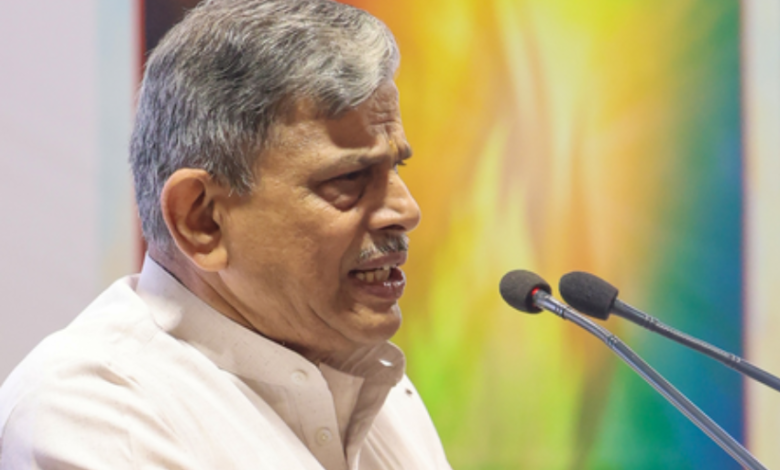

STANFORD — The Rashtriya Swayamsevak Sangh has outlined its approach to the Indian diaspora, with General Secretary Dattatreya Hosabale saying that Indians living abroad must place primary allegiance to their host countries while maintaining cultural ties to India.
Speaking during centenary reflections on the organisation’s 100-year journey, Hosabale said the RSS encourages overseas communities to integrate fully into local societies while preserving civilisational connections with India.
“Their allegiance to the nation where they are living, their loyalty to that country, and also contributing for the betterment and welfare of that society and country is the first thing,” Hosabale said. At the same time, he added, diaspora communities remain connected to India through shared cultural affinity and values.
He said RSS-linked volunteers abroad have worked to organise Hindu communities while also contributing to broader civic life in their countries of residence, reflecting what he described as a dual responsibility of integration and cultural continuity.
Hosabale framed this outlook within the RSS’s broader philosophy of Vasudhaiva Kutumbakam—the idea of the world as one family—saying it is not merely symbolic but actively practiced in social and community engagement.
“This message… world is one family… is ingrained… it is not just a slogan, but it is practiced,” he said, linking it to the organisation’s global outreach and civic engagement efforts.
He also pointed to India’s contemporary diplomatic messaging, including themes such as “one earth, one family, one future,” as aligned with this worldview.
Beyond diaspora engagement, Hosabale spoke about what he described as growing global challenges, including geopolitical tensions, religious conflict, and social fragmentation.
“Today’s world is also passing through very critical times,” he said, citing concerns such as violence in the name of religion, global power imbalances, and environmental stress.
He warned that extremism rooted in religion continues to pose a threat to global stability, even if it is often less visible in public discourse. At the same time, he stressed that family structures and social cohesion are weakening in many societies due to consumerism and declining interpersonal trust.
“If families are healthy, the society is healthy, nation is healthy,” he said, emphasising the role of family as the foundation of social stability.
Hosabale also highlighted environmental sustainability as a key concern, cautioning against unchecked technological and economic expansion at the expense of ecological balance.
“Science and technology growth is welcome, but not at the cost of our environmental balance,” he said.
He described the RSS as contributing to what he called “human social capital,” combining organisational discipline with cultural values aimed at strengthening communities. “RSS is an organisation by structure, movement by spread and impact. But RSS is a lifestyle,” he said.
According to Hosabale, the organisation’s international engagement is not intended to replicate its structure abroad, but to promote principles that support social harmony and civic responsibility within different national contexts.
“We want that… in each country for the benefit and betterment of that society,” he said, emphasising that local identity and national loyalty remain central.
On interfaith relations, he called for a shift toward broader spiritual understanding beyond institutional boundaries. “Religion is not spirituality. Spirituality is beyond religion,” he said, adding that greater understanding of civilisational traditions could help promote unity among communities.
Within India, he reiterated that religious freedom must coexist with national commitment. “Everybody has the freedom of faith… but everybody has to be loyal to the nation also,” he said.
The remarks come as Indian diaspora communities continue to expand their influence globally across politics, business, and academia, particularly in countries such as the United States, the United Kingdom, and across the Gulf region. (Source: IANS)