NISAR Satellite Data Shows Mexico City Sinking at Rapid Pace

WASHINGTON — A joint United States-India satellite mission has captured new evidence that parts of Mexico City are sinking by several centimeters each month, according to data released by NASA and ISRO.
The findings come from early observations by the NISAR satellite, short for NASA-ISRO Synthetic Aperture Radar. The satellite collected data between October 2025 and January 2026 showing that some areas of the Mexico City metropolitan region are subsiding by more than 2 centimeters per month.
Mexico City, home to nearly 20 million people, has been dealing with land subsidence for more than a century. The problem is driven largely by heavy groundwater extraction and the weight of urban development pressing down on the ancient lakebed beneath the city. In the late 20th century, some parts of the city were sinking by about 35 centimeters a year, damaging roads, buildings and the Metro system.
NISAR’s radar system can detect small changes in the Earth’s surface regardless of weather or lighting conditions. The satellite can also see through cloud cover and vegetation, giving scientists a clearer way to monitor ground movement over time.
“Images like this confirm that NISAR’s measurements align with expectations,” said Craig Ferguson, deputy project manager at NASA Headquarters. “NISAR’s long wavelength L-band radar will make it possible to detect and track land subsidence in more challenging and densely vegetated regions such as coastal communities where they may have the compounding effects of both land subsidence and sea level rise.”
The satellite can observe Earth’s land and ice surfaces twice every 12 days. Its dual-frequency radar system allows researchers to monitor a range of changes, including sinking land, glacier movement and shifts in agriculture.
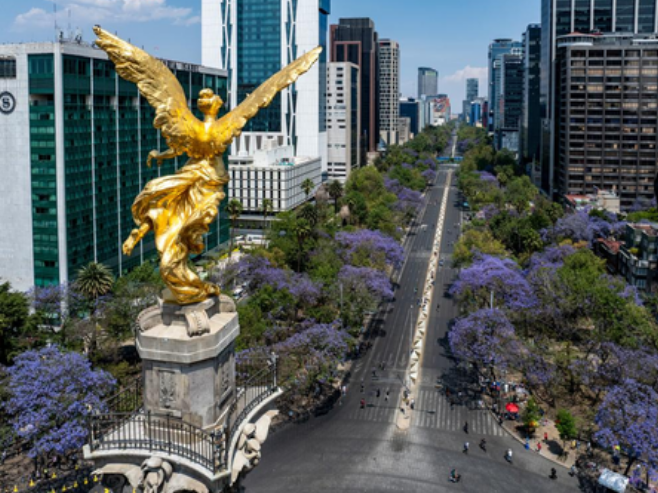
Mexico City’s long-running subsidence problem is visible in the Angel of Independence monument, which was built in 1910. Over time, 14 steps have been added at its base as the surrounding ground level dropped.
“Mexico City is a well-known hot spot when it comes to subsidence, and images like this are just the beginning for NISAR,” said David Bekaert, a project manager at the Flemish Institute for Technological Research and a member of the NISAR science team. “We’re going to see an influx of new discoveries from all over the world, given the unique sensing capabilities of NISAR and its consistent global coverage.”
The NISAR mission is a major space collaboration between the United States and India. NASA’s Jet Propulsion Laboratory is leading the U.S. contribution, while ISRO provided key spacecraft components. The satellite was launched in July 2025 from India’s Satish Dhawan Space Centre. (Source: IANS)