
In a Face-to-Face Interview, Dr. Muhammad Amjad Saqib Redefines Poverty as a Crisis of Hope and Reflects on Transforming Financial Hardship into Opportunity
The Akhuwat founder shares how the world’s largest interest-free microfinance movement is empowering millions to rebuild their lives with dignity, trust, and sustainable pathways out of poverty.
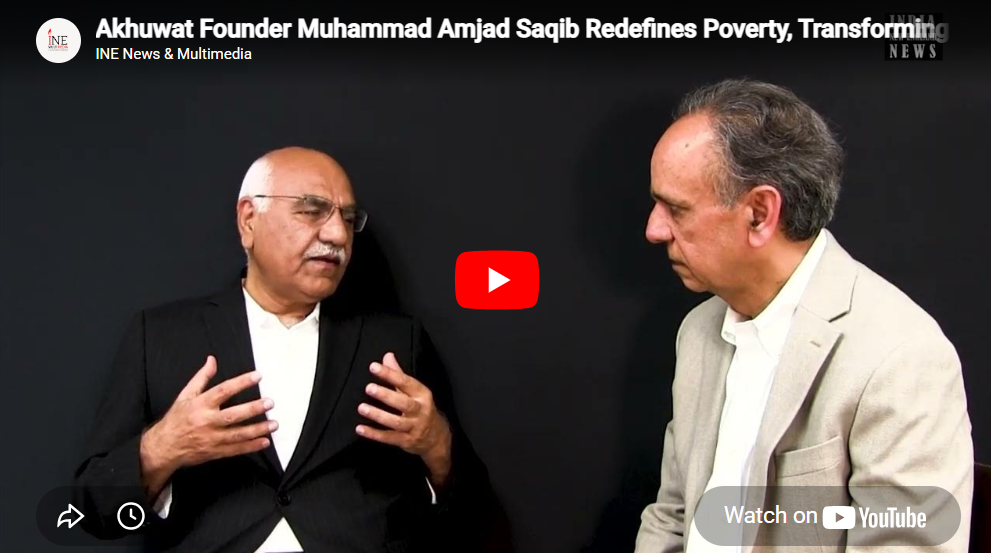

BOSTON–In a compelling conversation that spans personal conviction and global impact, Dr. Muhammad Amjad Saqib—founder and chairman of Akhuwat—offers a deeply human perspective on poverty, dignity, and social change.
Speaking with quiet clarity, he reflects on the journey that began about 25 years ago and evolved into one of the world’s most transformative microfinance movements.
Founded in 2001, Akhuwat was built on a simple but powerful idea: providing interest-free loans—Qarz-e-Hasan—to those excluded from traditional financial systems. What began as a modest initiative has since grown into the world’s largest interest-free microfinance program, supporting millions of families across Pakistan. By focusing not just on financial assistance but on restoring dignity and trust, Akhuwat has enabled over four million households to pursue sustainable pathways out of poverty.
To watch the full interview, please click here, or on the image below.S
During the interview, Dr. Saqib shares how his early experiences in public service exposed him to the structural inequities that trap communities in cycles of deprivation. Yet, it was not just material poverty that moved him—it was what he describes as the poverty of hope. This realization became the driving force behind Akhuwat’s mission: to rebuild not only livelihoods but also belief in possibility.
The organization’s model is rooted in compassion and community. Loans are often disbursed through local religious and community spaces, reinforcing a sense of shared responsibility and trust. Borrowers are not seen as clients, but as partners in a collective effort to uplift one another. This approach has helped Akhuwat maintain exceptionally high repayment rates while fostering social cohesion.
Beyond microfinance, Akhuwat has expanded into education, healthcare, and social welfare. Initiatives such as a fee-free university and programs for marginalized communities reflect a broader vision of inclusive development—one that addresses the many dimensions of poverty.
Dr. Saqib’s leadership and impact have earned him global recognition, but throughout the conversation, he remains focused on the mission rather than the accolades. He speaks of service as a moral responsibility and emphasizes that meaningful change begins with empathy.
This interview offers more than an overview of an organization—it is a window into a philosophy of giving that challenges conventional models of aid. At its core, Akhuwat is not just about financial support; it is about restoring faith—in oneself, in community, and in the possibility of a more just and compassionate world.