Capitol Hill Exhibition and Film Screening Highlight Hindu Refugee Crisis in Pakistan

Washington— An immersive art exhibition and documentary screening held on Capitol Hill this week drew attention to the plight of Hindu and other minority communities from Pakistan, highlighting allegations of forced conversions, abductions, and a refugee crisis that organizers say has received limited international attention.
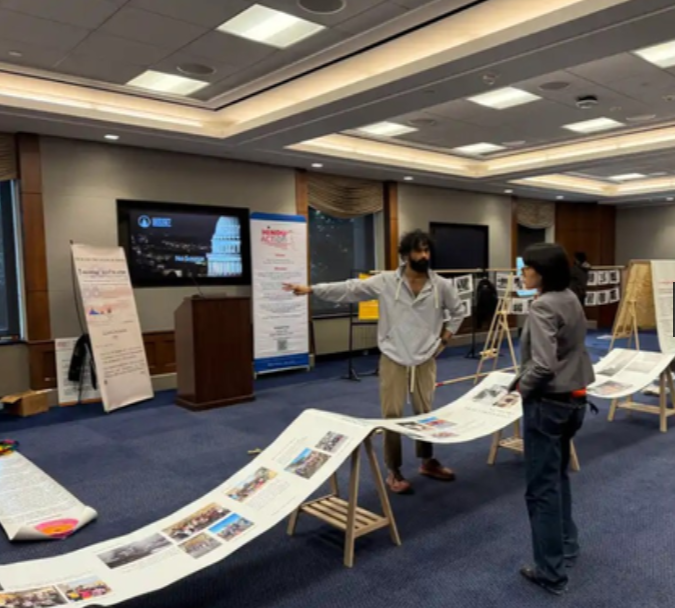
Titled “Seven Decades,” the exhibition is supported by HinduAction and combines photography, large-scale visual installations, textile art, quilts, and film to document what organizers describe as a largely overlooked refugee crisis involving religious minorities. The event was aimed at raising awareness among U.S. lawmakers and congressional staff about the challenges faced by minorities in Pakistan and the experiences of those who have fled to India.
According to organizers, the exhibition chronicles the lives of refugees now living in camps across India after escaping persecution. Visual elements include black-and-white photographs, extended narrative panels, and mixed-media installations designed to convey personal stories of displacement, loss, and resilience.
One of the central installations, known as the “Goddess Quilt,” focuses on the resilience of women who have rebuilt their lives after fleeing persecution. Other sections, including an “absence series,” depict abandoned homes, disrupted traditions, and the emotional toll of forced migration.
Organizers said the exhibition has previously been shown in cities such as Sydney, Melbourne, London, New York, and Mumbai, but noted that bringing it to Washington was intended to elevate the issue within U.S. policy and advocacy circles.
The event also featured short films and documentary screenings examining allegations of forced conversions and abductions of minority girls in Pakistan. Representatives from humanitarian organizations working with affected families said the films were designed to provide lawmakers with a clearer understanding of how such cases unfold.
An interactive walkthrough element of the exhibition recreated domestic spaces and incorporated testimonial narratives to illustrate what organizers described as a systematic process involving traffickers, religious figures, political influence, and institutional failures. The accompanying documentary explored the sequence of abduction, conversion, and marriage, as well as the role of poverty and vulnerability in targeting minority communities.
Organizers emphasized that Hindus represent a small minority in Pakistan and argued that their situation has not received sufficient global attention. They also pointed to similar concerns emerging in neighboring Bangladesh amid shifting political dynamics.
The Capitol Hill exhibition reflects a broader effort by diaspora organizations to use art, film, and firsthand accounts to bring human rights concerns involving religious minorities into international policy discussions, framing creative documentation as both advocacy and remembrance. (Source: IANS)