AI Could Deliver Humanity’s Fourth Great Ego Shock, Says Vedanta Scholar Swami Sarvapriyananda
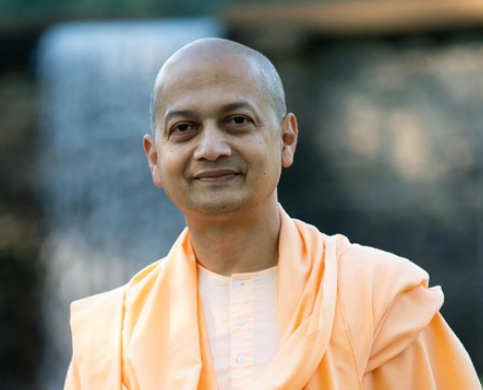

NEW DELHI — Artificial intelligence could fundamentally challenge humanity’s understanding of its own uniqueness, becoming the fourth major scientific disruption to human self-perception, according to Swami Sarvapriyananda, the spiritual leader of the Vedanta Society of New York.
Speaking at the NDTV World Summit 2026 on Thursday, the New York-based monk and Vedanta scholar said the rapid advancement of AI was raising profound questions about consciousness, intelligence, identity and the qualities that distinguish humans from machines.
Sarvapriyananda, who has recently engaged with researchers at artificial intelligence company Anthropic on questions surrounding consciousness, suggested that society may eventually need to reconsider how it interacts with increasingly sophisticated AI systems.
Asked whether advanced artificial intelligence should be regarded as a person, he offered a nuanced response, saying the answer was both yes and no.
“AI should be treated as a person,” he said, while distinguishing the idea of treating AI systems in a person-like manner from assuming that they possess human consciousness or spiritual awareness.
His comments reflected the growing philosophical debate surrounding artificial intelligence as technological advances enable machines to perform tasks once considered uniquely human.
Drawing on ideas associated with psychoanalyst Sigmund Freud, Sarvapriyananda explained that scientific discoveries have repeatedly challenged humanity’s belief in its own central importance.
He suggested that artificial intelligence could become the latest such disruption, forcing people to reconsider assumptions about human intellectual superiority.
“We thought we were the creative intelligence. Now we see that AI can do what the greatest human mind can do, and better,” he said.
Sarvapriyananda argued that the emergence of increasingly capable AI systems represents more than a technological turning point. It also presents a philosophical challenge concerning the nature of human existence.
“We have to ask ourselves what it is that distinguishes us, makes us unique, and where we should invest ourselves,” he said.
As artificial intelligence becomes more capable of reasoning, producing creative work and engaging in sophisticated conversations, he suggested that people may increasingly interact with such systems as though they were individuals.
However, he emphasized that treating AI in personal terms does not necessarily establish that machines possess consciousness or subjective experiences comparable to those of humans.
The distinction is central to ongoing debates among philosophers, scientists and technology developers about whether artificial intelligence can genuinely experience awareness or merely simulate aspects of human thought and behavior.
Sarvapriyananda also discussed his recent interactions with researchers at Anthropic, a prominent developer of advanced AI systems.
He said many researchers working at the forefront of artificial intelligence were deeply concerned about the potential consequences of the technology, despite their professional success and involvement in its development.
According to the monk, some researchers are increasingly examining unexpected behaviors displayed by sophisticated AI models.
One phenomenon he highlighted was “persona drift,” in which an AI system’s responses and behavioral patterns change as it adopts a particular role or identity during an interaction.
Such behavior has attracted attention from researchers seeking to better understand how advanced AI systems operate and why their responses can sometimes become unpredictable.
Sarvapriyananda suggested that these developments illustrate how artificial intelligence is opening new areas of inquiry that extend beyond engineering and computer science.
The technology, he argued, is compelling humanity to revisit longstanding questions about consciousness, personhood and the meaning of intelligence.
His remarks placed the AI debate within a broader philosophical and spiritual context, suggesting that the most important questions raised by the technology may concern not only what machines can accomplish, but also how humans understand themselves in an increasingly automated world. (Source: IANS)