Trump’s Crypto Push Wins Backing From Tech and Financial Executives
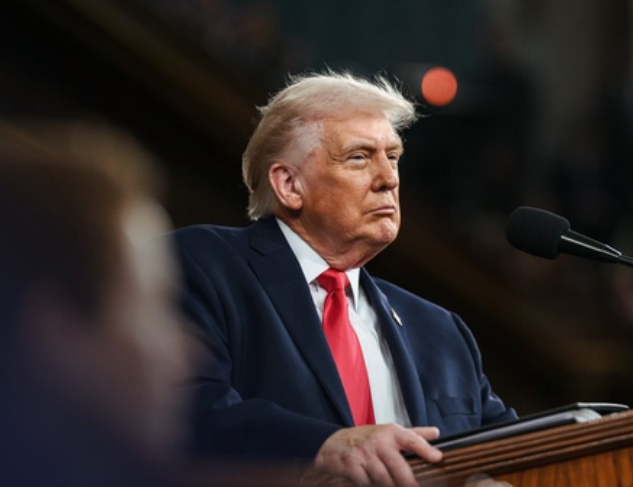

Washington — Leaders from major U.S. technology, cryptocurrency and financial companies have backed President Donald Trump’s push for lighter regulation and clearer digital-asset rules, arguing that his policies are encouraging investment and innovation in the United States.
Executives from Coinbase, Robinhood, Kraken, Chainlink Labs, Gemini and Intercontinental Exchange joined Trump at the White House ahead of the first meeting of the Commodity Futures Trading Commission’s Innovation Advisory Committee.
Coinbase co-founder Brian Armstrong said Trump recognized during the 2024 presidential campaign that millions of cryptocurrency supporters felt excluded by the previous administration.
“He made a commitment at that time to make America the crypto capital of the world and within weeks of taking office, delivered on that promise,” Armstrong said.
Armstrong pointed to the creation of a Strategic Bitcoin Reserve, enactment of the GENIUS Act and the appointment of regulators seen as more supportive of the industry.
He said the next major step is passage of the CLARITY Act, with a congressional vote expected on Sept. 15.
“This would make all of the progress that this administration has made durable into the future, so it could survive for decades and decades to come,” Armstrong said.
He acknowledged that some large banks could oppose the legislation because of increased competition from cryptocurrency companies, but described the measure as bipartisan.
“There are hundreds of pages of changes that have come in from the Democrat side as well,” he said. “It’s a true bipartisan compromise.”
Intercontinental Exchange founder Jeffrey Sprecher, whose company owns the New York Stock Exchange, credited Trump’s trade, energy and tax policies with contributing to increased market activity.
“Your trade policies of fair trade to bring back jobs and businesses from overseas, your energy dominance policies to fuel the next generation of technology in the United States, your big, beautiful bill that created incentives for investments has led to the records that you’re hearing about in our stock markets,” Sprecher said.
Robinhood CEO Vlad Tenev called for broader investor access to assets through tokenization, including stakes in privately held companies.
“Today, too much economic value is being created before ordinary investors get a chance to participate,” Tenev said.
He argued that American investors should benefit more directly from financial technologies being developed in the United States.
“American companies are building this technology, American markets are powering it, American assets are also at the center of it; American investors should not be the last to benefit,” he said.
Kraken co-CEO Arjun Sethi recalled telling Trump that his company operated at “warp speed.”
“The first thing he said is, ‘Why not at Trump speed,’” Sethi said. “So we started acting in that way.”
Gemini co-founder Cameron Winklevoss said the United States should seek to lead in both cryptocurrency and prediction markets, while his brother and fellow Gemini co-founder Tyler Winklevoss praised the leadership of the Securities and Exchange Commission and CFTC.
Chainlink Labs co-founder Sergey Nazarov said stablecoins were helping expand international use of the U.S. dollar and argued that tokenization could broaden global access to American equities.
“There’s actually a very real and tangible outcome that’s really now benefiting the U.S. and adoption of U.S.-issued assets and the U.S. dollar,” Nazarov said.
The White House gathering brought together companies involved in cryptocurrency exchanges, trading platforms, blockchain infrastructure and traditional securities markets.
Their businesses could be significantly affected by legislation determining how regulatory responsibility for digital assets is divided between the SEC and CFTC.
The CLARITY Act is intended to establish a federal regulatory framework for digital assets. Its progress is also being closely watched outside the United States, including in India, where technology companies, investors and blockchain firms have substantial exposure to U.S. clients and financial markets. (Source: IANS)