NASA Unveils Roman Space Telescope to Explore Exoplanets and Dark Matter
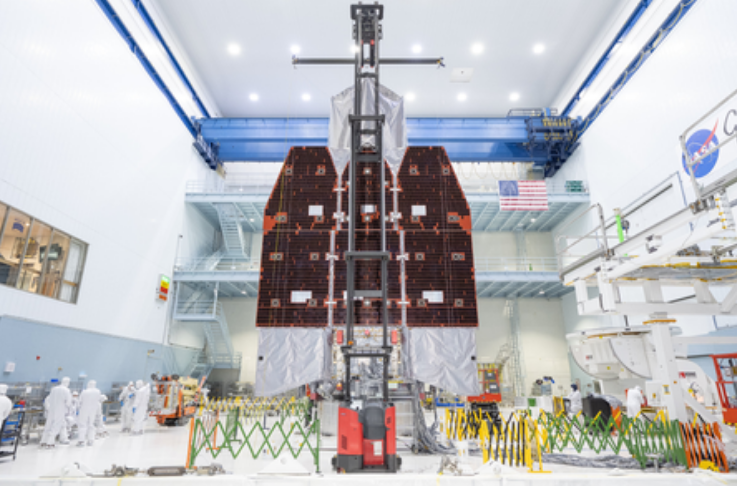

NEW DELHI — NASA has unveiled its Nancy Grace Roman Space Telescope, a next-generation observatory designed to search for planets beyond the solar system and investigate the nature of dark matter and dark energy.
Speaking at a news conference at the Goddard Space Flight Center in Maryland, NASA Administrator Jared Isaacman said the mission would provide an unprecedented view of the universe.
“Roman will give the Earth a new atlas of the universe,” he said.
The telescope, a large, wide-field observatory equipped with expansive solar panels, is expected to be transported to Florida for launch aboard a SpaceX rocket as early as September.
Named after NASA’s first chief astronomer, often called the “mother of the Hubble Space Telescope,” the Roman telescope will have a field of view at least 100 times larger than Hubble. NASA said it could measure light from up to a billion galaxies over its lifetime.
The observatory will also be capable of blocking starlight to directly image exoplanets and planet-forming disks, while conducting a broad survey of planetary systems within the Milky Way.
Built over more than a decade at a cost exceeding $4 billion, the telescope will be positioned about 1.5 million kilometers from Earth at the second Sun-Earth Lagrange point, or L2, where gravitational forces allow for stable operation with minimal energy.
NASA said the location will provide significant thermal stability, enabling a major improvement in data quality compared with earlier missions such as Hubble.
The telescope is expected to transmit roughly 11 terabytes of data per day back to Earth, supporting research across cosmology, infrared astronomy, and planetary science. (Source: IANS)