Year Ender 2025: Operation Sindoor and New India’s Security Doctrine
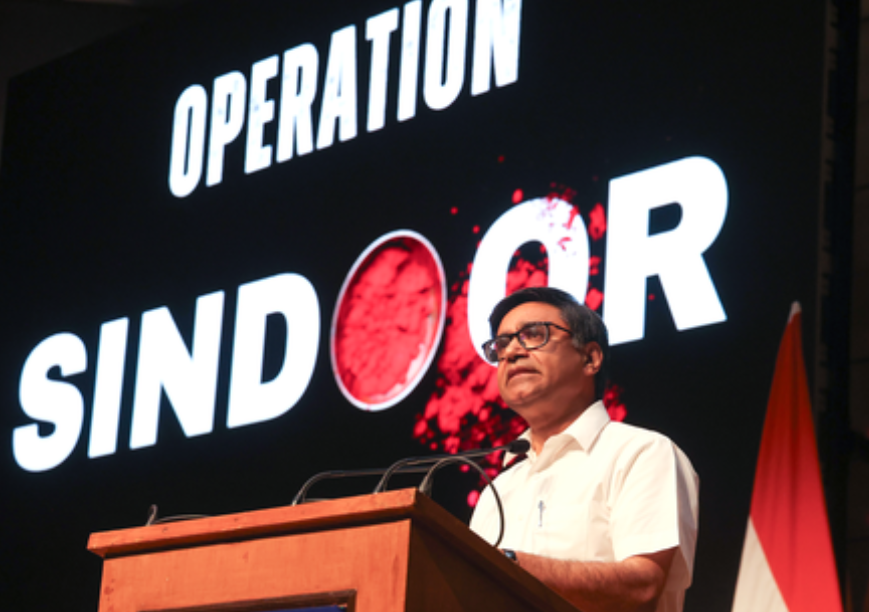

New Delhi–Operation Sindoor marked a decisive shift in India’s national security posture, sending a clear and uncompromising message to Pakistan in response to the deadly terror attack in Pahalgam. The operation underscored New Delhi’s revised doctrine: any act of terrorism against India will be treated as an act of war, not merely as cross-border violence.
Launched in the early hours of May 7, Operation Sindoor targeted terror infrastructure in Pakistan-occupied Kashmir (PoK) and deep inside Pakistan. The Indian armed forces destroyed multiple terror camps, launch pads and headquarters, including the Jaish-e-Mohammed base in Bahawalpur and Lashkar-e-Taiba’s key training facility in Muridke. Hizbul Mujahideen assets were also hit. The strikes inflicted heavy losses in manpower and infrastructure, leaving these groups struggling to regroup.
Security experts described the response as necessary and long overdue, particularly after the April 22 Pahalgam attack that killed 26 civilians. The assault, which targeted men who were reportedly identified by religion before being shot in front of their families, was seen as especially brutal and symbolic. India’s response, experts said, was intended not only to avenge the attack but also to fundamentally alter Pakistan’s cost-benefit calculation when it comes to sponsoring terror.
According to analysts, the objective of the attack in Pahalgam was to destabilise Jammu and Kashmir and damage its tourism sector, which had seen a revival since the abrogation of Article 370. While tourism suffered a temporary setback, Operation Sindoor ensured that the strategic impact on India remained limited and short-lived.
In the aftermath of the strikes, two women officers from the Indian armed forces briefed the media, outlining how terror camps were hit using indigenously developed systems such as Akash and BrahMos missiles. They also presented real-time recordings and technical evidence of the strikes. These briefings played a crucial role in countering disinformation campaigns from Pakistan, which attempted to portray itself as having emerged victorious. The visual proof and detailed explanations effectively dispelled such claims.
Operation Sindoor was widely seen as a comprehensive and multi-dimensional response, combining military precision with strategic communication. It demonstrated India’s military capability, reinforced deterrence, and reiterated its zero-tolerance policy towards terrorism, while avoiding uncontrolled escalation and maintaining international support.
The period following the Pahalgam attack was one of intense public anger, placing significant pressure on the Narendra Modi-led government to act swiftly. However, Prime Minister Modi opted for a calibrated yet decisive response rather than a hurried one, granting the armed forces operational freedom. The approach paid off, firmly establishing that India would treat terrorists and their sponsors as equally accountable.
In statements following the operation, the Prime Minister made it clear that India would not succumb to nuclear blackmail and would strike terror infrastructure wherever necessary. He reiterated that terror and dialogue, terror and trade, or bloodshed and cooperation could not coexist.
Operation Sindoor resulted in the destruction of nine major terror camps and showcased India’s air defence superiority. Indigenous systems such as Akashteer intercepted hundreds of drones and missiles. During the May 9–10 phase of the operation, Indian forces carried out precision strikes on 11 Pakistani airbases, damaging nearly 20 per cent of Pakistan Air Force assets and inflicting heavy losses, particularly at the Bhoolari airbase. The operation was jointly executed by the Army, Air Force and Navy.
The impact on terror networks has been profound. Funding channels are under strain, recruitment has slowed, and several top leaders have reportedly gone underground. Figures such as Hafiz Saeed and Masood Azhar have largely disappeared from public view. Azhar, linked to major attacks including the Parliament assault and the Pulwama bombing, suffered severe losses, including the destruction of infrastructure and the killing of close family members. High-value Jaish-e-Mohammed operatives, including Yusuf Azhar, Abdul Malik Rauf and Mudassir Ahmad—linked to the IC-814 hijacking—were also eliminated.
In essence, Operation Sindoor not only dismantled key elements of Pakistan-based terror infrastructure but also shattered the morale of its leadership. As a defining moment of 2025, it reflected a new Indian doctrine—firm, unapologetic and clear in its message that terrorism and its sponsors will face decisive consequences. (Source: IANS)