US Secretary of State Marco Rubio in Munich: “We Are Part of One Civilization — Western Civilization”
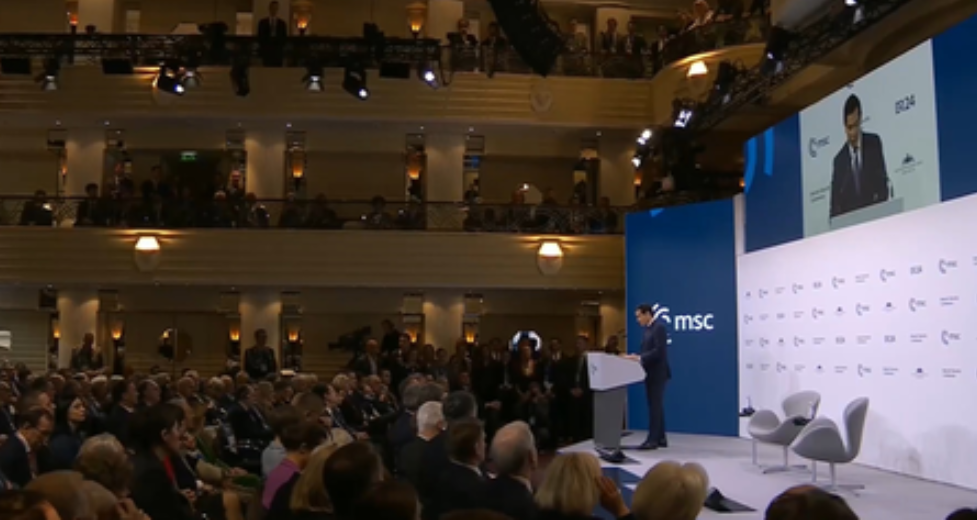

Washington/Munich— U.S. Secretary of State Marco Rubio on Saturday used his first major international address at the Munich Security Conference to call for what he described as a renewed transatlantic mission rooted in “seriousness and reciprocity,” declaring that the United States and Europe are part of “one civilization – Western civilization.”
Addressing global leaders and defense officials in Munich, Rubio invoked the Cold War origins of the conference, recalling the ideological divide that once ran through Germany. “We gather here today as members of a historic alliance, an alliance that saved and changed the world,” he said.
Rethinking the Post-Cold War Era
Rubio argued that the decades following the Cold War gave rise to what he called “a dangerous delusion,” including the belief in “the end of history,” that trade would replace nationhood, and that a rules-based global order would supersede national interests.
“That was a foolish idea,” he said, contending that such thinking contributed to deindustrialization and fragile supply chains across Western nations.
“We made these mistakes together,” Rubio said. “And now, together, we owe it to our people to face those facts and to move forward, to rebuild.”
Framing the Trump administration’s foreign policy as one of national renewal, Rubio told European allies that Washington is prepared to act independently if necessary but prefers collaboration. “We hope to do this together with you, our friends here in Europe,” he said.
Borders, Industry and Technology
Rubio emphasized that national security extends beyond military spending, arguing that it begins with defining what is being defended. “Armies fight for a people; armies fight for a nation. Armies fight for a way of life,” he said.
He described “mass migration” as a destabilizing force across Western societies and called for stronger border controls. “Controlling who and how many people enter our countries is not an expression of xenophobia,” Rubio said.
The secretary urged a broader transatlantic agenda focused on reindustrialization and emerging technologies, including industrial automation, commercial space travel, and “cutting-edge artificial intelligence.” He also called for building Western supply chains for critical minerals and coordinating efforts to compete in emerging markets across the Global South.
Ukraine and China
In a brief question-and-answer session, Rubio said prospects for ending the war in Ukraine remain uncertain. “We don’t know the Russians are serious about ending the war; they say they are,” he said, adding that key issues remain unresolved and “work remains to be done.”
Rubio also noted that the United States has imposed additional sanctions on Russian oil and said discussions with India had secured a commitment to halt additional purchases of Russian crude.
On China, Rubio said it would be “geopolitical malpractice” not to maintain dialogue ahead of an anticipated summit in the coming months between President Trump and President Xi Jinping. However, he cautioned that any agreement must not come “at the expense of our national interest.”
The Munich Security Conference, held annually in Germany, remains a central forum for transatlantic debate on NATO burden-sharing, global conflicts, and the future of Western alliances. Rubio’s remarks signaled a push to redefine that alliance around shared civilizational identity, economic resilience, and strategic competition in a rapidly shifting global order. (Source: IANS)