

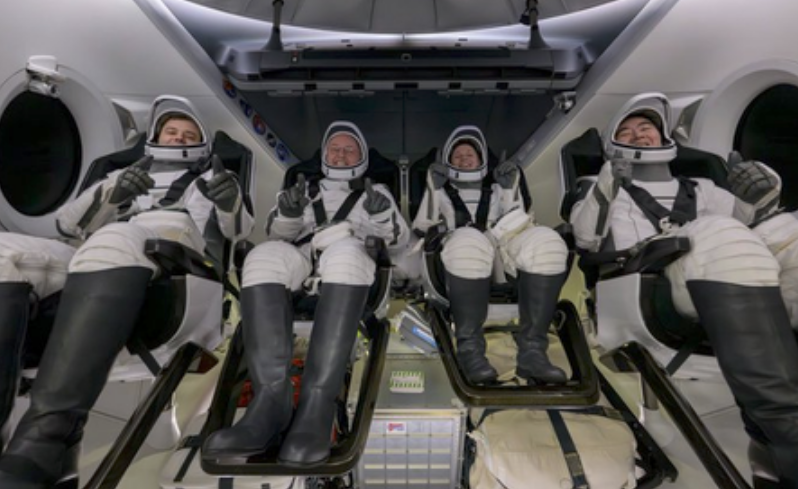

NEW DELHI — SpaceX on Thursday successfully returned four astronauts to Earth in what NASA described as the first-ever medical evacuation from the International Space Station, marking a significant operational milestone for human spaceflight.
NASA astronauts Zena Cardman and Mike Fincke, Japan Aerospace Exploration Agency astronaut Kimiya Yui, and Roscosmos cosmonaut Oleg Platonov splashed down at 12:41 a.m. PST off the coast of San Diego aboard SpaceX’s Dragon capsule, concluding a mission of more than five months aboard the ISS.
“Welcome home, Crew-11! At 3:41 am ET (0841 UTC), the SpaceX Dragon spacecraft splashed down off the coast of San Diego, California,” NASA said in a post on social media platform X.
“Dragon and NASA’s Crew-11 return to Earth, splashing down off the coast of California,” SpaceX said separately.
The early return reduces the ISS crew to three members — NASA astronaut Chris Williams and Russian cosmonauts Sergey Kud-Sverchkov and Sergei Mikaev — until the arrival of the next four-person crew scheduled for next month.
“All four crew members will be transported to a local hospital for additional evaluation, taking advantage of medical resources on Earth to provide the best care possible,” NASA said.
The return followed NASA’s decision on January 8 to postpone its first scheduled spacewalk of 2026 involving Fincke and Cardman due to what the agency described as a “medical concern” with one of the astronauts. NASA has not disclosed details of the issue or identified the crew member involved.
“Due to medical privacy, it is not appropriate for NASA to share more details about the crew member. The situation is stable,” the agency said in a blog post at the time.
NASA Administrator Jared Isaacman said Crew-11’s return underscored the resilience and capability of the U.S. space program to respond to unexpected situations while maintaining mission continuity.
“Crew-11 completed more than 140 science experiments that advance human exploration. Missions like Crew-11 demonstrate the capability inherent in America’s space programme — our ability to bring astronauts home as needed, launch new crews quickly, and continue pushing forward on human spaceflight as we prepare for our historic Artemis II mission, from low Earth orbit to the Moon and ultimately Mars,” Isaacman said.
During their 167-day mission, the crew traveled nearly 71 million miles and completed more than 2,670 orbits of Earth. The mission marked the fourth spaceflight for Fincke, the second for Yui, and the first for Cardman and Platonov. Fincke has now logged a cumulative 549 days in space, ranking him fourth among all NASA astronauts. (Source: IANS)