Raghav Chadha Calls for Greater Role for Women in Governance at Samarkand Conference
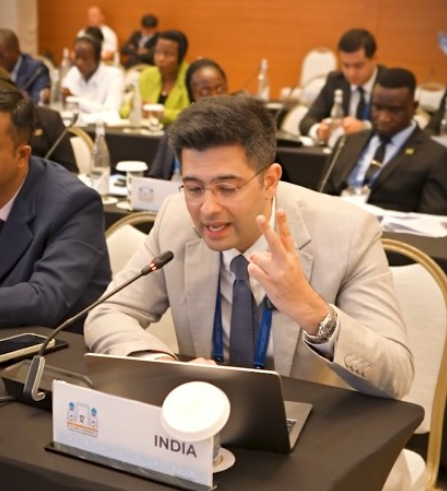

Samarkand — Rajya Sabha member Raghav Chadha highlighted India’s push toward women-led development at the 12th Inter-Parliamentary Union Global Conference of Young Parliamentarians in Samarkand, Uzbekistan, calling for women to have a greater role in political decision-making and governance.
Addressing a session on “Ensuring Women’s Political Rights,” Chadha said women’s participation in democracy should extend beyond voting to holding positions of authority and shaping government decisions.
“In India, we have seen that under the Honourable Prime Minister Shri Narendra Modi, India has made a deliberate shift from women’s development to women-led development. That means a woman is not merely seen as a beneficiary of policy; she is an active account holder, an entrepreneur, an elected representative, and a decision maker,” Chadha said.
He said India’s progress in women’s political participation could be seen at three levels: the ballot box, grassroots government and the highest levels of political decision-making.
Discussing voter participation, Chadha said more than 476 million women were registered to vote in India’s 2024 general elections, with women’s turnout at roughly 67 percent, slightly higher than the turnout among men.
“This was the second general election in succession in which women’s participation exceeded that of men. Indian women are not waiting at the doors of democracy; they are helping determine its direction,” he said.
Chadha also pointed to women’s representation in India’s Panchayati Raj institutions, the country’s third tier of government. He said about 1.45 million women serve as elected representatives in those institutions, making up approximately 46 percent of all elected representatives at that level.
“Twenty-one Indian states have gone beyond the constitutional minimum provision of having 50 per cent reservation for women in panchayats. These women are not just symbols of office holders. They lead communities, prepare local plans, and deliver public service,” he said.
At the national and state levels, Chadha cited the Nari Shakti Vandan Adhiniyam, also known as the Women’s Reservation Bill, which establishes a constitutional framework for reserving one-third of seats for women in the Lok Sabha and state legislative assemblies.
“This does not merely mean representation; it’s the voice, the authority, and the decision-making power being given to women,” Chadha said.
Concluding his remarks, Chadha said India’s message from the conference was that women should not only be encouraged to participate in elections but also be given meaningful roles in governing.
“India’s message from Samarkand is simple: do not only ask women to vote, enable them to govern. Give them a seat, give them authority, and do not only speak of empowerment, but also build institutions that make it irreversible,” he said. (Source: IANS)