Congresswoman Grace Meng Reintroduces Bill to Make Diwali a Federal Holiday
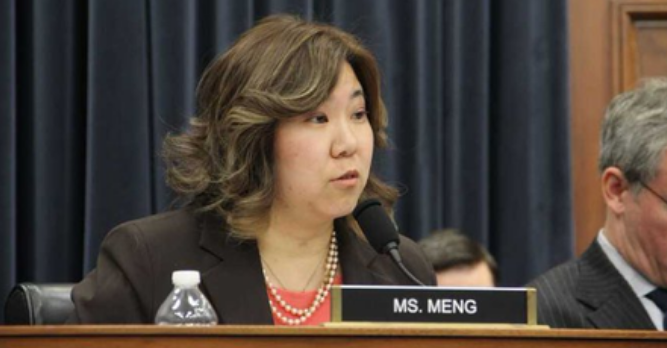
WASHINGTON–U.S. Congresswoman Grace Meng has reintroduced legislation to designate Diwali as a federal holiday, arguing that national recognition of the Festival of Lights would celebrate America’s cultural diversity and send a message of solidarity amid concerns about anti-Hindu and anti-South Asian hate.
The proposed Diwali Day Act would amend federal law to add Diwali to the official calendar of U.S. public holidays, making it the nation’s 12th federal holiday if enacted.
Meng, a Democrat from New York who chairs the Congressional Asian Pacific American Caucus (CAPAC), said the legislation would recognize the religious and cultural significance of a festival celebrated by millions of Americans.
“Diwali represents the triumph of good over evil and knowledge over ignorance,” Meng said.
The bill has attracted support from 19 congressional co-sponsors, including Indian American Representatives Ami Bera, Ro Khanna, Raja Krishnamoorthi, Suhas Subramanyam and Shri Thanedar.
Other lawmakers supporting the legislation include Nanette Barragán, Wesley Bell, André Carson, Judy Chu, Suzan DelBene, Josh Gottheimer, Timothy Kennedy, Stephen Lynch, Deborah Ross, Lateefah Simon, Tom Suozzi, Mark Takano, Rashida Tlaib and Bonnie Watson Coleman.
Meng emphasized that recognizing Diwali at the federal level would demonstrate support for Hindu, Sikh, Jain and Buddhist communities, particularly as concerns grow over incidents of religious and racial hostility.
“At a time when anti-Hindu and anti-South Asian hate is on the rise, recognizing Diwali as a federal holiday sends a powerful message that Hindus, as well as Sikhs, Jains, and Buddhists, are valued members of our society,” Meng said.
The legislation proposes amending Section 6103(a) of Title 5 of the U.S. Code, which establishes the country’s legal public holidays, to include Diwali Day.
Meng pointed to the importance of the festival in her congressional district in Queens, New York, which is home to a large and diverse South Asian population.
“Here in Queens, I see firsthand how meaningful Diwali is to so many families and communities,” she said.
“My Diwali Day Act will help educate Americans about the importance of this day, and I will continue working to create a more inclusive nation that honors the rich cultural traditions of its people.”
The renewed legislative effort comes amid heightened concerns about threats and harassment targeting Hindu and South Asian communities across the United States.
In announcing the proposal, CAPAC cited several recent incidents, including vandalism at Hindu temples, an alleged plot to carry out a mass shooting at a Hindu gathering in Illinois and the disruption of a Diwali celebration in Washington state.
The caucus called for such incidents to receive serious attention from federal law enforcement agencies and emphasized the importance of protecting religious communities from intimidation and violence.
Although CAPAC described anti-Hindu and anti-South Asian hate as increasing, its announcement did not provide statistical evidence documenting the trend.
Meng’s office said the Diwali Day Act has received endorsements from 17 civil rights, religious and community organizations, reflecting support from groups advocating for greater recognition of religious and cultural traditions.
Diwali, commonly known as the Festival of Lights, is celebrated by Hindus, Sikhs, Jains and some Buddhists. The festival is associated with themes of light overcoming darkness, the triumph of good over evil and spiritual renewal.
Federal recognition would place Diwali alongside other nationally observed holidays and provide an opportunity for broader public awareness of its cultural and religious significance.
Meng has also introduced separate legislation seeking to establish Lunar New Year as a federal holiday, part of her broader efforts to expand recognition of celebrations observed by Asian American communities.
The Diwali Day Act must pass both chambers of Congress and receive presidential approval before it can become law. (Source: IANS)