Mamata Banerjee: An Astute Yet Unpredictable Political Force
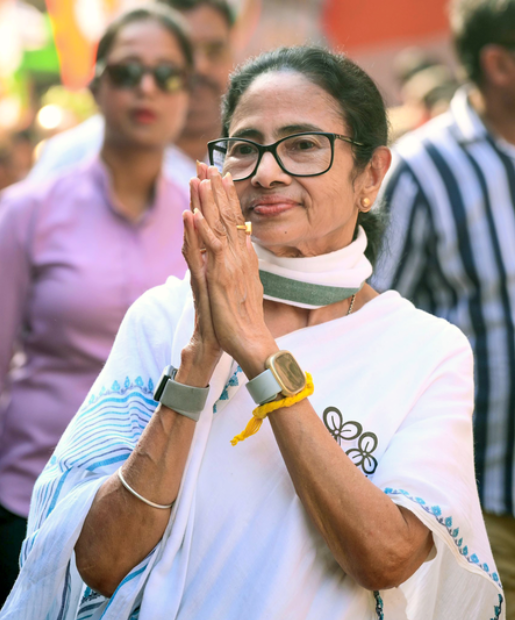

Few political figures in India embody grit, defiance, and unpredictability quite like Mamata Banerjee. From her early days as a fiery student activist to becoming the architect of one of the most significant political shifts in modern Indian history, Banerjee’s journey has been defined by persistence, political instinct, and an unyielding connection with the masses.
Born in Kolkata, Banerjee entered politics at a young age, rising through the ranks of the Indian National Congress. Her political style was evident early on—aggressive, grassroots-driven, and unapologetically confrontational.
One of her most iconic early moments came during the 1970s, when she climbed onto the car of veteran leader Jayaprakash Narayan during the anti-Emergency movement—an act that symbolized her fearless, street-fighter persona.
By the 1980s and 1990s, Banerjee had emerged as a prominent Congress leader in West Bengal, but grew increasingly frustrated with the party’s inability to challenge the entrenched Left Front government.
Birth of Trinamool Congress and Rise Against the Left
In 1998, she broke away from Congress to form the All India Trinamool Congress (TMC), positioning it as the principal opposition to the Left Front, which had ruled West Bengal for decades.
Banerjee’s rise was not immediate. The 2006 Assembly elections were a major setback, with the Left Front securing a sweeping victory. But she recalibrated quickly.
Her political breakthrough came through mass movements against land acquisition in Singur and Nandigram. By aligning herself with farmers and local communities, she tapped into deep anxieties over industrialisation and displacement, transforming these protests into a statewide political wave.
Banerjee’s moment of triumph came in 2011, when she defeated the Left Front government led by Buddhadeb Bhattacharjee, ending 34 years of uninterrupted communist rule in the state.
The victory was historic—not just for West Bengal, but for Indian politics—marking the collapse of one of the world’s longest-serving democratically elected communist governments.
Banerjee became the first woman Chief Minister of West Bengal, cementing her place as a transformative political force.
As Chief Minister, Banerjee focused heavily on welfare schemes targeting women, minorities, and economically weaker sections. Her governance style blended populist outreach with symbolic politics—festivals, cultural patronage, and direct engagement with citizens.
This approach helped her build a loyal support base, particularly among rural and marginalized communities.
At the same time, critics have pointed to concerns over industrial slowdown, governance challenges, and allegations of corruption within sections of her party.
The BJP Challenge and Electoral Battles
The political landscape shifted dramatically with the rise of the Bharatiya Janata Party (BJP) in West Bengal.
In the 2019 Lok Sabha elections, the BJP made major gains, emerging as a formidable challenger. The contest intensified further in the 2021 Assembly elections, which turned into a high-stakes battle.
Defying predictions once again, Banerjee led the TMC to a decisive victory, securing a third consecutive term and reaffirming her dominance in state politics.
An Unconventional Political Style
Banerjee’s leadership style defies conventional political norms. She is known to operate without a traditional inner circle, often relying on instinct and direct public feedback.
Her image oscillates between strength and vulnerability—whether addressing rallies with her foot in a cast or campaigning despite injuries, she projects resilience that resonates with her supporters.
She has also shown remarkable flexibility in alliances—having partnered with both the BJP and Congress at different points in her career, before choosing to contest elections independently in recent years.
An Enigma in Indian Politics
Despite decades in public life, Banerjee remains difficult to predict. Her decisions often surprise both allies and opponents, making her one of the most closely watched political figures in India.
Her ability to reinvent herself, adapt to shifting political currents, and maintain a strong grassroots connect has allowed her to stay ahead in a highly competitive political environment.
As West Bengal moves toward future electoral battles, including the 2026 Assembly elections, Banerjee continues to dominate the state’s political narrative.
Key challenges remain—anti-incumbency, corruption allegations, economic concerns, and a resurgent opposition. Yet, if history is any guide, writing her off has rarely worked.
More than four decades after she first stepped into politics, Mamata Banerjee remains what she has always been: a relentless fighter, a mass leader, and an enduring enigma in Indian democracy. (Source: IANS)