India-US Trade Talks May Have Reached Plateau, Sitharaman Says
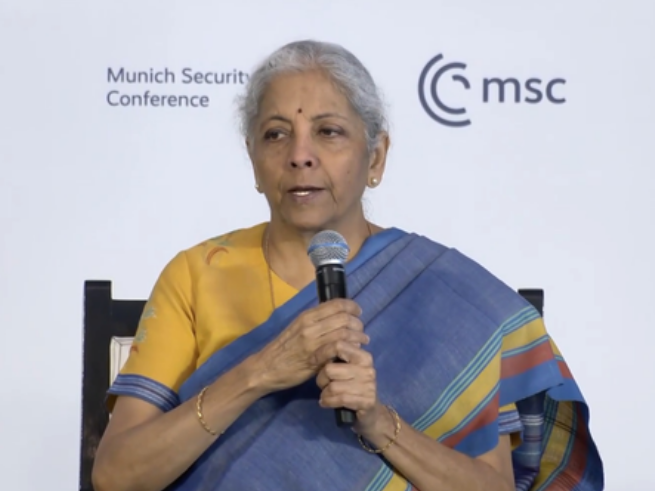

New Delhi — Finance Minister Nirmala Sitharaman said Monday that India-U.S. trade negotiations are continuing but may have reached a point where further concessions from either side could prove difficult.
Speaking at the Munich Leaders Meeting 2026, Sitharaman said the proposed trade agreement has involved difficult and intensive negotiations.
“The negotiations are still ongoing although we would like to believe both sides have reached a plateau beyond which giving or taking might be very, very difficult,” she said.
Sitharaman said the two countries could still examine whether there is room for additional movement in the negotiations.
She noted that the bilateral trade balance currently favors India and said the United States is seeking to narrow its trade deficit.
According to Sitharaman, the U.S. position reflects concerns over what Washington sees as accumulated losses in its trade relationship with India over the years.
The negotiations are taking place under a framework for an interim trade agreement announced in February 2026.
India and the United States have said they are working to finalize the interim pact while continuing negotiations on a broader bilateral trade agreement.
Sitharaman also pointed to the India-European Union trade agreement as an example of New Delhi’s approach to major trade negotiations.
She said the agreement would cover economies representing about two billion people and roughly a quarter of global gross domestic product.
Sitharaman said the phrase “the mother of all deals,” previously used by European Commission President Ursula von der Leyen, was an appropriate description of the agreement.
Under the pact, India opened 92.5 percent of its tariff lines and about 97 percent of trade value, while the European Union opened about 99 percent of trade value and roughly 97 percent of tariff lines, she said.
Sitharaman said the market access commitments were designed around the complementary strengths of the two economies while ensuring that India’s competitiveness was not adversely affected. (Source: IANS)