


TEL AVIV — India’s willingness to impose direct costs on networks that enable terrorism—without waiting for international endorsement—has opened new avenues for strategic cooperation with Israel, according to a new analysis released Tuesday.
The report, authored by John Spencer, Executive Director at the U.S.-based Urban Warfare Institute, and Lauren Dagan Amoss, an academic expert on India’s foreign and security policy, argues that India’s evolving response framework represents a newly assertive “Indian playbook” that global actors can no longer overlook. The findings were published by the Begin–Sadat Centre for Strategic Studies at Bar-Ilan University.
“These shifts matter for Israel. India’s new deterrence posture of explicitly rejecting nuclear blackmail, collapsing the line between proxy terror and state responsibility, and demonstrating a willingness to strike early and with precision mirrors many of the principles Israel has relied on for decades,” the authors wrote.
They noted that India and Israel both confront adversaries that employ terrorism as a strategic instrument under a shield of nuclear ambiguity. India’s actions during Operation Sindoor—including neutralizing Chinese-origin PL-15 missiles and HQ-9/P air defenses—offer operational insights that Israel may find relevant as Chinese defense technology becomes more prevalent across the Middle East.
According to the report, India has been gradually moving away from its long-held policy of “strategic restraint” for nearly a decade. Responses to attacks in Uri (2016), Balakot (2019), and Pahalgam (2025) demonstrated that predictable, limited retaliation was no longer discouraging terrorism but instead creating space for more cross-border violence.
“Indian strategic restraint was designed to prevent escalation with Pakistan. In practice, it did the opposite,” the authors wrote. They argued that Pakistan-backed terror groups exploited India’s reluctance to take decisive cross-border action, knowing that responses would remain limited and predictable.
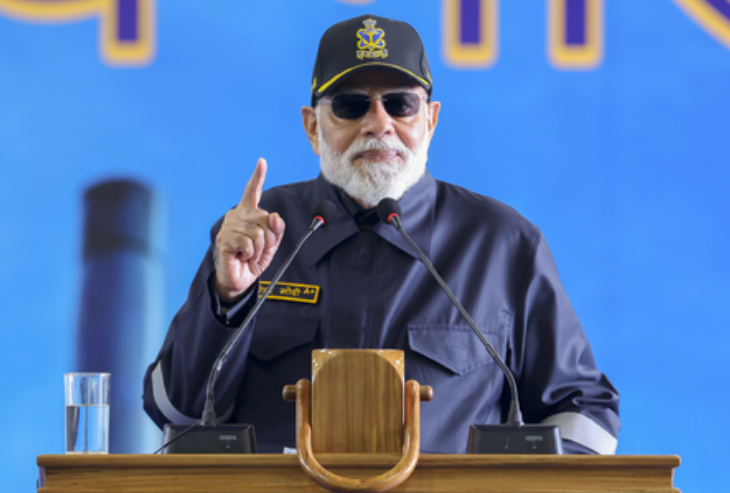
Spencer and Amoss said India has now adopted a doctrine of compellence, treating major terrorist attacks as acts of war rather than criminal incidents. The shift became explicit during Operation Sindoor, when Prime Minister Narendra Modi declared that such attacks would draw wartime responses.
“The government no longer waits for lengthy attribution cycles or international pressure before acting. Pre-emption is considered a sovereign right,” they wrote. During Operation Sindoor, India used long-range precision fire, drone swarms, loitering munitions, and real-time integrated intelligence to strike early and deep—signaling a permanent doctrinal transformation. (Source: IANS)