
Gita Gopinath Warns AI Investment Boom Could Face Major Market Correction
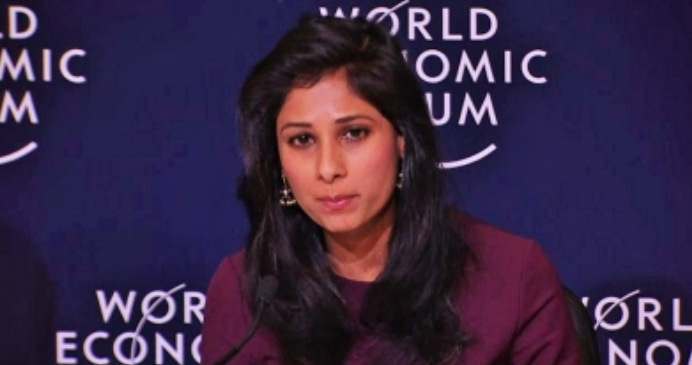

NEW DELHI–Former International Monetary Fund (IMF) Chief Economist Gita Gopinath has warned that the rapid expansion of artificial intelligence investments could lead to a significant market correction as technology companies face growing pressure to generate profits sufficient to justify their soaring valuations.
Speaking on entrepreneur Raj Shamani’s podcast, the Harvard University Professor expressed concerns about the sustainability of the global AI investment boom, particularly as companies commit enormous amounts of capital to infrastructure, computing power and technology development.
“I personally think that there will be a correction. It’s impossible to tell when that correction will happen,” Gopinath said.
Global spending on AI infrastructure and development is projected to approach $1 trillion in 2026, driven by substantial investments in the United States, South Korea, Taiwan and other major technology markets.
However, Gopinath questioned whether companies competing in the increasingly crowded AI industry would be able to generate enough revenue and profits to recover those investments.
“It’s hard to explain how each of these labs and companies who are investing close to a trillion dollars now globally in AI just in 2026 will be able to make the kind of profits that are needed to recover that investment,” she said.
She warned that intense competition among AI developers could make it difficult for companies to achieve the profitability implied by their current market valuations.
“In a hypercompetitive landscape, it remains difficult to see how all competing firms can generate sufficient profits to justify their current valuations. A significant market correction in AI valuations could heavily impact the US economy—which relies heavily on AI-driven wealth effects—potentially dropping US growth to zero or negative territory,” she added.
Gopinath said the potential consequences of an AI market downturn could extend beyond the technology industry and affect the broader U.S. economy.
She pointed to the growing influence of AI-related investments on stock market performance and economic growth, suggesting that a sharp decline in technology valuations could weaken consumer wealth and business confidence.
The risks could also spread internationally because of the close connections among global technology markets.
Countries such as Taiwan and South Korea have benefited from strong demand for semiconductors and other components essential to AI development. However, their dependence on technology supply chains could make them vulnerable to a sudden reduction in AI spending.
Gopinath also raised concerns about the interconnected financial relationships within the AI industry, where major technology companies invest in AI developers that subsequently purchase their products and services.
She cited Nvidia as an example, noting that the semiconductor company invests in AI laboratories that use funding to purchase Nvidia chips.
“If Nvidia were to collapse or any one of the AI labs were to collapse, that would have implications for Nvidia,” she said.
Such financial relationships, she suggested, could amplify the effects of a downturn if difficulties at one major company spread to its investors, suppliers and customers.
Beyond financial markets, Gopinath addressed the growing influence of AI on employment and professional development.
She urged young professionals to avoid what she described as “cognitive surrender,” warning against becoming overly dependent on AI tools such as ChatGPT and Claude.
Gopinath emphasized the importance of developing independent analytical and problem-solving abilities rather than relying entirely on AI-generated responses.
Her comments reflect concerns about whether the extraordinary pace of AI investment can translate into sustainable long-term profitability, even as the technology continues to reshape industries and the global economy. (Source: IANS)