India Votes Against US Embargo on Cuba at UN, Opposes Laws Violating National Sovereignty
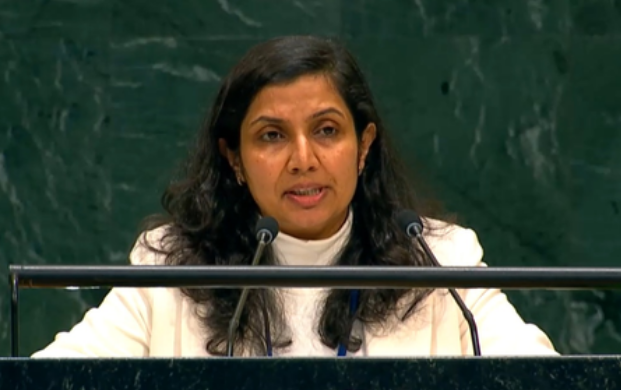

UNITED NATIONS–India has reaffirmed its opposition to laws and sanctions that undermine the sovereignty of other nations, voting in favor of a United Nations General Assembly resolution calling for an end to the longstanding U.S. economic, commercial and financial embargo against Cuba.
Speaking before the General Assembly vote on Wednesday, Soumya Nair, a counselor at India’s Permanent Mission to the United Nations, emphasized New Delhi’s commitment to national sovereignty, international law and diplomatic engagement in resolving disputes between countries.
Nair said India supports the General Assembly’s longstanding position against unilateral measures that impose restrictions beyond a country’s borders and interfere with the economic development of other nations.
She reiterated India’s support for rejecting “laws and regulations with extraterritorial effects that adversely affect the sovereignty of other states and the progress and prosperity of their peoples”.
“India reiterates the Assembly’s call to all states to refrain from promulgating and applying, and to repeal and invalidate such laws and measures in conformity with their obligations under the Charter of the United Nations and International Law”, Nair said.
The resolution passed with 130 countries voting in favor, 17 opposing and 25 abstaining, reflecting continued international opposition to the American embargo against Cuba.
India’s vote came amid heightened diplomatic tensions between Washington and Havana, including a confrontation inside the General Assembly chamber that resulted in the expulsion of a Cuban diplomat from the United States.
The dispute erupted Tuesday when Cuban Foreign Minister Bruno Rodriguez Parrilla approached the podium to confront U.S. Ambassador to the United Nations Mike Waltz while the American diplomat was addressing the assembly.
Waltz had been speaking about alleged corruption among Cuba’s political leadership when the confrontation occurred.
General Assembly President Khalilur Rahman temporarily suspended the proceedings to restore order after the exchange disrupted the session.
The diplomatic dispute escalated Wednesday when the United States announced the expulsion of Richard Tur de la Concepcion, first secretary of Cuba’s mission to the United Nations.
According to Waltz, the Cuban diplomat had allegedly engaged in physical contact with an American diplomat during the confrontation.
“If you lay a hand on an American diplomat in this body, there will be consequences”, Waltz said.
“That so-called diplomat today will be put on a plane back to Havana”, he added.
Waltz did not publicly identify the diplomat during his remarks, although Cuban officials subsequently identified him.
The incident prompted criticism from the United Nations, with officials emphasizing the need for diplomatic delegations to follow established procedures and maintain appropriate conduct during General Assembly proceedings.
Stephane Dujarric, spokesperson for UN Secretary-General Antonio Guterres, said the organization expected all representatives to respect the rules governing diplomatic proceedings.
“We expect every delegation to respect the decorum of the General Assembly’s hall and to respect the rules and procedures of the General Assembly”, Dujarric said during a Wednesday briefing.
He also noted that UN security officials deployed additional personnel to maintain order following the confrontation.
“They did a great job in ensuring that the situation did not get out of hand”, he said.
Against the backdrop of the dispute, India emphasized the importance of diplomacy and multilateral cooperation in addressing international disagreements.
“India’s commitment to multilateralism is rooted in our belief that international challenges are best addressed through dialogue and diplomacy in accordance with the UN Charter”, Nair said.
She expressed hope that Washington would eventually remove the economic restrictions, allowing Cuba to expand its participation in international trade and development initiatives.
“It is in this spirit that India hopes that the embargo will be lifted at the earliest, to help create an environment that would enable the people of Cuba to participate more fully in international cooperation and pursue their legitimate development aspirations”, she said.
Nair also highlighted the economic and humanitarian consequences of the embargo, pointing to shortages of essential medical supplies and declining agricultural production in Cuba.
According to figures she cited, Cuba’s healthcare system faces shortages affecting more than 60% of essential medicines, while domestic food production has fallen by more than 50% over the past five years.
She further criticized recently tightened restrictions on fuel exports to Cuba, arguing that they have compounded existing economic difficulties and disrupted critical public services.
The restrictions have “disrupted essential services, including healthcare, education, water supplies, food distribution and transportation”, Nair said.
India’s position reflects its longstanding support for ending the U.S. embargo and its broader opposition to economic measures that extend beyond national jurisdictions and interfere with the sovereignty of other countries.
The General Assembly resolution adds to repeated international calls for Washington to lift the restrictions, although the vote itself does not legally compel the United States to change its policy.
For New Delhi, the vote reinforced its position that international disputes should be addressed through diplomatic engagement, respect for national sovereignty and adherence to the principles of the United Nations Charter. (Source: IANS)