Ro Khanna and Ritesh Tandon Clash Over ICE, Green Card Backlogs and Billionaire Tax in Silicon Valley Debate
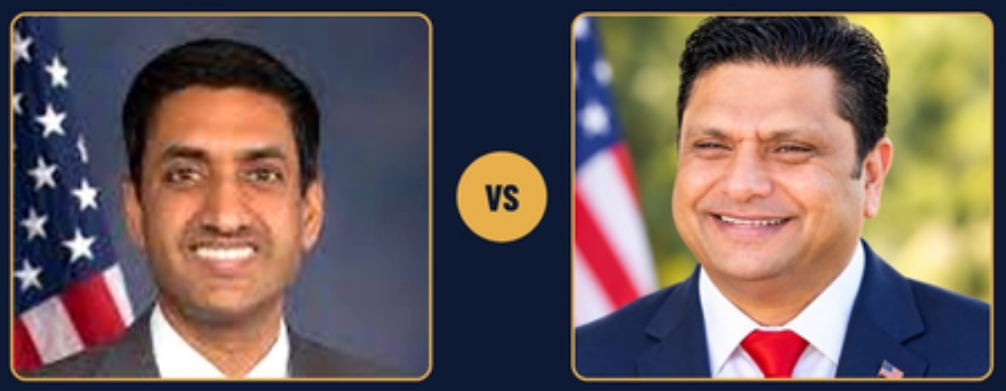

WASHINGTON– Indian American Rep. Ro Khanna and Republican challenger Ritesh Tandon clashed over immigration enforcement, green card backlogs, taxes on billionaires and economic policy during a congressional debate in California’s 17th District, highlighting sharp differences between the two Indian American candidates ahead of the November 3 election.
The roughly 50-minute virtual debate, held Wednesday evening and streamed live on Tandon’s campaign YouTube channel, featured competing positions on immigration reform, economic growth and the government’s role in addressing inequality.
Khanna, the Democratic incumbent who has represented the Silicon Valley district for nearly a decade, called for eliminating U.S. Immigration and Customs Enforcement (ICE), while Tandon advocated removing country-based limits on employment green cards and tightening immigration enforcement.
Despite their policy disagreements, the debate began on a cordial note, with Khanna acknowledging his opponent’s approach to political discourse.
“I appreciate the civil way he has conducted himself in the past few years. And I think this is absolutely critical to democracy to be able to have a debate of ideas with people who you may not share everything in common,” Khanna said.
Immigration emerged as one of the most contentious issues of the evening, with Khanna taking a firm position against ICE and arguing that the agency should be dismantled and replaced with a more accountable immigration enforcement organization.
“I would abolish ICE,” Khanna declared.
He described the agency as “a rogue agency” and proposed replacing it with “an agency like the INS was, which is under the Justice Department, humane, focusing on going after sex traffickers, criminals”.
Khanna also emphasized the importance of retaining international students, entrepreneurs and skilled professionals who contribute to the American economy.
He said “we need to be finding pathways of green cards for people who are studying here and starting businesses here and creating companies here”.
Tandon, an Indian immigrant who arrived in the United States at age 28, focused on the lengthy immigration process faced by legal immigrants, particularly Indian professionals waiting for permanent residency.
“I came here at the age of 28. I followed all the rules and waited my turn,” Tandon said.
He argued that the existing immigration system has failed applicants who comply with federal requirements, pointing to a backlog affecting more than 1.2 million people.
“My opponent has been in the Congress for almost 10 years. And the line has only grown longer,” Tandon said.
Tandon proposed eliminating per-country limits on green cards and making unused green cards from previous years available to eligible applicants.
His proposal, he said, would “first of all, end the per country cap”.
He also called for measures to prevent abuse of the H-1B visa program, supported voter identification requirements and advocated making unauthorized border crossings a felony.
Employment-based green card country limits have been a longstanding concern among Indian technology workers, many of whom face extensive waits for permanent residency despite living and working legally in the United States.
The candidates also disagreed sharply over taxation and economic inequality, particularly Khanna’s support for a proposed 5% tax on billionaires.
Khanna argued that the country’s economic policies have disproportionately benefited the wealthiest Americans while leaving working- and middle-class families behind.
“The question is why is this economy only working for a few billionaires?” Khanna asked.
“We need a new social contract in America that privileges the working and middle class.”
Tandon criticized the proposed tax, warning that taxing unrealized gains could discourage investment and accelerate the departure of businesses and wealthy residents from California.
He argued that the proposal “taxes the paper wealth, not the income”.
Tandon also pointed to companies and residents relocating from California as evidence that the state’s economic policies were undermining its competitiveness.
Khanna rejected the suggestion that Silicon Valley was losing its position as the nation’s technology innovation center.
“No one thinks the AI revolution is happening in Austin or Miami. It’s happening in Silicon Valley,” Khanna said.
The exchange highlighted competing approaches to economic policy in a district that includes some of the country’s most prominent technology companies and wealthiest communities.
Tandon also challenged Khanna over his progressive political positions, accusing the congressman of supporting policies that could push the Democratic Party further to the left.
“The Democratic socialist America are putting it on the far left, and I’m afraid it is taking the America down the road of Venezuela,” Tandon said.
He also criticized Khanna for endorsing a Democratic socialist candidate in New York City’s mayoral race.
Khanna, meanwhile, continued to emphasize economic fairness and the need for policies that expand opportunities for working Americans.
The debate also exposed a substantial difference in campaign fundraising between the two candidates.
During his closing remarks, Tandon contrasted his limited campaign resources with Khanna’s financial advantage.
“I raised only 58,000 and you have $17 million in your account,” Tandon said.
Tandon pledged to serve no more than three congressional terms if elected, presenting term limits as a measure to strengthen accountability in Washington.
He also expressed support for restrictions on stock trading by members of Congress, including provisions covering family trusts.
Khanna concluded by calling for national unity despite political disagreements.
“Ultimately, we’re all Americans, and we have to come together,” he said.
Khanna enters the November 3 general election with a significant electoral advantage in the heavily Democratic Silicon Valley district.
In California’s June top-two primary, Khanna received approximately 62% of the vote, while Tandon finished with roughly 15%.
The two candidates advanced under California’s primary system, which allows the two highest vote-getters to compete in the general election regardless of party affiliation.
The race features two Indian American candidates with contrasting positions on immigration, taxation and economic policy in a congressional district that is home to a substantial Indian American population and a major concentration of technology professionals. (Source: IANS)