NECA Awards Video Series: MIT Scientist and Cybersecurity Pioneer Srini Devadas on Work, Learning and Living: “Life Is a Vacation”
From IIT Madras to MIT, the award-winning computer scientist has helped shape the future of secure computing. Yet his philosophy of life is refreshingly simple: embrace what you do, never stop learning, and make every day an adventure.

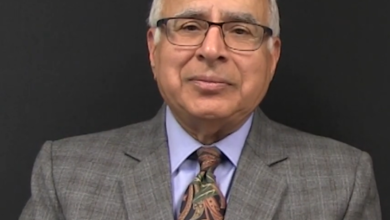
BOSTON, MA — “Life is a vacation.”
For Srini Devadas, the Edwin Sibley Webster Professor of Electrical Engineering and Computer Science at the Massachusetts Institute of Technology (MIT), these are more than just words. They capture a philosophy that has guided his professional journey, personal pursuits and approach to life.
“I’ve never worked a day of my life,” Devadas says in a video interview with INDIA New England News. He explains that going to work feels like going on vacation, recalling the familiar saying attributed to Mark Twain: “Find a job you love and never work a day of your life.”
It is an unexpected perspective from a computer scientist whose accomplishments span decades of research, teaching and innovation in secure computing, applied cryptography and cybersecurity. But the interview reveals that Devadas’s success is rooted not simply in expertise, but in a restless curiosity and a determination to keep discovering new things.
A recipient of the 2026 New England Choice Awards (NECA) Academia & Innovation Award, Devadas has built an extraordinary career. Yet his story is equally about family, the joy of learning and the freedom to remain a beginner at any age.
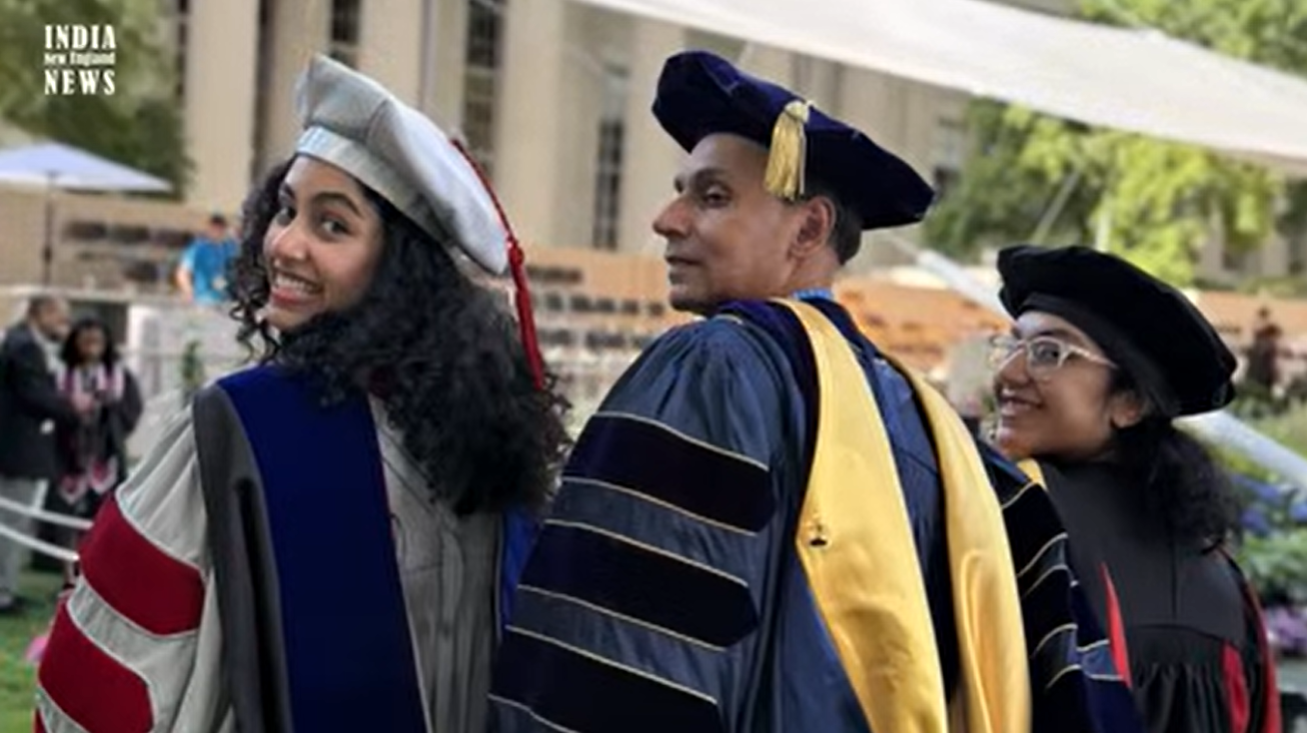
To watch the full interview, please click here, or on the image below.
From IIT Madras to MIT: A Journey of Discovery
Devadas earned his undergraduate degree in electrical engineering from IIT Madras before moving to the United States for graduate studies at the University of California, Berkeley. He arrived at MIT several years later and has spent decades there as a researcher and educator.
His academic journey, however, has never followed a single, unchanging path.
Devadas began his career working on circuits and hardware. About a decade into his MIT career, he found himself increasingly interested in what colleagues in computer science were doing.
“I’m all for enjoying myself in research and teaching,” he says, describing his decision around 1998 to move into computer architecture, the field concerned with the design and organization of computer processors.
Mentors and colleagues helped open new doors. His friend and mentor Arvind encouraged him to explore computer architecture, while conversations with renowned cryptographer Ronald Rivest introduced him to computer security.
Devadas began to see how hardware could play a much greater role in building secure computing systems. That insight ultimately shaped the focus of much of his research over the past two decades.
Today, his work addresses cybersecurity challenges from the ground up, exploring how hardware can be designed to protect sensitive information and defend against cyberattacks.
As digital threats become more sophisticated and artificial intelligence expands what both attackers and defenders can do, his research has growing relevance. Devadas discusses the importance of protecting sensitive data, securing digital transactions and developing confidential computing systems that help safeguard information processed in the cloud.
His advice to companies is straightforward: sound security begins with disciplined system design. Organizations must resist shortcuts, identify vulnerabilities before attackers exploit them, and build protections into their systems from the beginning.
Despite the growing challenges, he remains optimistic that artificial intelligence can help create a more secure digital world.
A Professor at Work—and a Father at Home
Devadas’s commitment to scholarship is perhaps most evident in his family.
His daughter Lalita Das opens the interview by offering a different perspective on his achievements: his success in raising two daughters who became professors, one in computer science and the other in mathematics.
“If that doesn’t tell you about how much he values scholarship and academia, I don’t really know what else does,” she says.
Lalita, who earned her Ph.D. at MIT, recalls growing up as one of her father’s informal teaching experiments. He would use his daughters to test subjects, explore better ways to explain ideas and discover what made children excited about learning.
She says she also saw firsthand how colleagues and students responded to his teaching. Even when he was often the oldest person in the room, she recalls, he was also the most energetic.
His approach as a mentor, she explains, resembles his approach as a parent: helping people pursue what excites them while encouraging them to recognize the possibilities within their chosen fields.
Devadas himself rejects the idea that academic achievement is simply a matter of family genes. Instead, he emphasizes motivation and the pleasure of doing what one loves.
“I think learning is fun,” he says.
That belief extends to family life. At home, conversations can turn into lively debates about technology, scientific discoveries, who deserves credit for an invention or whether a particular Nobel Prize was warranted.
The family, he acknowledges, is a loud one.
His wife, Roshni, has also devoted years to education, teaching and serving as principal of Shishu Bharati, an Indian language and cultural school in Lexington, Massachusetts. Both daughters attended the school.
For Devadas, the pursuit of knowledge is not confined to a university or a research laboratory. It is woven into everyday family life.
Learning to Swim, Ski—and Even Juggle
One of the most endearing aspects of Devadas’s story is his willingness to tackle things he does not yet know how to do.
He learned to swim in his 30s and took up skiing in his 40s. He has also taught himself to juggle.
His daughter describes him as someone who picks up a new sport whenever he gets bored. The same tendency, she observes, is evident in his research career, as he has moved from electrical engineering into increasingly different areas of computer science.
When asked what motivates him to keep learning, Devadas offers a candid answer.
“I think I just get bored with old things,” he says.
Once he becomes reasonably good at something, he begins looking for another challenge—something he is not yet good at. The appeal lies in the process of improvement itself.
“It’s just so much fun getting better,” he says.
He remembers deciding one summer to learn juggling. The beginning was frustrating, but eventually he reached the point where he could keep the balls in the air for a few seconds. That small victory was enough to make the effort worthwhile.
It is a revealing insight into his character. For Devadas, learning is not merely a means to professional advancement. The experience of mastering something new is its own reward.
He acknowledges that some abilities become harder to maintain with age. But his appetite for new experiences remains undiminished.
A Childhood of Cricket, Radios and Curiosity
The curiosity that defines Devadas’s career began long before MIT.
He remembers his childhood in India as happy and carefree, filled with cricket, table tennis and experiments with electronics. At about 12, he began buying transistors with his pocket money and using them to build radios and remote-control devices.
His experiments were not always permanent. When his aunt once asked to see a radio he had built the previous week, he explained that he had dismantled it to reuse its components for another project.
It was an early glimpse of a mind more interested in exploring what could be built next than preserving what had already been accomplished.
His father worked for the Indian Railways, and the family moved between cities every few years. Devadas attended Kendriya Vidyalaya schools, allowing him to continue his education despite changes in location and language.
Although he experienced different parts of India, he considers Chennai, formerly Madras, the place where he truly grew up, particularly because of his years at IIT Madras.
He eventually moved to the United States for graduate school at Berkeley and then joined MIT. During the interview, he reflects on how he has spent much of his adult life in universities and schools.
That continuity has given him a career in which learning and teaching are not separate activities but complementary parts of the same journey.
The One Thing He Wishes He Had Learned
For all his accomplishments, Devadas has one regret that has little to do with computer science.
He wishes he had learned to sing or play a musical instrument.
Near the beginning of the interview, his daughter introduces him with a lighthearted musical moment. Later, the interviewer asks what he would wish for if he could have one wish granted.
His answer returns to music.
“I wish I’d learned how to play a musical instrument or I wish I knew how to sing,” he says.
He explains that music did not seem important when he was younger, and as the years passed, there were always too many other things to do. Looking back, he wonders whether he might have chosen learning the piano over learning to ski.
It is a charming admission from someone who has mastered complex technical subjects and continually ventured into unfamiliar intellectual territory.
It also underscores a central theme of the conversation: even a life filled with achievement can leave room for curiosity, unrealized ambitions and the desire to learn something entirely new.
An Award for Innovation—and a Philosophy for Living
Devadas is being honored with the 2026 NECA Academia & Innovation Award for his contributions to computer science research, education and technology innovation.
As the Edwin Sibley Webster Professor of Electrical Engineering and Computer Science at MIT and a principal investigator at the university’s Computer Science and Artificial Intelligence Laboratory, he has helped advance secure processor design, privacy-preserving computing and cybersecurity.
He is a Fellow of the Association for Computing Machinery and the Institute of Electrical and Electronics Engineers. His honors include the ACM/IEEE Eckert-Mauchly Award, the IEEE W. Wallace McDowell Award, the IEEE Computer Society Technical Achievement Award and the ACM SIGSAC Outstanding Innovation Award.
These distinctions recognize the impact of his work. But his interview offers a lesson that reaches well beyond academia and technology.
Devadas’s career illustrates the value of remaining open to new ideas, following intellectual interests even when they lead in unexpected directions, and finding fulfillment in the process rather than focusing exclusively on the outcome.
His life also offers a reminder that learning does not end with a degree, a promotion or a lifetime of professional achievement. There is always another skill to explore, another question to investigate and another opportunity to improve.
For Devadas, the secret may be that he has never drawn a sharp line between work and life, achievement and enjoyment, or expertise and curiosity.
He has simply kept learning.
And, as he puts it, “Life is a vacation.”