BRICS Expands Its Global Role as India Prepares to Host Leaders’ Summit
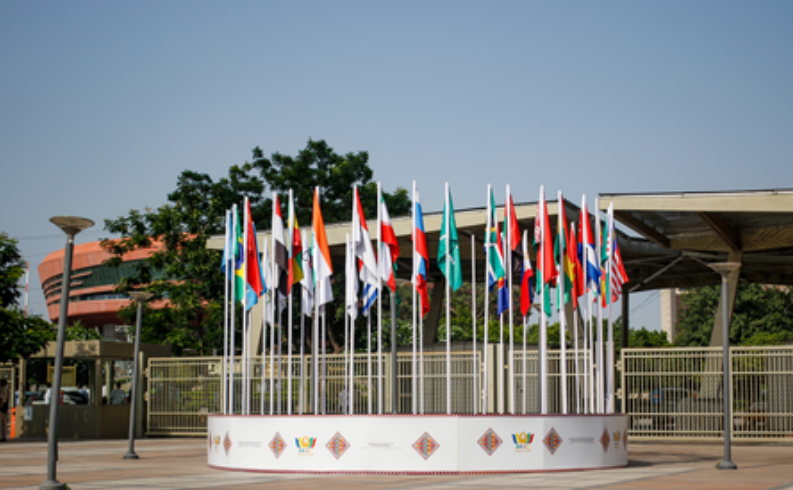

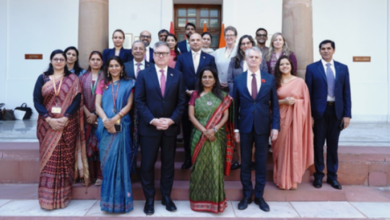
New Delhi — Prime Minister Narendra Modi will welcome leaders from the expanded BRICS grouping as India hosts the 18th BRICS Leaders’ Summit this weekend.
India officially assumed the BRICS chairmanship for 2026 from Brazil at the beginning of the year.
Heads of the 11 BRICS member countries are scheduled to meet Saturday, while leaders from partner countries and outreach invitees will join the summit program Sunday.
Although New Delhi extended an invitation to Bangladesh, the country has yet to confirm its participation or announce whether it will send a government representative. State Minister for Foreign Affairs Humaiun Kobir reportedly said Thursday that Prime Minister Tarique Rahman was not invited and that the invitation was instead extended to the current chair of BIMSTEC.
BIMSTEC is a regional organization of seven South and Southeast Asian countries focused on promoting economic, technical and strategic cooperation around the Bay of Bengal.
BRICS has grown from a grouping of Brazil, Russia, India, China and South Africa into a broader international platform with an expanding role in global economic and political affairs.
The grouping was formalized at the first meeting of BRIC foreign ministers on the sidelines of the United Nations General Assembly in New York in 2006. The inaugural BRIC Summit was held in Yekaterinburg, Russia, in 2009, with Brazil, India and China joining the host country.
The group expanded to BRICS after South Africa was invited to join in 2010. South Africa participated in its first summit as a member in Sanya, China, in April 2011.
Together, the original five members represented more than 40 percent of the world’s population and nearly a quarter of global GDP. China’s position as the world’s second-largest economy, India’s growing global influence and technology sector, Russia’s energy resources, Brazil’s agricultural strength and South Africa’s mineral wealth gave the grouping considerable economic weight.
Trade among BRICS countries has also expanded, with China becoming the largest trading partner for most members.
The grouping has increasingly positioned itself as a forum for developing countries to raise concerns about international economic and political governance. BRICS members have addressed issues including climate change, reform of the United Nations Security Council and opposition to unilateral sanctions.
The bloc has also presented itself as part of a broader shift toward a multipolar international system in which economic and political influence is distributed among a wider range of countries.
BRICS underwent a major expansion in recent years. Egypt, Ethiopia, Iran, Saudi Arabia and the United Arab Emirates became full members in January 2024, followed by Indonesia in January 2025.
Belarus, Bolivia, Kazakhstan, Cuba, Malaysia, Nigeria, Thailand, Uganda, Uzbekistan and Vietnam joined as BRICS partner countries in 2025.
The origins of the BRICS concept date to 2001, when Goldman Sachs economist Jim O’Neill identified Brazil, Russia, India and China as emerging economies expected to play an increasingly important role in global growth.
BRICS later developed into a forum aimed at increasing the influence of developing countries in global institutions and advocating changes to international economic governance.
Those efforts included the creation of the New Development Bank and the Contingent Reserve Arrangement in 2014. The Shanghai-based New Development Bank has financed projects in areas including renewable energy, transportation and urban development.
BRICS members also play major roles in global energy and technology. Russia and Brazil are major energy exporters, while China and India are among the world’s largest consumers. The grouping combines India’s information technology sector, China’s manufacturing capacity and Russia’s scientific research capabilities.
Despite differences among its members and other challenges, BRICS has continued to expand its international reach. Recent summits have included dialogues with additional developing countries as the bloc seeks a broader role as a platform for the Global South. (Source: IANS)