India Marks First Satellite Tagging of Endangered Ganges Softshell Turtle
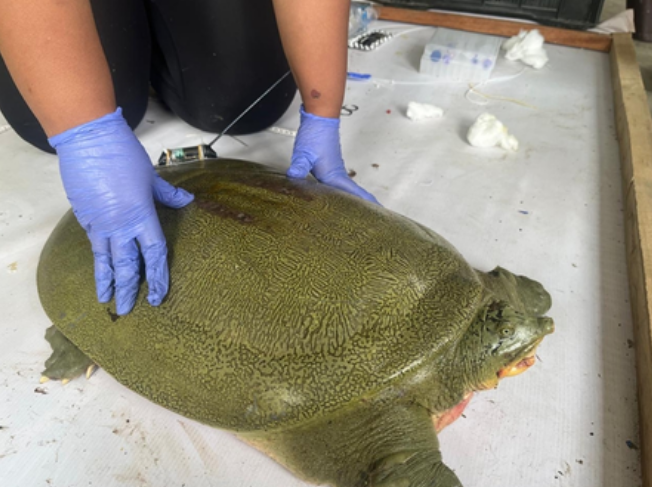

GUWAHATI, India — India has recorded its first satellite tagging of an endangered Ganges Softshell Turtle, a conservation milestone carried out in Assam’s Kaziranga National Park and Tiger Reserve, officials said Friday.
Assam Chief Minister Himanta Biswa Sarma announced the achievement on Endangered Species Day, calling it a historic step for wildlife conservation.
“A first for India at Kaziranga! Marking Endangered Species Day, the country’s first satellite-tagged Ganges Softshell Turtle was released in Kaziranga, a major step for wildlife conservation,” Sarma wrote on social media.
“A proud moment for Assam as we continue to protect every species that calls our forests home,” he added.
Kaziranga Director Sonali Ghosh said Assam is one of the world’s most important regions for freshwater turtle conservation because of its extraordinary turtle diversity. The state is home to 21 turtle species, making it one of Asia’s richest turtle habitats.
Of the eight softshell turtle species reported in India, five are found in Kaziranga.
“The Ganges Softshell Turtle (Nilssonia gangetica), listed under Schedule I of the Wildlife (Protection) Act, can be identified by the distinct arrowhead-shaped markings on the top of its head,” Ghosh said.
She said the species is found across India and lives in large rivers, lakes and reservoirs. Despite its wide distribution, the turtle is classified as endangered on the International Union for Conservation of Nature Red List.
“These long-lived, large-growing turtles are important predators in river ecosystems and also help maintain ecological balance by feeding on dead and decaying animal matter, thereby cleaning river systems,” Ghosh said.
Dr. Abhijit Das, a senior scientist at the Wildlife Institute of India, said the satellite-tagging project will help researchers better understand the turtle’s seasonal movement patterns, home range and critical habitats.
“Understanding seasonal movement patterns, home range and identifying critical habitats such as nesting and breeding sites will help in the active management and conservation of softshell turtles in the Brahmaputra river basin,” Das said.
Ghosh said the tagging was carried out under the implementation framework of the Union Ministry of Environment, Forest and Climate Change.
The project was led by a team headed by Das in collaboration with Kaziranga park authorities and the Assam Forest Department. It received financial support from the National Geographic Society.
As part of the effort, a healthy adult turtle was captured and fitted with a satellite transmitter under veterinary supervision before being released back into its natural habitat along the north bank of the Brahmaputra River. Wildlife researchers and forest officials monitored the process.
Officials said the initiative will help identify and protect critical habitats for endangered species such as the Ganges Softshell Turtle within Kaziranga’s riverine ecosystem.
Kaziranga National Park and Tiger Reserve, recognized as a UNESCO World Heritage Site, is known globally for its biodiversity and its “Big Five” wildlife species: the greater one-horned rhinoceros, Bengal tiger, Asian elephant, wild buffalo and eastern swamp deer.
The protected landscape spans the districts of Golaghat, Nagaon, Sonitpur and Biswanath and includes three forest divisions: Eastern Assam Wildlife Division in Bokakhat, Biswanath Wildlife Division in Biswanath Chariali and Nagaon Wildlife Division in Nagaon. (Source: IANS)