India-U.S. ties face trust deficit as policymakers call for reset
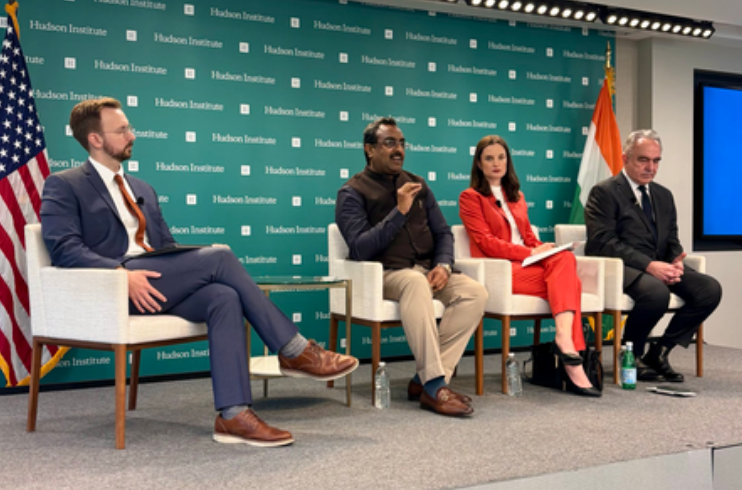

WASHINGTON — A growing lack of mutual trust has emerged as a central challenge in U.S.-India relations, even as both countries continue to engage on strategic and economic fronts, speakers said at a policy conference in Washington.
“There is a big lack of mutual trust today. We need to build that trust once again,” said Ram Madhav, pointing to a shift in perceptions compared with earlier periods of close political alignment.
Panelists said the relationship, while resilient, is navigating a difficult phase marked by misaligned expectations, policy uncertainty, and slower momentum.
Elizabeth Threlkeld of the Stimson Center said both sides often misinterpret each other’s constraints. “Each side has a tendency to see the others’ limits as choices, but their own limits as necessities,” she said, calling for a more candid reassessment of shared interests.
She added that rebuilding trust would require focusing on “genuine mutual interests” and delivering practical outcomes that reduce friction in cooperation.
Kurt Campbell, former U.S. Deputy Secretary of State, said the strain extends beyond policy disagreements. “This has caused a deep hurt… a deep, profound hurt among Indian friends,” he said, adding that emotional and political factors are shaping perceptions on both sides.
Campbell noted that the relationship has advanced significantly over the past two decades, with expectations that it could become the dominant global partnership of the century, making the current phase particularly consequential.
Speakers also pointed to persistent friction in areas such as trade, defense cooperation, and policy coordination, often slowed by bureaucratic processes and differences in political systems.
At the same time, they emphasized that engagement continues and opportunities remain, particularly in economic cooperation.
Madhav said India has shown flexibility on key issues, including tariffs and energy imports, and is moving ahead with a potential trade agreement despite domestic political pressures. “That wouldn’t discourage us… the government will go ahead,” he said.
He also stressed the importance of re-engaging on initiatives such as the India-Middle East-Europe corridor and I2U2, which have faced uncertainty in recent months.
Speakers broadly agreed that the relationship requires sustained political attention and renewed alignment on priorities, even as global challenges add pressure.
The conference brought together policymakers and experts to examine India’s global trajectory and the future of U.S.-India relations.
Over the past two decades, the partnership has expanded across defense, trade, and technology, supported by strong diaspora ties. However, recent geopolitical shifts and policy differences have exposed structural gaps, making trust-building a central task going forward. (Source: IANS)