India-Canada Energy Deal Could Shape Model for Global Clean Transition
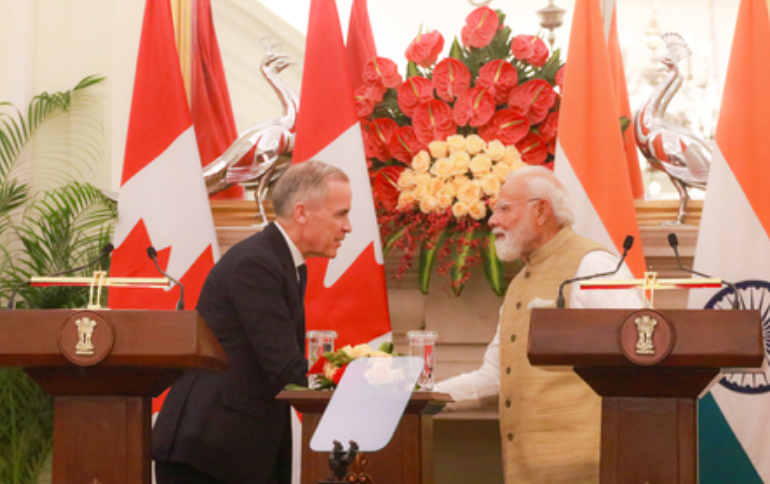

NEW DELHI — India and Canada’s newly announced Strategic Energy Partnership could become a blueprint for global clean energy cooperation, as both countries look to expand collaboration across solar, hydrogen, wind, and lower-carbon fuels, according to a new analysis.
The partnership, unveiled during Prime Minister Mark Carney’s visit to New Delhi, includes cooperation in liquefied natural gas (LNG), LPG, uranium, solar energy, hydrogen, and critical minerals. It is backed by commercial agreements worth more than 5.5 billion Canadian dollars and reflects a broader push to align climate goals with large-scale infrastructure development.
India has set an ambitious target of reaching 500 gigawatts of non-fossil fuel power capacity by 2030. Achieving that goal will require adding between 40 and 50 gigawatts of clean energy annually for the rest of the decade — far above the country’s historical pace.
As part of the agreement, Canada will join the India- and France-led International Solar Alliance and upgrade to full membership in the Global Biofuels Alliance, strengthening its role in multilateral clean energy initiatives favored by India. A separate memorandum of understanding outlines cooperation in solar, wind, bioenergy, small hydro, energy storage, and capacity-building through a joint working group.
Canada is positioning itself as a reliable supplier of lower-carbon LNG, uranium, and critical minerals, while also offering expertise in grid expansion and energy storage to support India’s growing demand.
During the visit, Carney acknowledged India’s plan to nearly double the share of LNG in its energy mix by 2030, even as it rapidly expands renewable capacity. Canada, aiming to produce about 50 million tonnes of LNG annually by the end of the decade, sees India as a key export market.
Supporters of the partnership argue that natural gas can serve as a transition fuel by replacing coal and providing stable backup for intermittent renewable sources. However, analysts warn that long-term LNG contracts signed now could extend into the 2040s, potentially complicating efforts to meet global climate targets and India’s own goal of net-zero emissions by 2070.
“The test of this partnership will be whether gas is clearly capped and time-bound as a transition fuel, with parallel investment in the technologies that will ultimately replace it,” the analysis noted.
Beyond individual deals, the partnership signals a broader effort to build a clean energy ecosystem. Both countries agreed to deepen cooperation on investment in emerging technologies and future-oriented industries. Academic institutions are also beginning to collaborate, including a partnership between Simon Fraser University and the Hydrogen Association of India aimed at advancing innovation in hydrogen production and storage.
Still, experts say India’s challenge is no longer pilot projects but scaling up deployment. Meeting its targets will require consistent auction schedules, faster grid expansion, and access to lower-cost financing for renewable energy and storage projects.
Analysts say Canada’s long-term impact will depend on whether its financial institutions and investors support large-scale renewable and infrastructure projects, rather than focusing primarily on fossil fuel exports.
If the partnership leads to joint manufacturing hubs, battery supply chains, grid-balancing projects, and resilient critical mineral networks, it could mark a turning point in international energy cooperation. If not, analysts warn, it risks becoming another example of fossil fuel investment framed as climate progress. (Source: IANS)