India Says Indus Waters Treaty to Stay Suspended Until Pakistan Ends Support for Terrorism
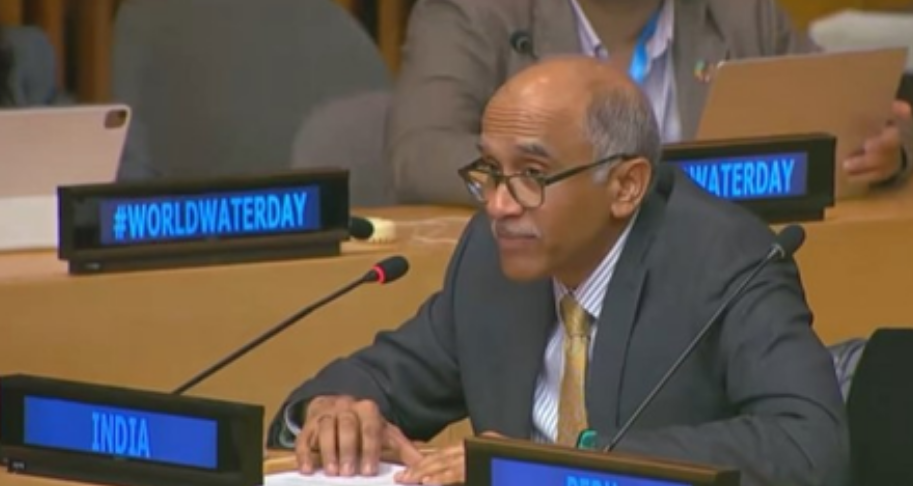

UNITED NATIONS — India has reiterated that the Indus Waters Treaty will remain in abeyance until Pakistan, which it described as the “global epicentre of terror,” takes credible steps to end its support for terrorism.
Speaking at a United Nations event marking World Water Day, India’s Permanent Representative P. Harish said Pakistan must change its approach before raising concerns about the treaty.
“Pakistan must uphold the sanctity of human life before talking of upholding the sanctity of treaties,” Harish said Thursday. “India has always been a responsible upper riparian state, but responsibility is a two-way street. Pakistan must unconditionally abjure terrorism as an instrument of its state policy.”
Harish’s remarks came after Pakistan raised the Indus Waters Treaty during the high-level UN event, which focused on advancing the Sustainable Development Goal of ensuring access to safe water and sanitation for all.
India signed the treaty with Pakistan in 1960 “in good faith, in a spirit of goodwill and friendship,” Harish said, but accused Islamabad of undermining that spirit through repeated conflicts and attacks.
“Pakistan violated this spirit by inflicting three wars and thousands of terror attacks on India,” he said. “Tens of thousands of innocent Indians became victims of Pakistan-sponsored terror attacks.”
India placed the treaty in abeyance following the Pahalgam religion-based terrorist attack last year, which it said was carried out by The Resistance Front, a group linked to the Pakistan-backed Lashkar-e-Taiba.
“Our patience and magnanimity did not change Pakistan’s ways,” Harish said. “Eventually, we were compelled to announce that the Treaty will be held in abeyance until Pakistan, the global epicentre of terror, credibly and irrevocably ends its support for all forms of terrorism.”
Harish also said that changes over the past 65 years — including technological, demographic, and ecological developments — necessitate revisions to the treaty, but India’s efforts to engage Pakistan on modifications have been unsuccessful.
“All our efforts to discuss modifications to the Treaty with Pakistan were rebuffed,” he said.
Addressing the broader theme of the UN event, Harish said India remains committed to expanding access to safe water and sanitation.
“Through the Jal Jeevan Mission, India is implementing one of the world’s largest programmes to provide piped drinking water to rural households,” he said.
Launched in 2019, the initiative has brought safe tap water to 81.76 percent of rural households, or approximately 158 million homes.
“Community participation is a cornerstone of this effort, with village water committees, many of them led by women, playing a key role in planning, monitoring and maintaining local water systems,” Harish said.
He added that international cooperation remains essential to addressing global water challenges.
“Here at the United Nations, our collective efforts can be most impactful when they focus on areas that unite us, like strengthening national capacities, particularly in developing countries, promoting technological innovation and advancing scientific cooperation,” he said. (Source: IANS)