India’s Rise and China’s Slowdown Reshaping Asia’s Balance of Power, Report Says

KUALA LUMPUR/NEW DELHI — India’s growing economic and strategic influence, alongside China’s prolonged structural slowdown, is reshaping the balance of power in Asia, according to a report released Wednesday that highlights New Delhi’s expanding role in the Indo-Pacific.
The report said Prime Minister Narendra Modi’s Act East Policy, launched in 2014, has provided a strategic framework that has repositioned India as a key Indo-Pacific power with a long-term stake in Southeast Asia’s security and prosperity.
Through deeper economic integration, improved connectivity, and greater engagement in regional security and resilience, Southeast Asia has benefited from a stronger counterbalance and expanded cooperation with India in both economic and security domains, the report said.
According to the analysis, the policy’s emphasis on ASEAN and the wider maritime corridor stretching from the Andaman Sea to the Strait of Malacca underscores the importance of India’s strategic presence at a time when the region is facing renewed risks and tensions.
The report argued that India’s influence has historically been underestimated, but said its emergence as a global economic force and a decisive balancing power in the Indo-Pacific has become increasingly significant as China enters a period of economic deceleration and heightened strategic friction.
For Malaysia and Southeast Asia, the report said, India’s rise has tangible implications, positioning New Delhi as a central pillar in the region’s future economic and geopolitical landscape. It described India as a growing source of stability in areas including economic resilience, security cooperation, food and energy security, technology access, and strategic flexibility.
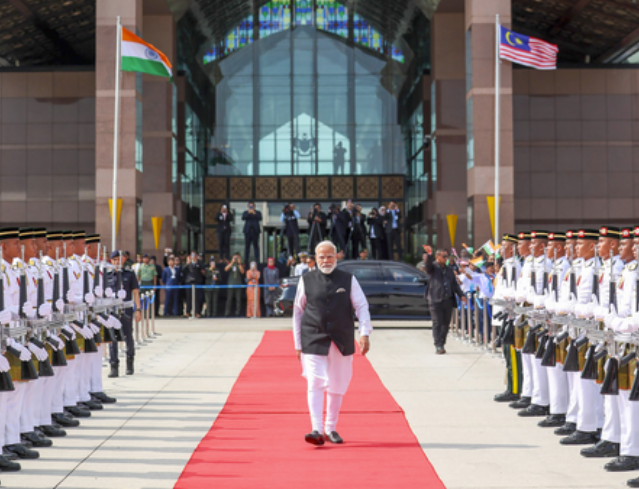
The report also highlighted Modi’s visit to Malaysia on February 7 and 8 as strategically important for both countries, particularly for Kuala Lumpur. It said the visit provided Malaysia with an opportunity to move beyond a traditional hedging strategy and recognize India as a top-tier strategic partner for the decades ahead.
India’s current and future role, the report said, has never been more integral, with its ascent unfolding in parallel with China’s structural slowdown and contributing to a rebalancing of power across Asia.
For Malaysia, the report stressed, the strategic choice is not between India and other partners, but between preparing early for India’s rise or adjusting later. It noted that both countries face similar long-term challenges and share significant potential for collaboration.
The report described Modi’s visit as a strategic inflection point that could usher in a new phase of ties, with expanded cooperation across defense, technology, semiconductors, energy, food security, education, and cultural exchange. Strengthening relations with India, it said, would be central to the region’s long-term prosperity, security, and autonomy. (Source: IANS)