“Shikanji Over Cola”: Mohan Bhagwat Calls for Swadeshi Economy Built on Self-Reliance and Indian Values
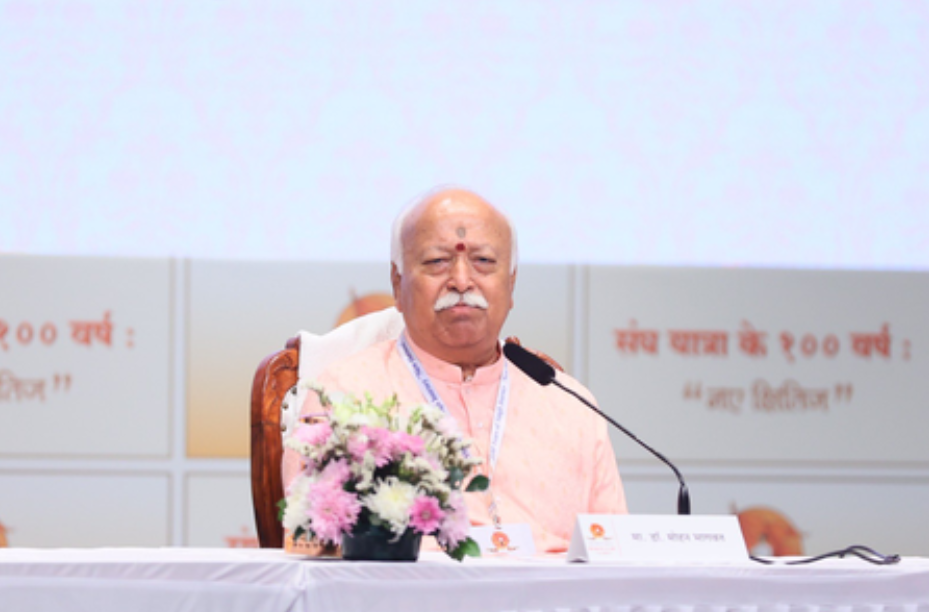

Mumbai —Rashtriya Swayamsevak Sangh (RSS) chief Mohan Bhagwat on Saturday made a strong case for a “Swadeshi” economic model, urging India to pursue self-reliance without retreating into isolationism and warning against global trade driven by pressure, tariffs, and economic coercion.
Speaking at the two-day New Horizons lecture series marking the RSS Centenary Year, Bhagwat said global interdependence is inevitable but must be voluntary and rooted in national choice rather than compulsion. The event was attended by more than 900 prominent figures, including actors Salman Khan and Ranbir Kapoor, along with leading scientists, industrialists, and artists.
“The world is interdependent, but that should not become helplessness,” Bhagwat said, in remarks widely seen as a response to escalating global trade tensions and tariff-driven policies, particularly by the United States. He stressed that Swadeshi does not mean shutting doors to the world, but adopting a clear hierarchy: prioritize local production, selectively import necessities, and protect domestic livelihoods.
“If goods can be made in your own village or country, do not buy them from abroad,” Bhagwat said. “Import only what is essential and cannot be produced here. Buying foreign goods that are already available locally hurts local vendors and weakens the domestic economy.”
The RSS chief outlined a development model anchored in three pillars — self-reliance, environmental sustainability, and Dharma-based economics — and called on Indian families to practice Swadeshi not just in markets, but in everyday life.
He urged households to embrace Swadeshi habits across five areas: Bhasha (language), Bhusha (attire), Bhraman (tourism), Bhojan (food), and Bhavan (home and living). He encouraged families to use their mother tongue or native Indian languages at home, reduce dependence on foreign languages in daily communication, and prioritize Indian clothing to support local weavers and the domestic textile industry.
“Visit Indian destinations and heritage sites before travelling abroad,” Bhagwat said, adding that domestic tourism helps keep wealth within the country. He also called for homes to be designed and maintained according to Indian traditions and environmental ethics.
Using a relatable metaphor, Bhagwat contrasted homemade lemonade with foreign soft drinks. “If shikanji can be made at home, there is no need to buy cola,” he said, drawing applause from the audience.
He further advocated buying products made within one’s own village, city, or state whenever possible, saying that choosing foreign brands over local alternatives undermines small vendors. As part of what he described as “environmental Swadeshi,” Bhagwat called for reduced plastic use and a return to traditional, sustainable household practices.
Bhagwat also emphasized the importance of regular family dialogue, warning that the absence of such engagement leaves children vulnerable to unfamiliar or foreign ideologies that may not align with Indian values. He contrasted Indian family structures with Western models, stating that in Bharat, a woman’s role as Matri Shakti — the nurturer — forms the foundation of society and should be honored within the home.
Summing up his message, Bhagwat said India’s prosperity must rest on its own strengths. “Innovate for Bharat, produce in Bharat, and let the world come to you,” he said. “Our growth should be built on Swa-shakti so that even if the world shuts its doors, Bharat continues to thrive.”
(Source: IANS)