Ro Khanna Wins Sixth Term in Congress, Strengthening Role as Leading Voice on U.S.-India Relations
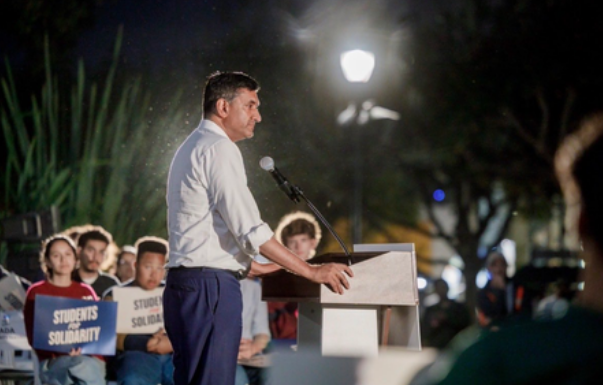

WASHINGTON–Democratic Rep. Ro Khanna has won a sixth term in the U.S. House of Representatives, defeating Republican Ritesh Tandon in California’s 17th Congressional District and securing another term as one of the most prominent Indian American lawmakers in Washington.
Khanna, who represents Silicon Valley and serves as Co-Chair of the Congressional Caucus on India and Indian Americans, received approximately 71% of the vote compared with Tandon’s 29%. About 44% of the expected ballots had been counted when the race was called.
His reelection comes as Democrats regain control of the House and amid continuing tensions between Washington and New Delhi over trade restrictions, immigration policies and regional security issues.
Khanna has emerged as one of President Donald Trump’s most vocal congressional critics over the administration’s tariffs on Indian goods, which reached 50% in 2025 following an additional 25% duty imposed in response to India’s purchases of Russian oil.
In September 2025, Khanna accused Trump of undermining decades of bipartisan efforts to strengthen the strategic relationship between the United States and India.
“Trump is destroying 30 years of bipartisan work to build the US-India strategic partnership because Modi refuses to nominate him for a Nobel Peace Prize. He imposed higher tariffs of 50% on India than China,” Khanna said.
He also publicly challenged Indian American voters who supported Trump in the presidential election.
“I am waiting for all those Indian Americans who voted for Trump over Harris — you know who you are — to speak out against Trump sabotaging the partnership with blanket tariffs that are harsher than those on China. Anyone willing to speak up?” he wrote.
“We can’t allow the ego of Donald Trump to destroy a strategic relationship with India that is key to ensuring that America leads and not China,” he added.
Khanna joined Democratic Rep. Deborah Ross in leading a letter signed by 19 lawmakers in October 2025 urging the administration to “reset and repair” relations with India and eliminate the tariffs.
His advocacy for closer U.S.-India relations predates the current trade dispute.
In 2022, Khanna successfully introduced an amendment to the annual defense authorization legislation supporting a waiver for India from sanctions under the Countering America’s Adversaries Through Sanctions Act, commonly known as CAATSA.
The measure argued that granting India a waiver “is in the best interests of the United States and the United States-India defence partnership to deter aggressors in light of Russia and China’s close partnership.”
At the time, Khanna’s office characterized the amendment as “the most significant piece of legislation for US and India relations out of Congress since the US and India nuclear deal.”
Khanna has also addressed security developments in South Asia, including tensions between India and Pakistan following the April 2025 terrorist attack in Pahalgam and India’s subsequent Operation Sindoor.
Speaking to CNN in May 2025, he said, “India took a response that helped take out some of the terrorist networks. The important thing now is for de-escalation.”
He also criticized Pakistan’s military leadership, describing Army Chief Asim Munir as “a dictator” and calling for the release of former Prime Minister Imran Khan.
Khanna’s connection to India extends beyond his political career.
Born in Philadelphia in 1976 to parents who emigrated from Punjab, he is the grandson of Amarnath Vidyalankar, an Indian independence activist who was imprisoned during the struggle against British colonial rule and later served in India’s first Parliament.
Khanna has frequently cited his grandfather’s political activism as an important influence on his own beliefs.
“Because of my grandfather, I was influenced by Gandhi’s thinking, by Nehru’s beautiful speeches about liberal democracy, about pluralism,” Khanna told NBC News in 2023. “Those are the values I champion. … I’ve spoken out where I think those values are being challenged.”
In 2023, Khanna became Co-Chair of the Congressional Caucus on India and Indian Americans alongside Republican Mike Waltz, becoming the second Indian American to hold the position after Rep. Ami Bera.
At the time, Khanna emphasized the growing political influence of the Indian American community.
“I think this is a historic moment for our community. I think we’re really emerging and coming into our own as a strong voice,” he said.
He pledged to make the caucus “about not just us India, but also the Indian American community,” identifying immigration backlogs and the challenges facing children of H-1B visa holders as major priorities.
“These kids of H1B are like the Dreamers,” Khanna said, referring to children who risk losing their immigration status when they reach adulthood.
On the H-1B visa program, Khanna has acknowledged concerns about misuse while opposing the Trump administration’s $100,000 application fee.
“There’s definitely abuse… it definitely needs to be corrected,” he said, adding, “I don’t love the blanket 100,000 fee.”
In Congress, Khanna serves on the House Armed Services Committee, where he is the Ranking Member of the Subcommittee on Cyber, Innovative Technologies and Information Systems.
He also serves on the House Select Committee on the Chinese Communist Party and the House Oversight Committee.
His voting record places him among the more progressive members of the Democratic Party, particularly on military spending and foreign policy.
Khanna opposed the House and final versions of the fiscal 2026 defense authorization legislation, as well as the fiscal 2027 defense bill. He also voted against a Republican reconciliation package in May 2025 and a federal spending measure in January 2026.
He supported legislation seeking to end the national emergency used to justify tariffs on Canada.
However, Khanna has occasionally departed from his party’s position on immigration legislation.
In January 2025, he supported the Republican-backed Preventing Violence Against Women by Illegal Aliens Act, while fellow Indian American Democratic Representatives Pramila Jayapal and Ami Bera voted against it.
An analysis of House Clerk records covering January 2025 through mid-September 2026 found that Khanna voted with the Democratic majority approximately 97% of the time and missed about 11 votes.
According to Voteview’s DW-NOMINATE ideological rankings, Khanna ranks as the 58th most liberal member among House Democrats.
Khanna has also worked across party lines on government transparency legislation. He co-authored the Epstein Files Transparency Act with Republican Rep. Thomas Massie, which passed the House on November 18, 2025.
His broader legislative priorities include rebuilding American manufacturing, strengthening U.S. technology leadership, expanding economic opportunities for working families and addressing climate change.
Before entering Congress, Khanna served as Deputy Assistant Secretary of Commerce during the Obama administration.
He first challenged incumbent Democratic Rep. Mike Honda in 2014 but lost. Khanna defeated Honda in their 2016 rematch and has represented the Silicon Valley district since 2017.
Khanna entered the 2026 election with substantial financial resources. His campaign raised approximately $15 million during the election cycle and reported about $17 million in cash on hand as of October 14, according to Federal Election Commission filings.
With his sixth consecutive congressional victory, Khanna is positioned to continue influencing Democratic policy on technology, national security, immigration and U.S.-India relations while representing one of the country’s most important technology hubs. (Source: IANS)