
Pearls of Wisdom: When Someone Makes You Look Up, a Lifetime of Memories Comes Alive
One evening walk in Weston led me back to my grandfather, the village nights of my youth and the wonder my own children would one day share.
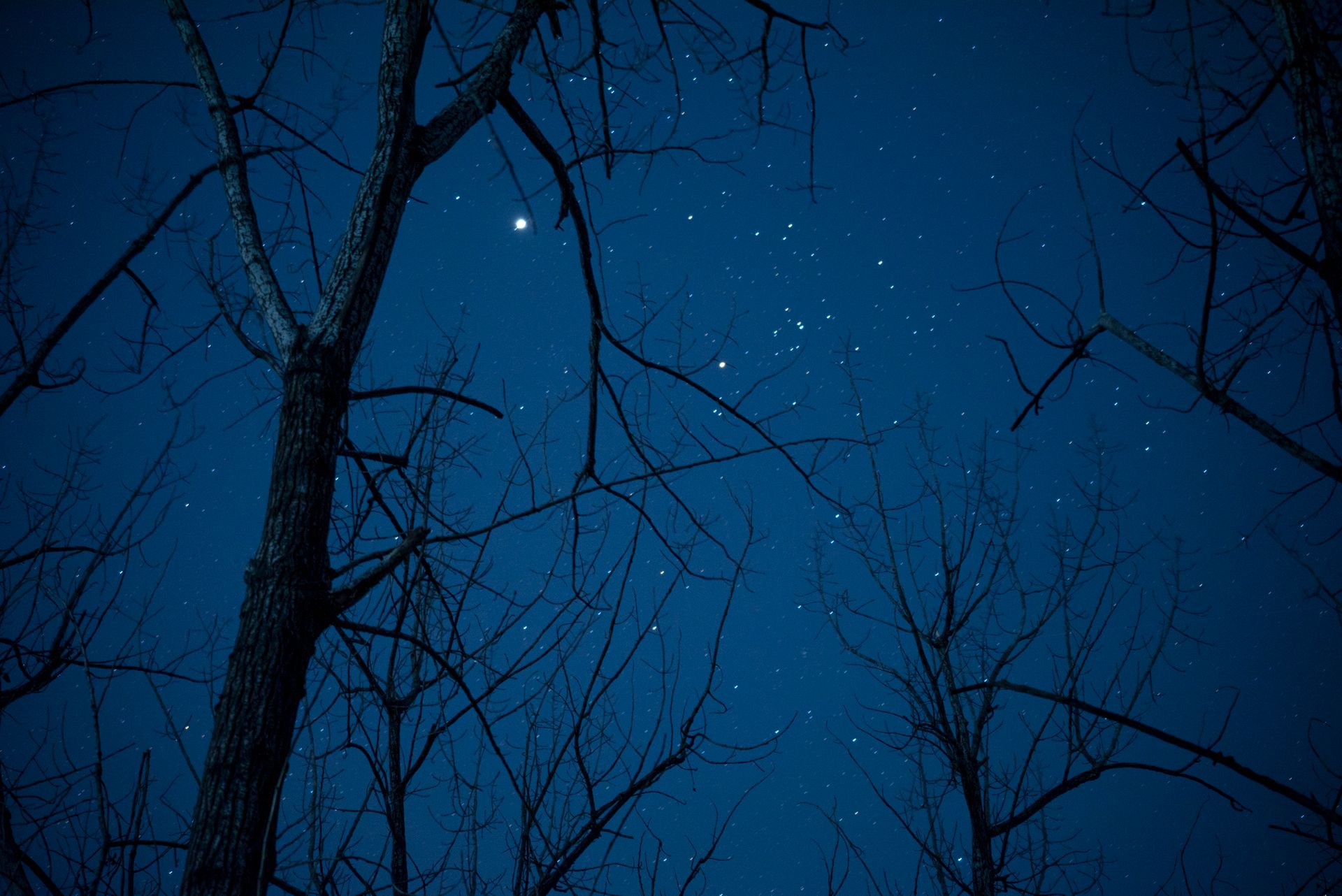

BOSTON — Just outside Boston is the wooded town of Weston, where I have lived for nearly 30 years. It is a beautiful place, lush with greenery, tall trees and winding roads. But in winter, when the sun disappears early, the darkness can be striking. There are very few streetlights, except along the main roads. Beneath the thick canopy of trees, the night can feel almost completely dark.
One evening, I was visiting my sister-in-law and her mother in Weston. As I was getting ready to leave, my sister-in-law picked up the leash of her large Labrador Archie and decided to take him for a walk. It was already very dark, so she grabbed a powerful flashlight. I decided to join her.

We began walking along the quiet road, the flashlight cutting a narrow path through the darkness. Then, quite unexpectedly, she switched it off.
“Jijaji, come here,” she said.
We had reached a small clearing where the trees opened up to the sky.
“Look up,” she said.
I did. And what I saw took my breath away.
The sky was filled with stars. Not just a handful of scattered dots, but hundreds, perhaps thousands, twinkling against the vast darkness. It was the kind of sky I remembered from India. For a moment, I stood there in complete awe. I had not expected to see such a magnificent display so close to home.
But what made the moment even more special was my sister-in-law’s own excitement. She, too, seemed captivated by the spectacle. There was a childlike delight in the way she pointed out the stars and shared the view with me. Her enthusiasm was contagious. It was as if she had discovered something extraordinary and couldn’t wait for me to experience it, too. We stood there for a while, both looking up, marveling at a sight that had been above us all along, hidden in plain view by the trees and the distractions of everyday life.
On my drive back, my mind kept returning to those stars. And then, almost like a sudden cloudburst, a flood of childhood memories came pouring in.
I had lived in Weston for nearly three decades and had hardly ever noticed the stars. Perhaps I had never really looked up. Every now and then, I would admire a particularly large and beautiful moon. But the stars? They had somehow disappeared from my everyday world.
That night, they brought back a world I thought I had left far behind.
I grew up in a remote village in India, and some of my earliest and fondest memories are of sleeping beside my grandfather. We slept on a traditional wooden cot, its frame woven with strong ropes and covered with a simple sheet. I don’t remember the very earliest years of my childhood, but from the time I began forming lasting memories, that wooden cot and my grandfather were always part of them.
During the rainy season and winter, the cot would be moved to the veranda. On summer nights, however, it would be carried outside and placed in the open courtyard, beneath the enormous sky.
There were no city lights, no buildings blocking the horizon and no artificial glow to compete with the stars. The night sky seemed endless, glittering with countless stars. The air was still, except for the occasional sounds of the village, and the gentle evening breeze made those nights especially comforting.
As we lay side by side, my grandfather would point toward the sky and tell me stories about the stars. My favorite was Saptarishi.
Saptarishi, which means the Seven Sages, is a familiar Indian name for a group of seven prominent stars that form part of the constellation Ursa Major. In Western astronomy, this recognizable pattern is commonly known as the Big Dipper. Four stars form a roughly rectangular bowl, while three more extend from it in a curved line, creating a handle. Together, they make a pattern that is easy to recognize once someone has shown it to you.
My grandfather would tell me about the seven great sages associated with these stars. I would listen, fascinated, believing every word. To a little child lying beneath that enormous sky, the stories seemed as real as the stars themselves.
He would also point out Dhruv Tara, the Pole Star, which appears almost fixed in the northern sky while other stars seem to move around it. In Indian tradition, Dhruv is associated with a young boy whose devotion and determination earned him an eternal place among the stars. I loved that story, too.
At that tender age, I never questioned any of it. My grandfather’s stories, the stars above us and the quiet darkness surrounding our home all blended into one magical experience.
Even today, I can close my eyes and almost return to those nights. I can picture myself lying on that old wooden cot outside our mud house, with my grandfather beside me, telling me stories until my eyes grew heavy and I drifted off to sleep.
As I grew older and moved to cities, the stars slowly disappeared from my life. The bright lights of urban living took away the darkness that makes the night sky come alive. Once in a while, I would catch a glimpse of a few stars, but rarely enough to stop and admire them.
The next time the stars truly captured my attention was years later, when my young son and daughter visited India for the first time.
It was summer, and the heat was intense. There was no fan to make the nights comfortable, so the entire family carried beds to the rooftop of our house. We spread them out under the open sky, hoping to catch whatever cool breeze might come our way.
For my children, it was an entirely new experience. They were used to sleeping indoors, surrounded by the comforts of modern life. Now they were lying on a rooftop, with nothing between them and the vast night sky.
They looked up and were astonished by the sheer number of stars.
“Can we touch them?” my three-year-old son asked.
“They are so close!” he added, his little voice filled with wonder.
I smiled. I knew exactly how he felt. I had once been that little boy, lying under the same kind of sky, listening to my grandfather explain the mysteries of the stars. And now, decades later, I was watching my own children experience that same wonder.
Three generations, separated by time and distance, connected by the same sky.
That evening in Weston brought all these memories rushing back. It made me realize how much of life is made up of memories. Some are tucked away so deeply that we hardly know they are there. Then, in one unexpected moment, one familiar sight, one smell, a song, a photograph or even someone saying, “Look up,” can bring them all back.
Perhaps that is one of the greatest gifts of life: the gift of memories.
We often think of happiness as something that lies ahead of us—in the next achievement, the next destination, the next milestone. But so much happiness is already behind us, waiting quietly in the corners of our minds. A childhood afternoon, a grandparent’s voice, a family gathering, a conversation with a loved one, a child’s innocent question. These moments may seem ordinary when they happen, but over time, they become priceless.
And the beautiful thing about memories is that we don’t always have to rediscover them alone. Sometimes, someone else helps us find them again.
My sister-in-law may have simply wanted to take her dog for a walk that evening. But by switching off that flashlight, asking me to look up and sharing her own excitement at the sight of the stars, she gave me something far more precious than a beautiful view. She opened a window to my childhood and brought my grandfather, those village nights and the memories of my own children rushing back. I will always be grateful for that simple, beautiful moment.
We cannot hold on to time. Children grow up, grandparents leave us, familiar homes change, and the places we once called home may become distant memories. But the moments we share with people we love remain with us in ways we often don’t appreciate until much later.
That is why I believe we should make more memories. Spend time with family and friends. Take children outside and let them discover the world. Listen to our elders and their stories. Laugh together, travel together, share simple meals, take walks, and look up at the stars once in a while.
We may not realize it at the time, but these are the moments that will one day bring a smile to our faces and warmth to our hearts.
Life moves forward, but memories give us the beautiful gift of reliving it. Let us create as many wonderful memories as we can, with the people we love. They are among the greatest treasures we will ever have.
(Upendra Mishra is the founder of Precise Marketing & Media and a leading advocate for rethinking how marketing drives business growth. Through his “Marketing Upside Down” perspective, he challenges the traditional focus on marketing activity and instead emphasizes revenue as the only metric that matters.With more than 30 years of experience, Upendra has developed the Precise Marketing System, a proven framework that helps companies uncover revenue leaks, focus on high-value opportunities, and build scalable growth engines. His approach has delivered measurable results, including helping a company grow from $14 million to $55 million in just three years. He is the author of Precise Marketing: The Proven System for Growing Revenue in a Noisy World, where he outlines his philosophy for succeeding in today’s crowded and uncertain marketplace. He is also the author of After the Fall: How Owen Lost Everything and Found What Truly Matters. For more, vivit: www.UpendraMishra.com)